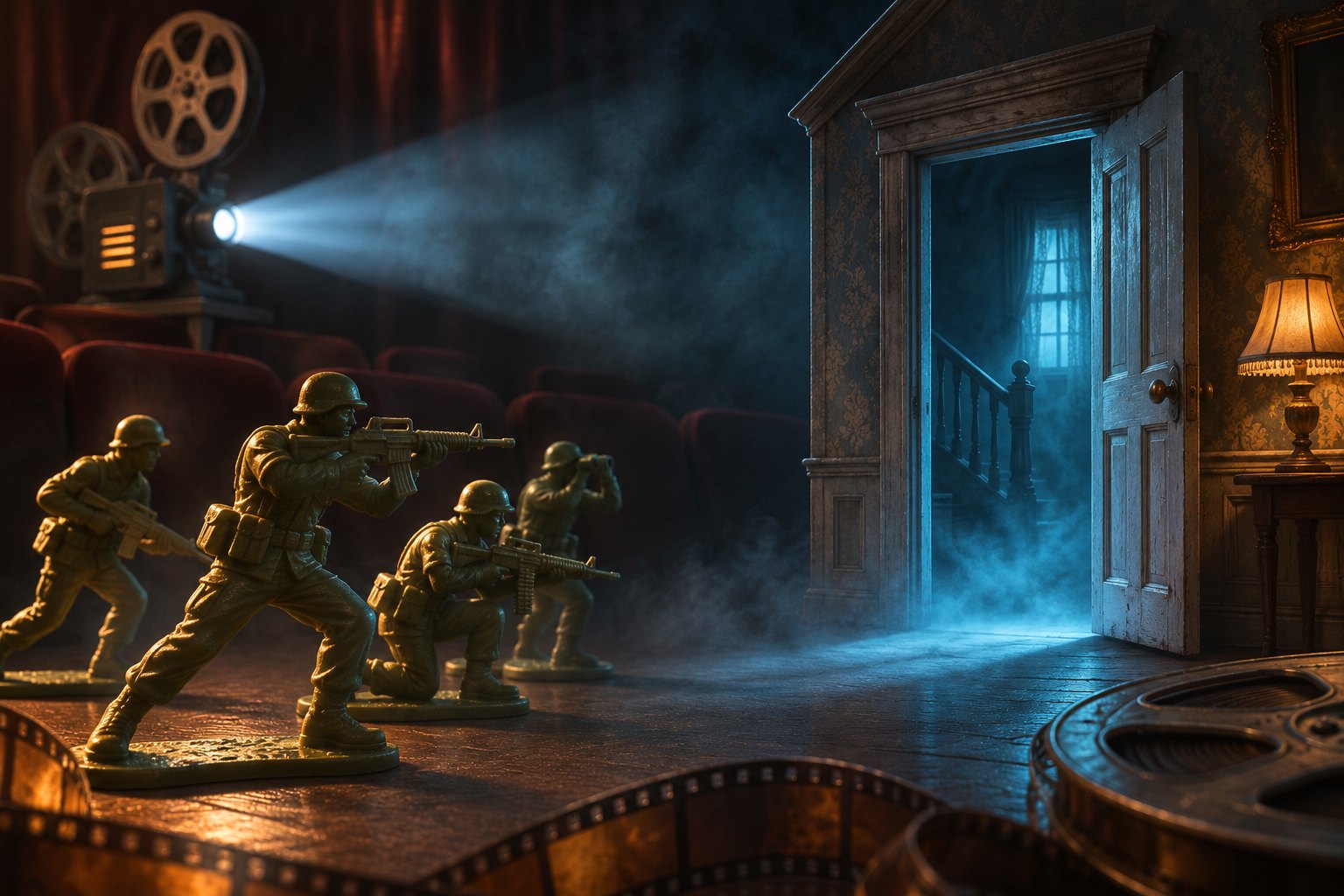
Bradley Cooper and Danny McBride’s G.I. Joe is headed for a 2028 release, according to Variety. That gives audiences a year to anticipate. It also raises a creative question worth considering before the promotional campaign takes over: will this feel like a team whose members need one another?
For an ensemble action movie, assembling recognizable faces is only the beginning. The more interesting achievement is making each person’s judgment matter. My strongest hope for this project is that its characters will change the direction of the story through disagreement, specialized knowledge, and earned trust.
This is a spoiler-free critical preview, not a review of the finished film. The release announcement does not provide a basis for evaluating performances, quoting dialogue, describing scenes, or identifying Easter eggs. The discussion below sets out an editorial argument about the project’s possibilities, without presenting those possibilities as its actual plot.
What the 2028 announcement tells viewers
The central news is straightforward: a G.I. Joe movie associated with Cooper and McBride has a 2028 release planned. A calendar announcement establishes a destination for the project. It cannot establish whether the eventual movie has an engaging story, a satisfying balance of personalities, or action that rewards attention.
That distinction matters because recognizable names invite audiences to imagine a finished film almost immediately. One viewer pictures broad comedy; another expects solemn military spectacle. Neither imagined version becomes evidence simply because the pairing sounds interesting.
Our earlier coverage of the G.I. Joe release announcement and its franchise context considered the broader challenge of bringing familiar properties back. Here, the narrower question is how an ensemble earns its place within a single story. The answer starts with who gets to make consequential decisions.
A team becomes interesting when authority moves
In my view, the most satisfying action ensembles let authority shift according to the problem. The person qualified to lead one moment may need to listen in the next. That movement creates relationships through behavior: confidence becomes something colleagues test, and respect becomes something viewers can watch develop.
A useful distinction is between giving a character a specialty and giving that character agency. A specialty supplies a recognizable function. Agency means a decision changes what happens. Someone can perform an impressive technical task yet remain dramatically incidental if every meaningful choice belongs to someone else.
For this G.I. Joe, the appealing possibility is an ensemble in which competence carries a point of view. Different people might assess danger differently, disagree about priorities, or recognize limits that others miss. These are hypothetical storytelling opportunities, not descriptions of announced scenes.
The test is simple: if a supporting character disappeared, would the remaining characters have to make different choices? If the answer is no, an entertaining personality may still be present, but the team’s dramatic structure needs work.
Let disagreement change the plan
Friction can give an action movie energy without requiring anyone to behave foolishly. Two capable people can understand the same situation and value different outcomes. Their conflict becomes interesting when both positions have a reasonable basis and choosing between them costs something.
The weaker version is decorative bickering. Characters exchange insults, the scene briefly pauses, and the original plan proceeds untouched. We have heard that these people differ without seeing their differences affect anything.
A stronger approach would allow an objection to alter a decision. Someone revises an assumption. Someone accepts a risk they initially rejected. Someone wins an argument and then has to live with the responsibility. Those consequences give even a brisk action sequence an emotional history.

This is where listening can become cinematic. A reaction shot, a hesitation before agreement, or a changed position within a group can communicate a transfer of trust. An ensemble need not explain every relationship aloud if its staging makes those relationships visible.
Humor should reveal who has power
Comedy offers another way to establish a team’s internal relationships. The revealing question is often who feels entitled to make a joke, and who feels obliged to laugh. A teasing exchange can express affection, insecurity, rivalry, or an attempt to reclaim control.
My preference would be for humor that belongs to specific personalities. If every character could deliver the same punch line, the dialogue may be lively while the ensemble remains indistinct. Different rhythms matter: one person deflects, another provokes, another refuses to participate.
Timing also changes meaning. A joke before a difficult decision can expose apprehension. The same joke immediately after a painful consequence can make the film seem unwilling to acknowledge what happened. Tonal flexibility depends on recognizing when a moment needs room to land.
None of this requires predicting whether Cooper and McBride’s project will lean toward comedy. It provides a useful standard for judging whatever balance the finished film chooses: does humor sharpen our understanding of the people involved?
Action can make relationships visible
An ensemble’s teamwork should remain understandable when dialogue stops. Geography helps. Viewers need enough information about positions, obstacles, and immediate goals to appreciate why one person depends on another. Confusion can convey a character’s experience, but sustained confusion makes cooperation difficult to recognize.
There is also a difference between alternating individual showcases and building a shared action sequence. In a showcase, each character gets a turn. In a shared sequence, one person’s choice creates the next person’s opportunity or problem. The second structure can make the entire group feel necessary.
This need not mean slowing everything down. A clear glance, a delayed movement, or a visible response to a mistake can connect separate actions. The pleasure comes from understanding the relationship between them.
Our discussion of how character choices give large-scale spectacle emotional weight approaches a related issue from another direction. Scale becomes more involving when viewers understand whose decision shaped what they are watching.
The deeper opportunity: belonging without sameness
The most promising idea for this G.I. Joe, to my mind, is belonging that preserves individual judgment. A team becomes dramatically thin when membership requires everyone to agree, speak alike, and admire the same person. Cooperation is more rewarding when differences remain visible.
That would give the film a meaningful way to connect excitement with character. A successful outcome could reflect people learning whose expertise to trust, when to challenge an instruction, and how to accept responsibility together. The emotional payoff would emerge from changed relationships as much as completed objectives.
For now, 2028 is the release horizon. The eventual film must supply the evidence for any verdict. What would make this particular return worthwhile is a group whose members alter one another’s decisions—and whose collective identity means more by the ending than it did at the start.
Original content by this site's editorial team. Published: November 7, 2026 at 04:48:30 PST (Los Angeles time)