Sylvain Chomet is pushing back against AI accusations involving his Dior film featuring Robert Pattinson’s voice. Variety reports that the director behind The Triplets of Belleville defended the work with a direct statement: “Everything was drawn by hand.” That answers the immediate question of how Chomet has responded. It also opens a more complicated discussion about what viewers can establish from finished animation—and what requires evidence about its production.
The distinction matters. An accusation is not a demonstrated production history, and a filmmaker’s response should be accurately attributed rather than expanded into claims it does not specifically establish. My view is that this controversy deserves scrutiny grounded in craft and evidence, with room left for the film to be judged as a film.
This is spoiler-free critical commentary on the reported dispute, not a firsthand screening review. It makes no claims about unverified scenes, dialogue, or character identities.
What Chomet’s response establishes
The central reported facts are narrow: Chomet made a Dior film featuring Pattinson’s voice, the work attracted AI accusations, and Chomet rejected those accusations by asserting that everything was drawn by hand. The statement is significant because it puts the director’s account of the drawing process on the record. It should neither be dismissed automatically nor stretched into an independent audit of every production stage.
One tempting shortcut would be to read “drawn by hand” as a complete description of how a finished animated film came into existence. It is not necessarily that. Drawing, movement, editing, sound, and final presentation raise different questions. A claim about the origin of the drawings does not, by itself, specify every tool involved in assembling the finished work.
That observation is a reason to ask precise questions, not a reason to insinuate undisclosed wrongdoing. Responsible coverage should identify which part of a process is disputed and what evidence addresses it. Otherwise, a broad argument about “AI” can become a conversation in which different people are objecting to entirely different things.
Why appearance alone cannot settle authorship
A viewer can reasonably describe an image as awkward, overly smooth, inconsistent, or emotionally flat. Those are observations about an experience of watching. Moving from that description to a claim about how the image was produced requires another step—and supporting evidence.
In animation criticism, that distinction is especially useful. An unusual proportion might be expressive exaggeration. A movement might look strange because of its timing. A visually polished passage might still feel lifeless. None of those responses, standing alone, supplies a reliable account of who drew what or which production tools were used.
For Chomet’s Dior project, the fair approach is therefore to keep aesthetic objections specific. If a viewer dislikes a gesture, the useful criticism explains what the gesture fails to communicate. If the concern is authorship, the useful investigation seeks information about authorship. Treating the first as conclusive proof of the second weakens both arguments.
This also protects the freedom to dislike something handmade. Human effort deserves accurate recognition, but it does not make a film immune to criticism. Equally, a viewer’s disappointment does not justify erasing the possibility of human effort.
Robert Pattinson’s voice brings character performance into focus
Pattinson’s reported involvement adds a performance dimension that can easily disappear beneath the production controversy. Without verified scene details, there is no responsible basis here for evaluating his delivery, identifying his character’s motivations, or quoting his dialogue. There is, however, a useful question to bring to the film: how does the relationship between voice and image create a personality?
In an animated performance, a voice can suggest hesitation while a pose suggests confidence. A pause can give a glance weight. A change in rhythm can make a small movement seem like a decision. These are general critical possibilities, not descriptions of scenes in Chomet’s film. They explain why a character-centered assessment needs moving images and sound together.
Our discussion of Pattinson and the demands of creating a convincing character approaches a related issue: a recognizable performer’s name creates interest, but characterization depends on what the performance communicates. In animation, that communication is shared with the artists shaping posture, expression, and timing.
Handmade craft and artistic success are separate judgments
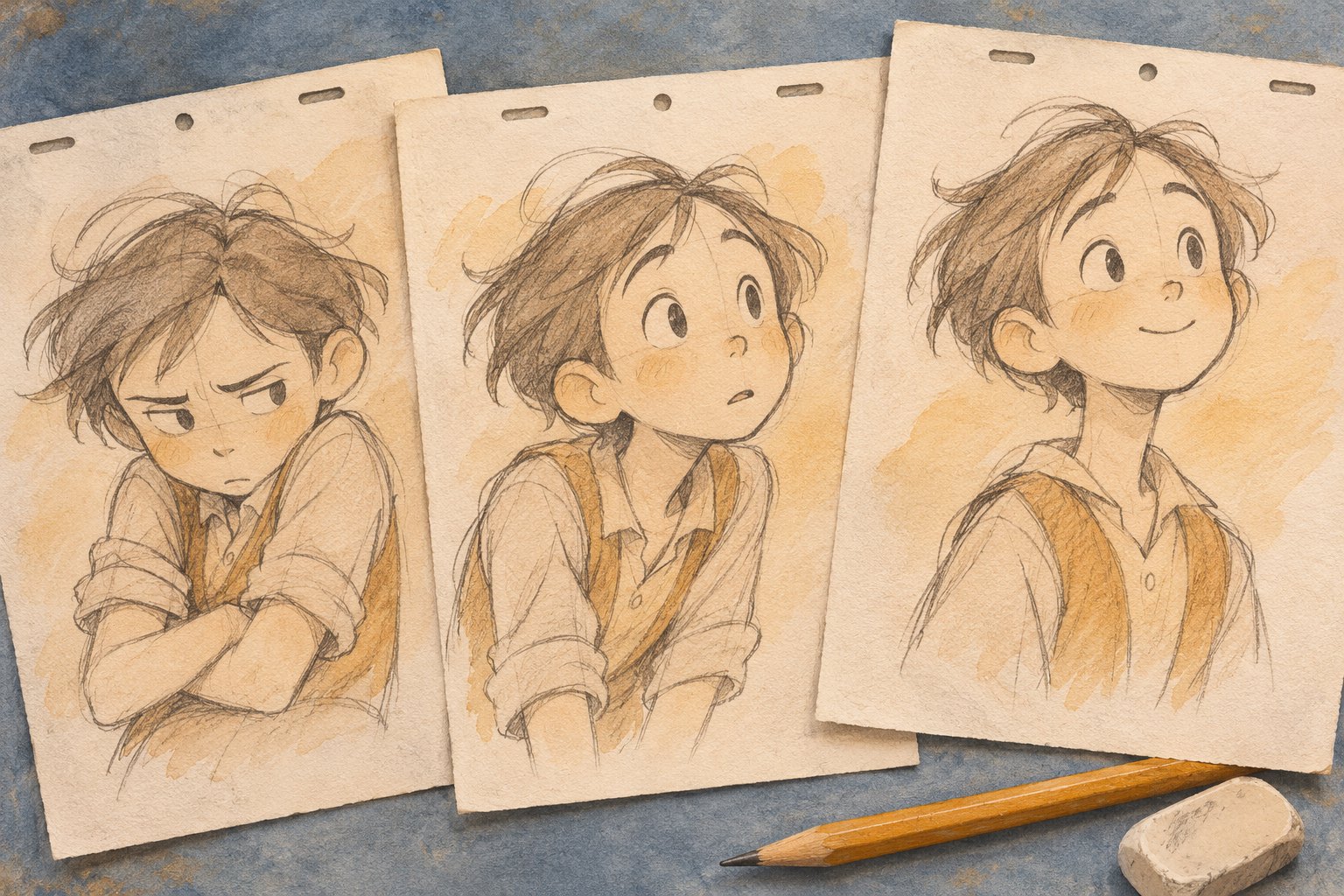
The strongest defense of animation craft does not require claiming that a particular technique guarantees a successful film. A drawing can be painstaking and dramatically unhelpful. A beautifully designed character can have little to express. The critical question is how the choices accumulate into an experience: curiosity, humor, tension, affection, or something less convincing.
For a Dior film, I would also ask how effectively the work balances its identity as a brand commission with its ambitions as moving-image storytelling. That is an evaluative question, not a conclusion about this film. Does the visual world invite attention beyond recognition of the brand? Do the performances have enough individuality to sustain that attention?
Those questions remain worthwhile regardless of the answer to the production dispute. Establishing how a film was made can change our understanding of its labor and authorship. It cannot substitute for explaining whether its images and performances work together.
The same discipline underlies our commentary on what a sweeping film verdict can—and cannot—tell viewers. A memorable declaration gives a discussion its headline. Detailed criticism still has to supply the reasoning.
How to assess the controversy without losing sight of the film
Readers do not need to become animation technicians to evaluate coverage more carefully. Three distinctions make a substantial difference:
- Separate attribution from verification. Chomet’s statement is his reported account. Describing it accurately does not require presenting it as an independently verified record of the entire production.
- Separate a visual reaction from a process claim. “This movement looks wrong to me” and “this movement was generated by AI” require different kinds of support.
- Separate production ethics from artistic judgment. Questions about labor and disclosure matter, while questions about storytelling, performance, and emotional effect still deserve their own answers.
Useful additional evidence would clarify the disputed process through specific, attributable production information. That might include explanations of responsibilities or documented stages of the work. These are examples of evidence that could help, not claims that such material has been released for this film.
The deeper issue is recognition
My reading of Chomet’s defense is that its force comes from the demand to recognize drawing as work. “Everything was drawn by hand” asks the audience to picture decisions and effort behind the finished image. The concern is understandable: if viewers assign authorship solely from a visual impression, the people responsible for an image can vanish from the discussion.
But recognition works best when it remains precise. Artists deserve credit for the work they performed; audiences deserve clear accounts of consequential production choices. Neither goal is served by turning suspicion into certainty or reputation into automatic proof.
The most productive response to the Dior controversy is to take Chomet’s denial seriously, keep its attribution visible, and reserve artistic conclusions for evidence from the film itself. Animation deserves criticism attentive enough to notice both its makers and the life they try to give their characters.
Original content by this site's editorial team. Published: November 7, 2026 at 07:21:15 PST (Los Angeles time)