Otis, the bear associated with Fat Bear Week’s first victory, is the subject of Love Letters to Otis, a short documentary tribute. The appeal is easy to understand: a familiar wild animal can become part of someone’s daily life without ever knowing that person exists. Remembering him means considering both the bear in the river and the people watching from far away.
According to Popular Science’s coverage, the film reaches back to a 2013 livestream appearance, explores his appeal during pandemic lockdowns, and includes fan artwork alongside his fishing behavior and later physical challenges. Those elements suggest a portrait built around familiarity and attachment. This is a spoiler-light critical commentary on the film’s reported content, rather than a review based on a firsthand screening.
The champion behind the celebration
There is a small but useful distinction behind the familiar description of Otis as the first Fat Bear Week winner. His initial victory came in 2014, when the event was called Fat Bear Tuesday; the weeklong celebration followed. That history supplies a recognizable introduction, but a competition result can explain only so much about why an animal matters to an audience.
A winner gives people a reason to click. A recognizable presence gives them a reason to return. The more interesting question for this tribute is how Otis crossed that distance: from a bear people could support in a playful contest to an individual whose habits they wanted to observe.
From a film criticism perspective, that difference matters. A biographical portrait organized entirely around achievements can leave its subject strangely indistinct. Attention to repeated behavior offers another route. It lets viewers recognize a subject through the way he occupies space, responds to conditions, and goes about an ordinary activity.
Reading Otis through behavior
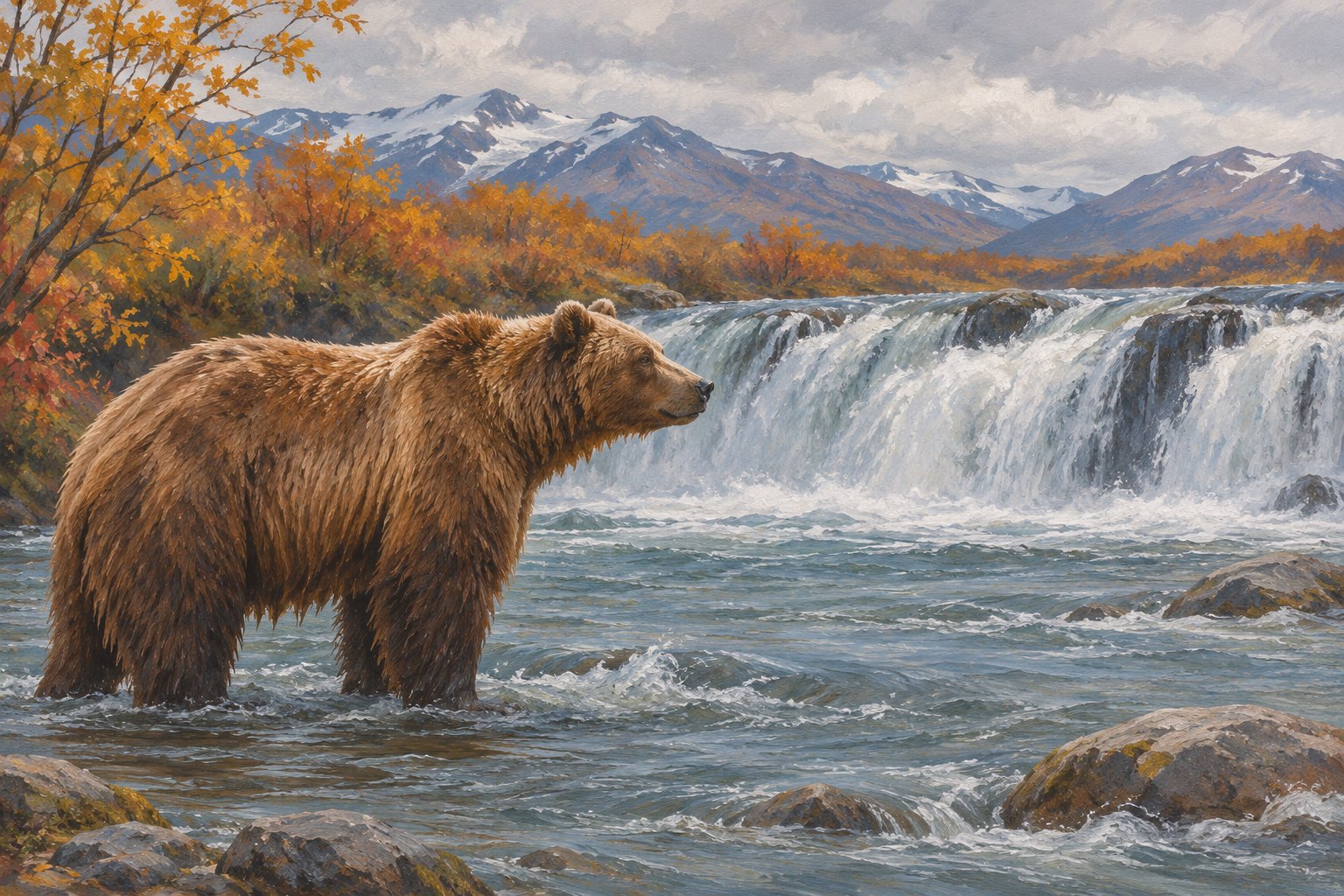
The reported emphasis on Otis’s fishing is especially promising because it places observable action at the center of characterization. A bear does not need an invented inner monologue to hold the screen. Where he waits, how he positions himself, and how he responds to the water can give an audience something concrete to follow.
Patience, however, is also an interpretation. To a viewer, waiting quietly may resemble composure or wisdom. For the animal, that same behavior belongs to the practical business of feeding. Good wildlife criticism should hold those perspectives together without pretending they are identical.
My reading of this premise is that Otis’s appeal rests partly on that gap. People can find reassurance in his behavior while acknowledging that reassurance is their response, rather than his purpose. He does not have to be trying to teach anyone a lesson for watching him to become meaningful.
That makes an animal-centered approach unusually demanding. It requires attention to physical needs and circumstances while resisting the temptation to translate every movement into a human emotion. Admiration becomes more interesting when the subject retains some mystery.
The viewers become part of the story
The film’s reported inclusion of fan artwork introduces a second perspective: the people who turned watching into a relationship. A drawing is evidence of attention. Someone looked closely enough, and cared enough, to make something after the screen went dark.
That is a useful distinction from simply counting an audience. Popularity describes scale; a personal response can reveal texture. Different viewers may recognize comfort, humor, persistence, or vulnerability in the same animal. Their interpretations tell us something about them as well as about the subject they share.

The lockdown connection gives this relationship a particularly resonant context. As an interpretation, the attraction of a wildlife livestream during isolation seems less about escape than about access to another rhythm. A river continues moving. An animal continues looking for food. The viewer can witness activity that does not require a reply, an appointment, or a performance.
There is a related question in our discussion of looking beyond outdoor spectacle to the relationships around it: what changes when watching becomes a shared experience? Here, the community forms around sustained attention to a wild subject rather than a human undertaking.
What a short film changes about a livestream
A livestream and a documentary ask viewers to spend time differently. The livestream leaves open the possibility that very little will happen. A finished film selects moments and gives them a sequence. That selection can make a long relationship accessible, but it also changes the experience that originally created the attachment.
For this reason, the relevant artistic question is how much room a tribute gives ordinary behavior. A collection of dramatic highlights might explain why an animal became famous. A quieter passage could help explain why people enjoyed his company.
Without a screening, the film’s pacing, sound, and individual transitions cannot be fairly judged. Nevertheless, those are the formal choices worth attending to. Does a moment last long enough for the viewer to observe independently? Does music support an emotion already present, or tell the audience what to feel before it can look?
Our commentary on what makes a short film’s creative choices matter raises a complementary issue: limited running time makes selection especially consequential. In a wildlife tribute, even the decision to preserve a pause can express a point of view.
Aging without turning a bear into a fable
The reported attention to Otis’s later physical challenges brings vulnerability into the portrait. That material deserves particular care. An aging animal should not have to demonstrate heroic determination in every image to remain worthy of attention.
The strongest interpretation available here is less triumphal. Familiarity can make changes visible. An audience that has learned a subject’s routines may notice effort where a newcomer sees only an uneventful scene. Time supplies emotional meaning because the viewer has something to compare.
There is also a danger in treating every difficulty as an uplifting metaphor. Such a reading can smooth away the animal’s circumstances in favor of a reassuring message for people. A more respectful response allows affection and discomfort to coexist. Caring about a wild animal does not give viewers control over his life.
What remembering Otis can mean
The title Love Letters to Otis offers a revealing direction for interpretation. A letter expresses the sender’s feelings; it does not guarantee that the recipient can understand or return them. Applied to this relationship, that imbalance is the emotional center.
Otis could matter deeply to people without participating in their understanding of him. Recognizing that does not diminish their attachment. It makes the attachment more specific: they were moved by a life unfolding beyond their own concerns.
For me, that is the most worthwhile idea behind this tribute. The championship provides the introduction, but the deeper subject is what repeated attention makes possible. A bear becomes recognizable. A distant place becomes consequential. Remembering then becomes an invitation to keep looking carefully at the living world, even when it offers no tidy resolution and asks nothing of the camera.
Original content by this site's editorial team. Published: November 7, 2026 at 06:49:28 PST (Los Angeles time)