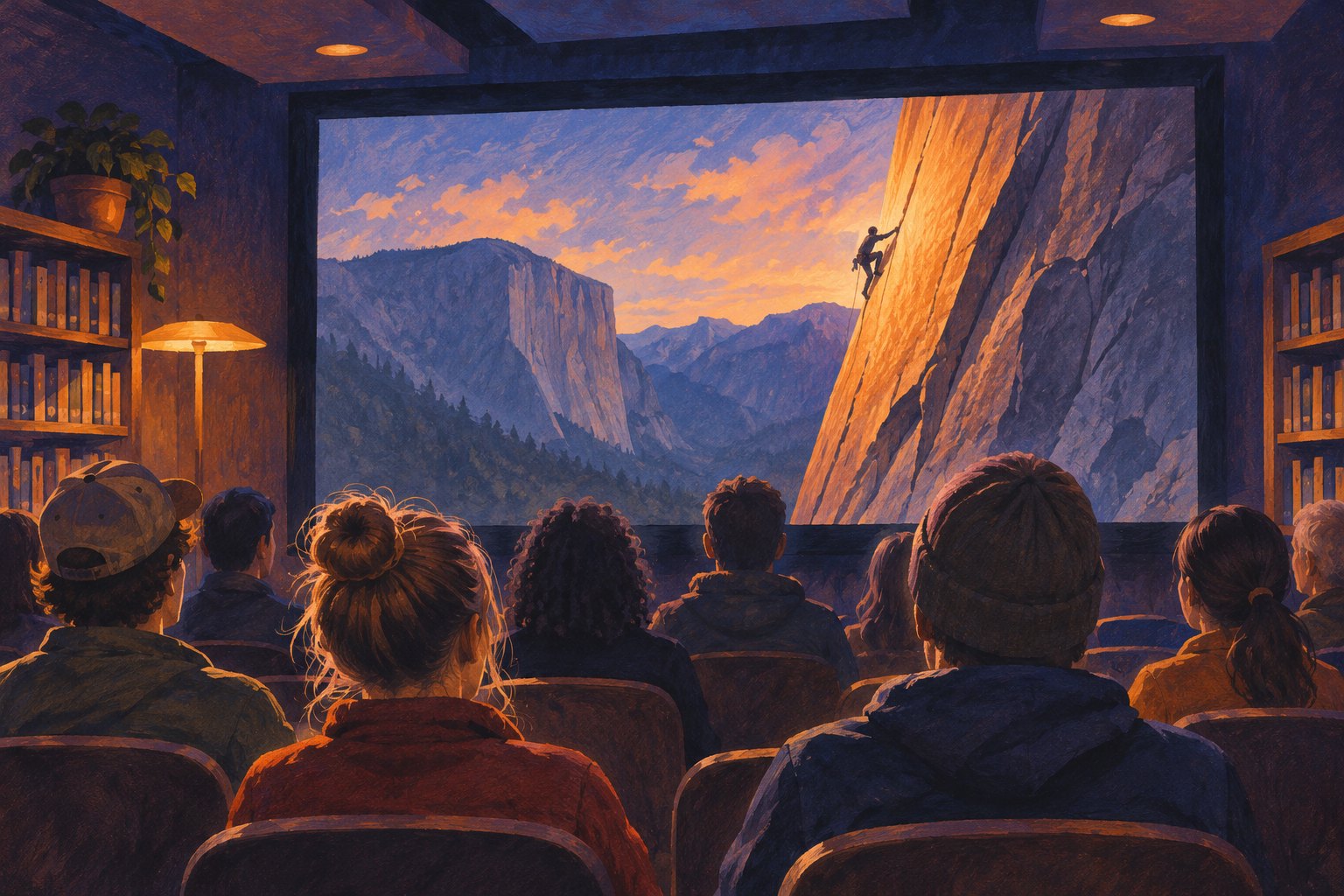
Reel Rock is scheduled to screen Tuesday at Bud Werner Library, according to Steamboat Pilot & Today. For viewers drawn to climbing films, the attraction is easy to understand: an immense rock face, an apparently impossible movement, and a person willing to attempt it. But the more interesting question for a movie audience begins before anyone leaves the ground. What makes this particular climb matter to this particular person?
This is a spoiler-free screening preview and critical viewing guide, not a review of the individual films. A screening announcement establishes an event; it does not establish the quality of its storytelling. The useful approach is to arrive with curiosity about the participants and a few ways to distinguish an exciting athletic record from a revealing documentary.
Start with the person’s definition of success
Climbing provides an unusually clear external objective: reach a particular point by a particular route. That clarity is a gift to filmmakers. An audience can understand the broad goal immediately, even without understanding the technical difficulty. Yet an obvious destination can conceal a less obvious emotional story.
When watching Tuesday’s screening, listen for how each participant describes the undertaking. Is the goal expressed as curiosity, professional ambition, personal satisfaction, or something else? Those possibilities are questions to ask, not motives to assign. A documentary earns emotional depth by letting its subjects explain themselves, especially when their explanations complicate the heroic impression created by the images.
My preference is for films that allow the meaning of success to develop. Reaching the top may answer the sporting question while leaving the personal one open. Conversely, an unfinished attempt may produce a meaningful change in perspective. The result deserves attention, but it should not determine every judgment about the person.
Listen for language that complicates the pictures
A dramatic image can make confidence look absolute. Speech can restore uncertainty. Pay attention to whether a participant’s words support the visual impression or quietly challenge it. Someone who looks composed may describe confusion; someone shown struggling may understand the problem with remarkable precision.
This is where memorable documentary dialogue earns its place. A revealing remark need not sound like a motivational slogan. It might clarify a decision, acknowledge dependence on another person, or revise an earlier belief. Its value comes from context: who says it, what they know at that moment, and whether the film lets us see what follows.
No dialogue is quoted here because a line should be checked against the film before being treated as something a participant actually said. During the screening, notice which remarks remain meaningful after the music and scenery fall away. Those are often the words that bring an athlete into focus as a person.

Ask what the edit allows you to understand
Documentaries organize experience. A filmmaker chooses where to begin an attempt, how long to stay with a pause, and when to move from a wide view to a close-up. Those choices shape our sense of effort and uncertainty. An apparently straightforward sequence can contain a substantial argument about the person we are watching.
A useful test is whether you understand a decision before the film tells you how to feel about it. Can you recognize the obstacle? Has the participant explained what makes it difficult? Is there enough context to understand why a change of approach matters? You do not need climbing expertise to notice when a film provides that information.
Music can deepen a scene, but it can also supply urgency that the storytelling has not established. Similarly, rapid editing can communicate strain while making the physical problem harder to follow. Neither technique is inherently a flaw. The question is whether the style helps you understand the experience or simply intensifies your reaction.
Our discussion of what sports footage can actually demonstrate raises a related distinction: an arresting moment and a well-supported interpretation are different achievements.
Notice who remains outside the heroic frame
A climber may occupy the center of an image, but the film’s attention need not end there. When partners, friends, family members, or crew appear, consider whether they have perspectives of their own. Are they allowed to express priorities, or do they function mainly as witnesses to the central person’s determination?
This matters because relationships can change the meaning of an undertaking. Encouragement, disagreement, practical assistance, and boundaries each reveal something different. A documentary becomes more interesting when another person can affect the story rather than merely confirm the protagonist’s importance.
The same standard applies to the landscape. Does the film give viewers a sense of a specific place, or could its scenic images be exchanged for another spectacular backdrop? Our commentary on how locations become meaningful on screen explores why setting deserves attention as part of a story’s substance.
Let the library audience broaden the conversation
The Bud Werner Library setting invites an appealing possibility: viewers can encounter the same images with very different kinds of knowledge. An experienced climber might notice technique. A newcomer might focus on a relationship or a moment of hesitation. Neither response automatically exhausts what the film offers.
After the screening, a more productive conversation than simply choosing the most impressive climb could begin with three questions:
- Which participant’s choices became easier to understand as the film progressed?
- Which sequence gave you enough information to form your own judgment?
- Whose perspective would have changed the story if it had received more time?
These questions make room for disagreement without requiring technical expertise. They also keep the discussion attached to what appeared on screen, rather than to assumptions about what adventurous people must be like.
The deeper question: what deserves admiration?
The strongest reason to approach Reel Rock with a character-centered eye is that admiration can become more precise. Persistence may deserve it. So may patience, honesty, collaboration, or a decision to reconsider. A film has the opportunity to show which qualities actually matter in the experience it records.
My critical standard for Tuesday’s screening would therefore be simple: does each story leave its central person more understandable? Spectacular images can establish the scale of a challenge. The deeper achievement is helping an audience recognize the thinking, relationships, and uncertainty within it. That is what can make a climbing film stay with viewers after the height itself has stopped taking their breath away.
Original content by this site's editorial team. Published: November 7, 2026 at 04:09:11 PST (Los Angeles time)