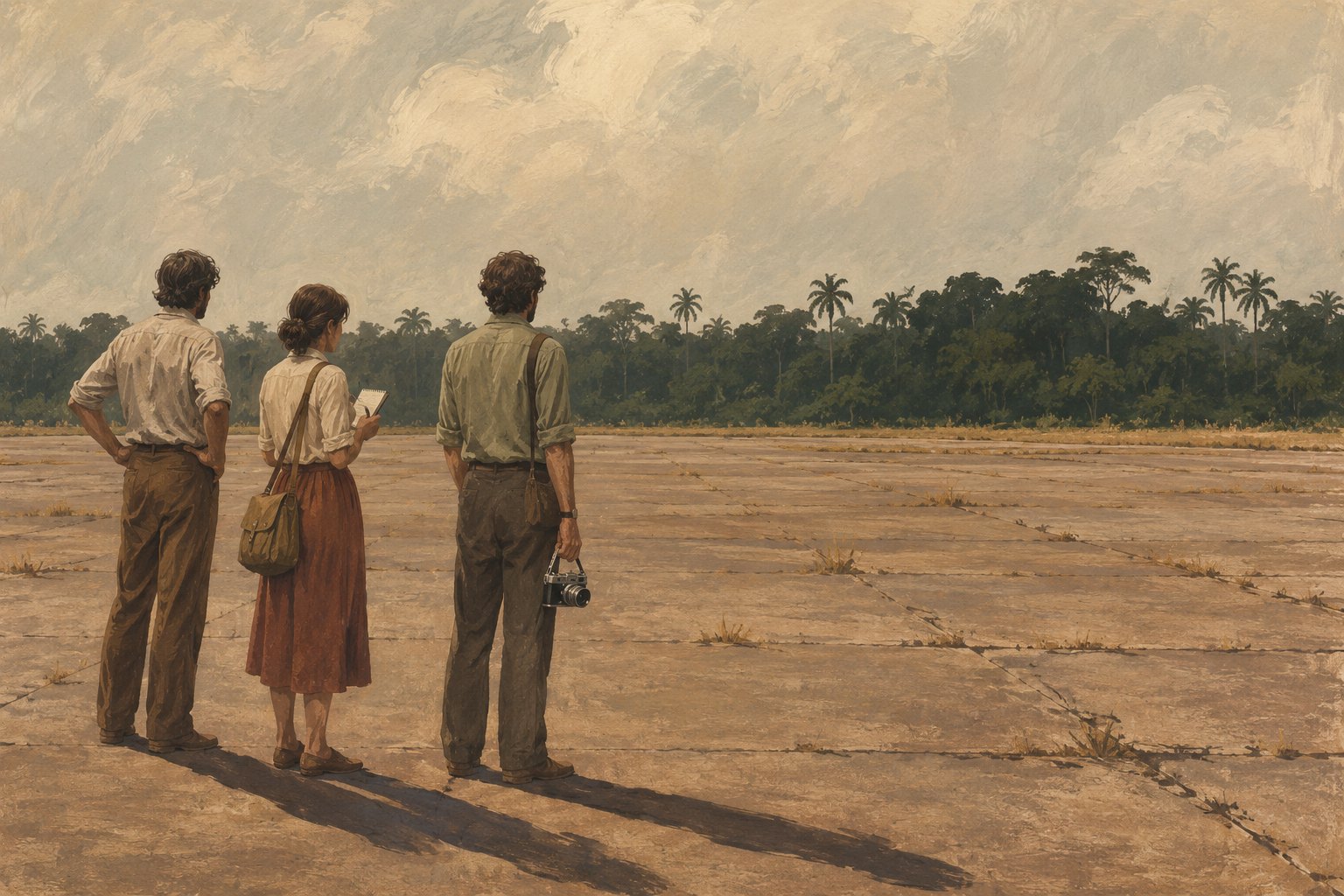
Meeting with Pol Pot finds its most disturbing subject in the distance between being admitted somewhere and being allowed to understand it. Rithy Panh’s 2024 historical drama follows three French visitors to Cambodia in 1978, where an invitation to interview the Khmer Rouge leader becomes an exercise in controlled perception. My reading is that the film works best as a study of compromised witnessing: each visitor possesses a useful way of seeing, and each discovers its limitations.
Carroll College’s French-film presentation offers an occasion to revisit a work whose questions extend beyond its historical setting. Who selects the people a reporter can interview? What does an apparently peaceful landscape conceal? At what point does loyalty to an idea become permission to disregard another person’s suffering?
Spoiler notice: This review discusses the visitors’ discoveries, the interview with Pol Pot, and the film’s visual methods. It avoids detailing the final fates of the central characters.
Three visitors, three competing obligations
The film is freely inspired by Elizabeth Becker’s When the War Was Over. Its central characters are fictionalized figures, not a literal reproduction of the historical delegation. Irène Jacob plays journalist Lise Delbo, Cyril Gueï plays photographer Paul Thomas, and Grégoire Colin plays Alain Cariou, an intellectual sympathetic to the revolution.
That distinction matters because these characters organize different kinds of responsibility. Lise has obligations to people she remembers. Paul seeks evidence through images. Alain has invested himself in a political explanation of the world. Their disagreement is therefore more substantial than a division between suspicious visitors and a gullible companion: they have different things to lose when the official story collapses.
Their hosts, meanwhile, need the visitors to carry a favorable account beyond Cambodia. The interview is both an apparent opportunity and a means of influence. Before anyone asks Pol Pot a question, the regime has already tried to determine the terms of the conversation.
Lise: remembering people the official story cannot accommodate
Lise’s search for news of her former interpreter gives the film an essential human scale. A government can describe sweeping historical transformation indefinitely; a question about one missing person demands a different kind of answer. Her attachment makes abstraction harder to sustain.
“Where are the intellectuals?” she asks, in an English rendering of the dialogue. The force of the question lies in its specificity. It asks the revolution to account for people whose absence its triumphal language cannot explain. It also shifts our attention from what the visitors are shown to who has been removed from view.
Lise’s perspective makes silence active. An empty street can look orderly until someone remembers the conversations, businesses, and ordinary encounters that should occupy it. Her knowledge of Cambodia gives those absences weight. The country cannot be reduced to the itinerary because she remembers a life outside it.
For me, this is the character’s strongest contribution: she treats memory as a form of resistance to an imposed explanation. Yet memory cannot locate the missing by itself. Her personal connection sharpens her questions without guaranteeing that she can obtain answers.
Paul: the camera must escape the guided tour
Paul’s movement beyond his escorts takes him toward suffering excluded from the official presentation. His photographic role makes the regime’s control especially concrete. A camera can record what stands before it, but someone else may have arranged the scene or determined where the photographer is permitted to stand.
This is why his departure from the authorized route matters more than a conventional act of daring. He challenges the conditions under which evidence is produced. The guided tour offers visible things, but visibility alone does not make them representative.
Paul’s predicament also complicates the comforting notion that uncovering a fact completes a journalist’s task. Evidence must survive, reach an audience, and remain intelligible outside the circumstances of its discovery. Recognition can precede the ability to communicate it.
Place consequently becomes part of the argument. As in our examination of how locations acquire meaning on screen, a setting matters through the human activity it permits or suppresses. Here, access to space determines access to knowledge.
Alain: when belief becomes a defense against evidence
Alain’s connection to Pol Pot and sympathy for the revolutionary project make him the most uncomfortable member of the group. He arrives with an explanation already available. The danger is that events will be judged by whether they preserve that explanation.
His position is dramatically useful because admitting the truth requires more than correcting a mistaken prediction. It threatens his understanding of his own commitments. A visitor can leave a disappointing tour; abandoning an organizing belief is a more intimate rupture.
During the encounter with Pol Pot, Alain asks, “What is counterrevolution?” It is a brief question with enormous consequences. If a category can justify repression, its definition matters. An undefined enemy gives power room to expand its accusations indefinitely.
The question also marks a change in how Alain listens. He begins pressing political vocabulary for an accountable meaning. That is the moral test of his character: whether his ideals can withstand scrutiny of the people claiming to embody them.
The relationship between conviction and self-protection also runs through our discussion of belief and self-interest in character-driven cinema. Here, however, the consequences extend far beyond personal hypocrisy.
Why the handmade images matter
Panh combines the acted drama with archival material and clay figurines. Those changes of form interrupt the expectation that a historical film should provide one continuous, convincing reconstruction.
I find that interruption central to the film’s meaning. A miniature declares that someone has constructed an image. It asks us to examine representation at precisely the moment the story is exposing representations designed to prevent examination.
The contrast also creates a productive difficulty. Viewers looking for an uninterrupted political thriller may find the transitions distancing. The film repeatedly asks us to consider how suffering is pictured, which can suspend immediate identification with its characters. My judgment is that this tension strengthens its inquiry, even when it makes the narrative less fluid.
The handmade figures do not supply missing evidence. They offer an expressive response to what ordinary dramatic reconstruction may struggle to convey. Their stillness invites contemplation without turning every atrocity into a spectacle of performed violence.
The deeper meaning: access carries an obligation
The title promises a meeting with one man, but the film’s larger subject is the apparatus that makes that meeting possible. Escorts, selected interviewees, restricted movement, and approved explanations shape what can be known long before the central encounter.
The three visitors expose complementary failures. Attachment needs corroboration. Images need context. Conviction needs the possibility of revision. None of those tools is sufficient alone, yet surrendering any of them would make the regime’s work easier.
One deliberate reference deepens this reading: Panh has explained that Lise’s surname honors writer and Holocaust survivor Charlotte Delbo. It connects the character’s attention to missing people with the persistence of testimony. The return of clay figures also recalls his earlier film The Missing Picture, placing this drama within a continuing investigation of memory and representation.
Meeting with Pol Pot is most compelling when it makes observation feel like an unfinished responsibility. Seeing through an official story is only the beginning. The harder obligation is to preserve the people, distinctions, and unanswered questions that story was designed to erase.
Original content by this site's editorial team. Published: November 7, 2026 at 01:22:53 PST (Los Angeles time)