
Disney’s Hexed has prompted an interesting disagreement: does its witch fantasy bring a sharper sensibility to family animation, or does the promise of mischief exceed the storytelling? Deadline’s favorable assessment emphasizes its young-adult edge, while The Guardian’s response is distinctly disappointed. Those contrasting judgments make one question especially useful: what would being genuinely edgy mean for a Disney story about female power and family bonds?
The most compelling answer concerns characters rather than atmosphere. Witches can supply danger, humor, and visual extravagance. The harder achievement is making power feel emotionally complicated—something that changes relationships instead of simply making an adventure bigger.
This is spoiler-free thematic commentary on the film’s reported subjects and critical reception, rather than a firsthand screening review. It does not evaluate individual scenes, reproduce unverified dialogue, or reveal the ending.
The distinction between attitude and emotional risk
Calling a fantasy edgy can describe several different qualities. It might mean irreverent jokes, unsettling imagery, a confrontational personality, or a willingness to question comforting assumptions. Those qualities do not necessarily travel together. A film can sound rebellious while arranging every conflict around familiar answers.
For Hexed, the young-adult framing offers a more useful possibility. Adolescence makes belonging difficult because affection and independence can pull in different directions. Wanting recognition does not mean wanting supervision. Wanting freedom does not mean knowing what to do with it. A fantasy becomes emotionally adventurous when it gives those contradictory desires room to coexist.
My critical preference is for stories that allow a character’s understandable decision to have an uncomfortable consequence. That is a more demanding form of darkness than a threatening setting. It asks an audience to remain engaged with someone who cannot always be excused, easily corrected, or reduced to a reassuring lesson.
Female power needs a point of view
Reuters’ coverage identifies female power and family bonds as central subjects of Hexed. That combination matters because power means different things depending on where a character stands. To someone seeking independence, it may promise escape from other people’s expectations. To someone invested in keeping a family together, the same independence may feel destabilizing.
Neither perspective automatically settles the argument. A character can be right about needing freedom and wrong about the way she pursues it. Another can express sincere concern while treating her own preferences as universal wisdom. The interesting dramatic territory lies between those positions.
Witch fantasy is particularly suited to making that disagreement visible. Magic gives abstract questions a concrete vocabulary: ability, permission, restraint, and responsibility. But possessing an extraordinary ability is not the same as having agency. Agency means making consequential choices, including choices that other characters would rather prevent.
That distinction also informs our analysis of ambition and the power to define other people’s stories in Ink. The settings differ, but the critical question travels well: who gets to decide what another person’s success should look like?
Family bonds are more interesting when they stretch
A family-centered fantasy can draw considerable strength from the fact that love does not guarantee understanding. People may care deeply about each other while disagreeing about danger, obligation, or the future. Affection can make those disagreements harder because refusing a request may feel like rejecting the person making it.
This is where Hexed’s reported thematic combination becomes especially promising. Female power and family connection need not function as separate messages. They can test each other. Independence raises the question of what remains shared; loyalty raises the question of what each person is allowed to keep for herself.
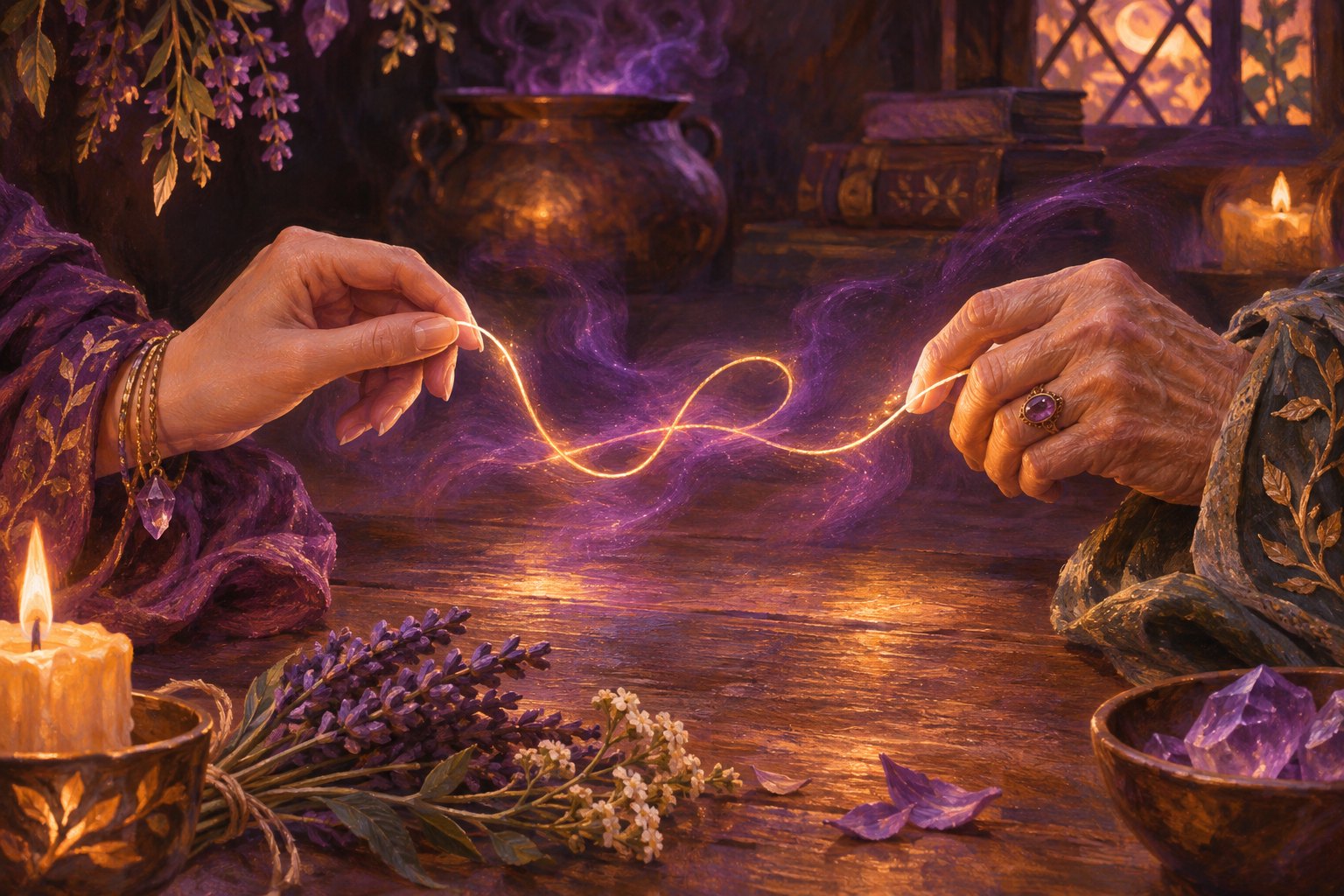
The illustration above is conceptual, not a scene from the film. Its loose thread suggests a useful way to think about family storytelling: connection has value without needing to become confinement. A bond that can stretch may be stronger than one maintained through obedience.
Our commentary on family memory and shared tradition in The Mochi Movie approaches a related concern from a different direction. What people inherit becomes meaningful through participation and interpretation. In fantasy, that same tension can turn inheritance into a question rather than an automatic answer.
Why the contrasting reviews matter
The disagreement surrounding Hexed should not be flattened into a claim that critics cannot agree about anything. Different responses can reveal different priorities. One viewer may value energy and tonal surprise; another may need those qualities to produce more distinctive characterization. Both standards are reasonable, although the brief descriptions of these reviews do not establish every reason behind their verdicts.
For readers choosing whether the film sounds appealing, the useful distinction is between subject and execution. Witches, family relationships, and female power identify its territory. They cannot establish the quality of its humor, emotional transitions, animation, or performances. Even an appealing thematic combination still needs dramatic shape.
Likewise, the phrase young-adult fantasy describes an interpretive angle, not a reliable parental guide. It should not be treated as a substitute for verified content information. Emotional complexity and suitability for a particular child are separate questions.
What deserves attention beyond the magic
A character-focused viewing of Hexed can begin with three concrete questions. Who initiates the important choices? Whose explanation of events receives the most sympathy? And when relationships change, does anyone have to change their behavior as well as their language?
These questions help distinguish a story about empowerment from a story that merely celebrates it. A declaration of independence has limited dramatic weight if nothing afterward becomes harder. Similarly, reconciliation feels more substantial when it alters expectations rather than simply ending an argument.
Dialogue matters here because people reveal themselves through what they cannot comfortably say. A joke can deflect vulnerability; a command can disguise fear; an apology can acknowledge harm or evade it. Without verified wording and context, attaching a supposedly memorable line to Hexed would obscure that distinction rather than illuminate it.
A deeper reading: the freedom to remain connected
The most productive interpretation of Hexed’s reported themes is that becoming powerful and becoming independent are not necessarily the same achievement. Power concerns what someone can do. Independence concerns whether she can choose her actions without surrendering her judgment to another person.
Family adds a further complication: freedom need not require emotional isolation. The richer possibility is a relationship in which disagreement does not cancel love and love does not cancel autonomy. Whether Hexed fully realizes that possibility requires a closer assessment of the finished film than the available descriptions allow.
That is nevertheless the standard its premise makes worth considering. A witch fantasy earns its edge when it lets affection become difficult without making affection worthless. The lasting magic would be a character finding room to belong without having to become smaller.
Original content by this site's editorial team. Published: November 24, 2026 at 14:11:07 PST (Los Angeles time)