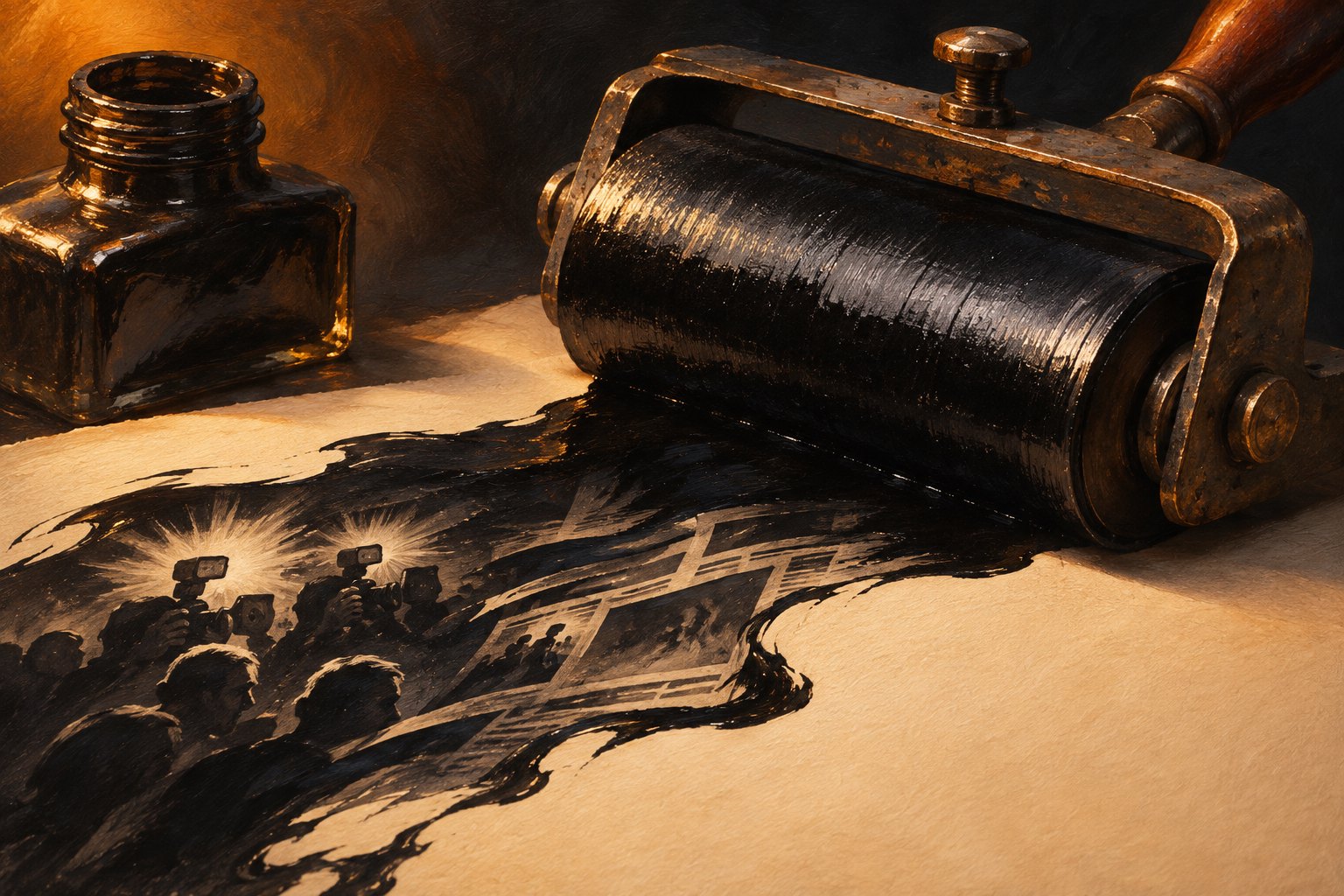
Ink presents a troubling proposition: making a newspaper more exciting can also make its moral compromises easier to celebrate. Danny Boyle’s drama follows Rupert Murdoch and editor Larry Lamb as they transform The Sun, placing professional ambition beside the question of what a publication owes the people it turns into stories. The most interesting tension is between the pleasure of breaking through and the responsibility that arrives with power.
Scope and spoilers: This is a critical analysis of the film’s documented premise, character conflicts, and published dialogue, rather than a firsthand screening review. It discusses the newspaper’s transformation and broad thematic developments without revealing the resolution of its crime storyline.
The newspaper is the project; recognition is the prize
Set around Murdoch’s acquisition of The Sun in 1969, Ink is directed by Boyle and written by James Graham, adapting his stage play. Jack O’Connell plays Lamb, Guy Pearce plays Murdoch, and Claire Foy plays Jules Davies. Those central credits and the historical premise are documented by the [British Council’s film listing](https://filmsandfestivals.britishcouncil.org/projects/ink).
The distinction between an owner and an editor matters immediately. Both can want a successful newspaper while wanting different things from success. Ownership offers expansion and influence. Editing offers the chance to make judgment visible: this story deserves attention, this voice belongs here, this is what tomorrow’s conversation should be about.
For Lamb, that authority has an especially personal dimension. Graham has described him as someone who believed he deserved an editorship and had been denied one. The writer also identifies the opening dinner conversation as a discussion of journalism’s five W’s. These details establish a useful tension between professional knowledge and professional resentment. [Netflix’s interview with Graham](https://cdn.nflxext.com/tudum/features/ink-the-art-of-adaptations-james-graham) supplies that account of the character and opening scene.
My reading is that recognition offers the strongest way into Lamb’s predicament. A man who wants to prove that others underestimated him may begin treating every success as vindication. At that point, criticism becomes difficult to hear: it sounds like another attempt to keep him outside the room.
Larry Lamb: when proving yourself becomes the whole job
“The Sun is the laughing stock on the street,” Lamb says in dialogue quoted by [Radio Times](https://www.radiotimes.com/movies/ink-review-danny-boyle-jack-oconnell/). The line makes humiliation part of the paper’s identity. Turning it around promises more than a commercial achievement; it promises relief from being dismissed.
That is a compelling dramatic motive because it is recognizable without being admirable in every consequence. Wanting meaningful work is ordinary. Wanting people who rejected you to acknowledge your talent is ordinary, too. The ethical problem begins when their acknowledgment becomes more important than the people affected by your work.
Through that lens, circulation becomes an emotionally dangerous measure. Sales can demonstrate that a publication has reached readers. They cannot, by themselves, demonstrate that its treatment of a person was justified. The same result can reward strong reporting, entertainment, intrusion, or cruelty.
The question I would put at the center of Lamb’s character is therefore precise: can he distinguish a successful editorial decision from a defensible one? If those categories collapse, every boundary starts to look like an obstacle placed by someone less imaginative.
Rupert Murdoch and the power behind the invitation
Murdoch recruits Lamb to remake the struggling paper. The owner supplies an opportunity that the editor has wanted, making their partnership fertile ground for a story about gratitude, permission, and dependence.
It is tempting to understand such a relationship entirely through chemistry: two ambitious people recognizing something in one another. But the unequal distribution of power deserves equal attention. One man receives authority within an institution; the other owns the institution. Shared enthusiasm does not erase that difference.
This is where the familiar appeal of the outsider story becomes complicated. Exclusion can sharpen someone’s understanding of unfairness. It can also create a determination to occupy the privileged position personally. Breaking into an establishment does not automatically change how authority works once you get there.
For me, the useful question is whether the partnership expands other people’s freedom or merely expands its own room to maneuver. That distinction gives the film’s newspaper setting significance beyond an account of business success.

Jules Davies tests the promise of a new beginning
The Virginia Film Festival describes Jules as a woman seeking space for a modern female perspective inside the newsroom’s male culture, then encountering the limits of the transformation she has joined. That documented conflict gives her a distinct stake in the paper’s future. [The festival’s synopsis](https://virginiafilmfestival.org/festival/2026/films/ink) establishes this aspect of her role.
Jules’s perspective changes what progress means. For an owner or editor, progress may look like a larger audience and greater influence. For someone seeking a voice within the organization, it also means being able to challenge decisions without becoming expendable.
Her position invites a sharper test than whether a workplace calls itself modern. Does it distribute meaningful authority? Can a dissenting colleague change the outcome? Does an invitation to participate survive disagreement?
This also makes adaptation a question of attention. As our discussion of what adaptations owe their characters considers, fidelity involves more than carrying events from one medium to another. A character’s perspective needs enough space to shape the story’s meaning.
Why a compelling story can still leave frustration
“People need stories” is another line attributed to Lamb in published coverage. It sounds generous until the editor’s power enters the equation: who decides which stories people need, and what happens to the people inside them? The line is quoted in [Variety’s review, republished by Yahoo](https://malaysia.news.yahoo.com/ink-review-danny-boyle-gripping-180000604.html).
My concern with the dramatic premise is the imbalance between the visibility of success and the visibility of its costs. Building a paper supplies obvious milestones. Harm is often less tidy. It may continue beyond the event that attracted attention, beyond the deadline, and beyond the moment a newsroom moves on.
That is a critical question, rather than proof that Boyle’s film fails it. Understanding why an ambitious character makes a choice is valuable; it does not settle whether the film gives sufficient attention to everyone affected. Our examination of the difference between a compelling performance and a complete film raises a related distinction between a magnetic center and the work surrounding it.
A deeper reading: attention is a form of authority
The richest interpretation of Ink begins with the editor’s everyday power to make something visible. A newspaper does more than satisfy existing interests. Through repetition, prominence, and omission, it helps establish what deserves public notice.
Read this way, Lamb’s desire for recognition, Murdoch’s ownership, and Jules’s struggle for influence belong to the same argument. Each concerns who gets to decide what matters. The discomfort lies in the possibility that a project promising to recognize overlooked readers can still overlook people within its own operation—or within its stories.
The question that stays with this premise is not simply whether the newspaper wins. It is whether winning leaves its leaders more capable of hearing someone whose experience complicates their preferred account of themselves.
Original content by this site's editorial team. Published: November 24, 2026 at 12:25:57 PST (Los Angeles time)