
Dollar Bank Cinema in the Park is Pittsburgh’s free outdoor movie program, bringing feature films to neighborhood locations during the summer. For readers looking for a screening, the essential details are the specific park, date, title, and weather status. The city’s announced 2026 season ran from June through August; those summer listings should not be mistaken for upcoming September events.
One selection deserves attention beyond its place on the calendar: Cars. The city listed Pixar’s animated film at West End Overlook on June 8 and Arsenal Park on June 12. A movie about discovering the value of an overlooked community makes an unusually thoughtful choice for a neighborhood gathering.
Spoiler warning: The following review discusses the original Cars, including its final race. It evaluates the film and its relationship to outdoor moviegoing, rather than reporting on audience reactions at a particular screening.
Before heading to a park screening
The city’s announcement describes free admission, encourages blankets and lawn chairs, and says movies begin at dusk unless otherwise noted. Because this is a seasonal program, start with the current official city event listing rather than assuming that an older calendar remains valid.
- Confirm the year, exact park location, film, and start-time instructions.
- Check the Office of Special Events’ latest weather announcements before leaving.
- Review the individual film’s rating and content when choosing an outing for children.
- Check access arrangements that matter to your group, including the route from transportation to the viewing area.
Those practical details make room for the more interesting question: what does a familiar movie reveal when we watch it beside people who share our neighborhood?
McQueen sees every place as a stepping-stone
Lightning McQueen introduces his philosophy with a compact declaration: “I am speed.” He has reduced identity to performance. Anything that cannot help him win looks like wasted time, and anyone outside the spotlight risks becoming part of the scenery.
His unexpected arrival in Radiator Springs interrupts that worldview. After damaging the road, he must repair it. The assignment is especially well chosen for this character: an athlete accustomed to measuring progress through speed must do work whose value depends on patience and usefulness to others.
The film’s strongest early joke is therefore also its moral foundation. McQueen thinks finishing quickly and finishing properly are interchangeable. The town makes him confront the difference. His talent does not exempt him from the consequences of moving carelessly through someone else’s home.
That gives Cars more substance than a generic instruction to be nice. McQueen needs a different understanding of achievement. His problem is not ambition itself; it is his assumption that ambition makes everyone else’s needs secondary.
Sally gives the town a future
Sally is crucial because she sees Radiator Springs as a place worth choosing. Pixar’s character description identifies her as someone who left California’s fast-paced life and became committed to putting the town back on the map. She possesses a sense of purpose before McQueen enters the picture.
“Because we are a town worth fixing!” is her clearest statement of that purpose. The line insists that diminished attention does not equal diminished worth. A community can lose passing traffic without losing the relationships and skills that make it valuable.
The drive she takes with McQueen changes the film’s visual rhythm. Landscape becomes something to experience instead of something to pass. For McQueen, slowing down initially means falling behind. Through Sally’s perspective, it becomes a way of noticing what his preferred measures of success leave out.
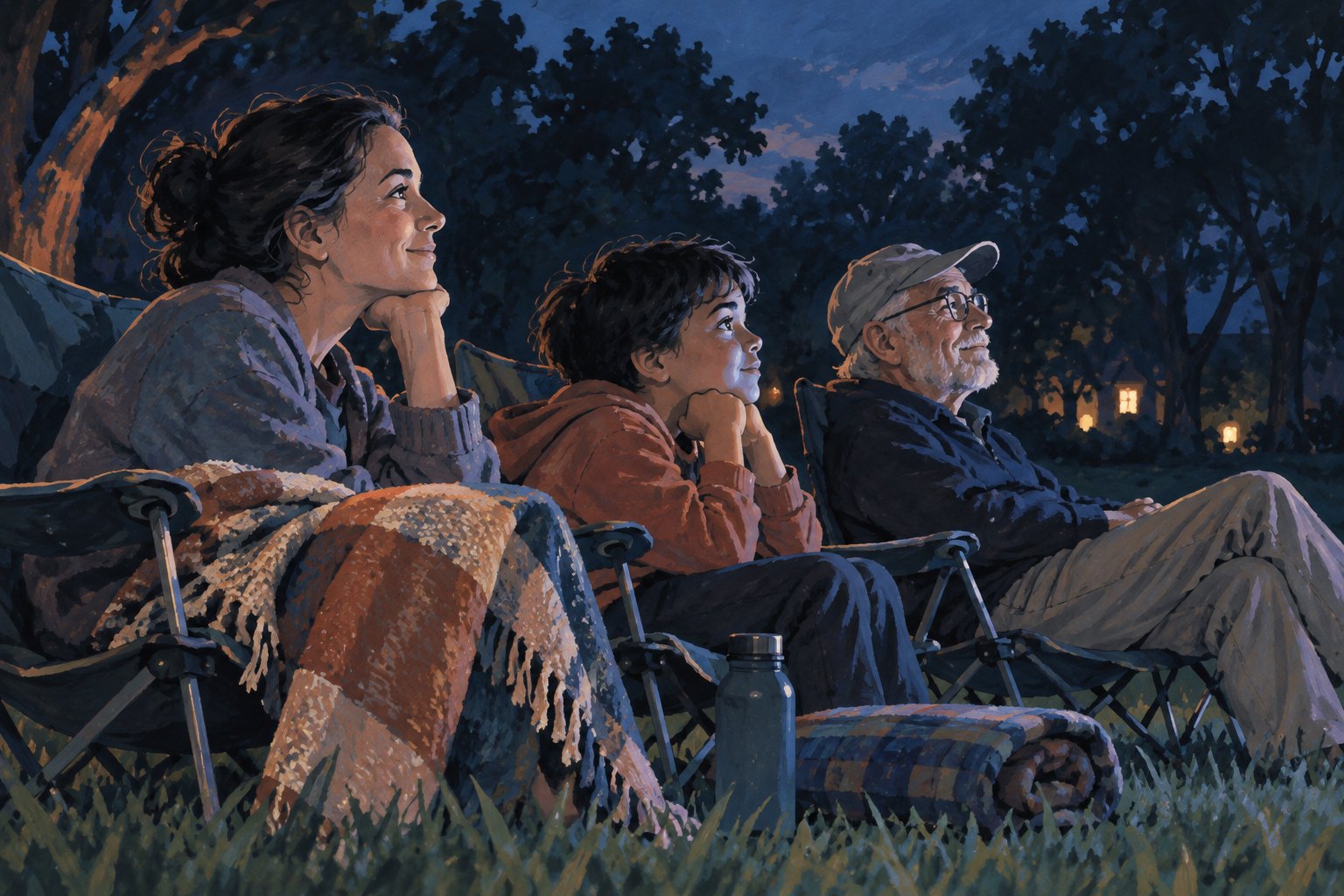
This is where the connection to Dollar Bank Cinema in the Park feels strongest. In my reading, neighborhood moviegoing offers a small version of Sally’s invitation: spend time in a shared place and give it your attention. The park becomes a destination for an evening, with a story providing the reason to stay.
Doc knows what applause cannot promise
Doc Hudson complicates the film’s warmth. His guarded behavior comes from experience: he was a celebrated racer, and his relationship with racing carries the hurt of being discarded. “They quit on me” compresses that disappointment into four words.
For McQueen, recognition seems like a permanent destination. Doc knows it can disappear. Their conflict is consequently more interesting than a wise elder correcting an arrogant youngster. Doc has knowledge to offer, but he also has resentment that interferes with his judgment.
Paul Newman’s restrained vocal performance gives that tension weight. Doc can sound authoritative without sounding emotionally secure. His eventual willingness to help McQueen matters because it requires him to become involved again, accepting the possibility of disappointment instead of protecting himself through distance.
The gap between a public identity and a private need also shapes our analysis of fame and individuality in A Hard Day’s Night. In Cars, Doc embodies the difficult question beneath the applause: who remains when the audience moves on?
The final race makes kindness cost something
The ending gives McQueen a real choice. After Chick Hicks causes the King to crash, McQueen stops short of victory and returns to help the damaged veteran finish. Chick wins the race.
That lost result is essential. A weaker ending could let McQueen demonstrate compassion while collecting the trophy anyway. Instead, the film makes his new priorities visible through a sacrifice. He can still compete brilliantly, but competition no longer decides everything.
The gesture also answers Doc’s history. McQueen cannot undo what happened to his mentor. He can recognize another racer’s vulnerability and refuse to treat it as a convenient opening. Learning becomes meaningful when it changes his response to someone else.
Our discussion of Bruce Wayne’s conscience and redemption raises a related critical test: does a character’s claimed transformation change what they actually do? Here, the answer is visible on the track.
Where the film’s comfort becomes a limitation
My reservation is that Cars makes community renewal reassuringly easy. McQueen’s attachment helps bring attention back to Radiator Springs, leaving the ending dependent in part on the celebrity the story has taught him to put in perspective.
That does not erase the emotional achievement, but it limits the film’s social argument. A neglected place should not need a famous admirer to prove its worth. Sally already understands that; the resolution is somewhat less confident about trusting it.
For a park audience, this tension creates a useful conversation after the credits. Does the town become valuable because McQueen notices it, or does he become wiser because he finally recognizes value that was already there?
An Easter egg—and a reason to look closer
One small visual joke rewards attention: McQueen’s Lightyear tires reference Buzz Lightyear, as Disney’s D23 explains. It is a playful detail rather than a hidden explanation of the plot, and it suits a film that gradually teaches its protagonist to notice his surroundings.
The deeper achievement of Cars is its shift from being admired to being accountable. McQueen discovers that belonging involves obligations, memory, and the willingness to interrupt your own progress for another person. That makes it a fitting selection for Dollar Bank Cinema in the Park: a story about learning to care where you are, watched in a place that becomes more meaningful when people spend time there together.
Original content by this site's editorial team. Published: September 23, 2026 at 08:16:06 PDT (Los Angeles time)