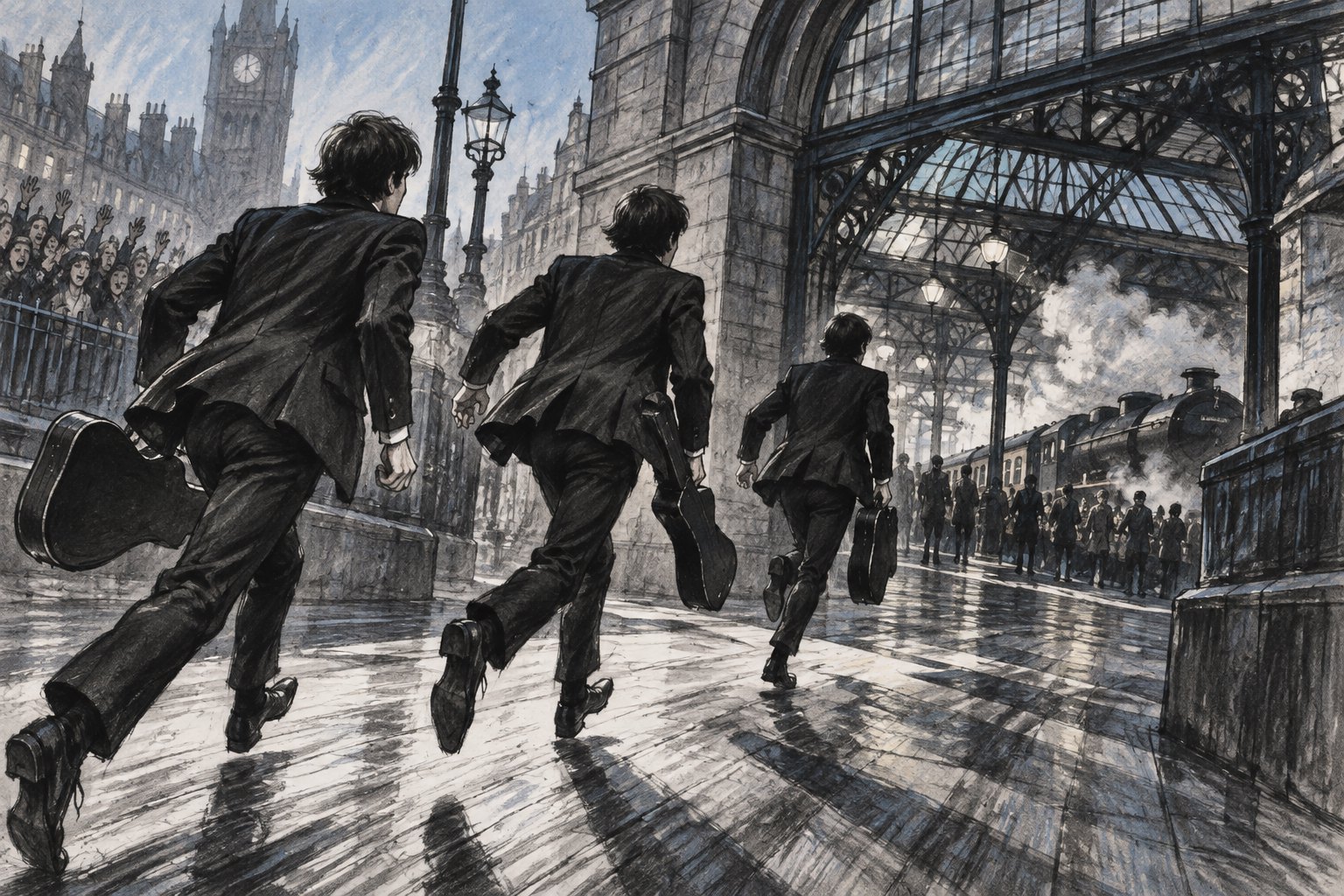
Barry Keoghan, Joseph Quinn and Harris Dickinson have been spotted filming a recreation of the opening of A Hard Day’s Night for a Beatles biopic, according to Variety. That is an intriguing sequence to revisit: the original introduces its stars by making them run. Before audiences can admire the Beatles, they see the practical problem of being the Beatles—getting somewhere when everybody wants a piece of you.
The report establishes a filming connection, not how the sequence will function in the finished biopic. It offers no basis for judging the actors’ performances or assuming that the recreation opens the new film itself. What it does provide is a compelling reason to reconsider the original and the peculiar freedom its characters find inside celebrity.
Spoilers follow for the 1964 film A Hard Day’s Night. Discussion of the biopic is limited to the reported filming; the critical judgments concern the original.
Why the opening chase still matters
The opening’s great achievement is making excitement and inconvenience occupy the same frame. Fans rush after the musicians, and the musicians rush away. The title song supplies exhilaration, but the bodies on screen have an immediate destination and a crowd to negotiate. Fame is already a physical condition.
Richard Lester’s staging makes that condition funny without explaining it away. The Beatles arrive as people reacting to pressure, rather than statues waiting for an admiring camera. The opening chase and the film’s later burst of outdoor freedom are also discussed in Criterion’s [essay on the original film](https://www.criterion.com/current/posts/3205-a-hard-day-s-night-the-whole-world-is-watching).
For my money, that is the essential challenge facing any recreation involving Keoghan, Quinn and Dickinson. Recognizable clothes and gestures can establish resemblance. The harder achievement is to make a familiar image feel uncertain again. A successful scene would let us register the immediate scramble before we congratulate ourselves for recognizing cinematic history.
A working day disguised as an adventure
The original’s narrative follows the group toward a television performance, with travel, supervision and interruptions complicating the journey. Paul’s grandfather adds trouble; Ringo’s disappearance threatens the schedule. The Beatles’ [official film overview](https://www.thebeatles.com/hard-days-night) identifies that combination of pursuing fans, press attention, family interference and an eventual television appearance.
Viewed from the characters’ perspective, this is a workplace comedy with unusually enthusiastic customers. Everyone needs the musicians somewhere else: on a train, in a room, at rehearsal, before a camera. Their apparent privilege comes with very little control over an ordinary afternoon.
That tension gives the comedy its shape. The men responsible for keeping everything moving are not irrational to want cooperation. Yet the film makes us feel the dullness of being continuously organized. The Beatles’ jokes become small acts of possession: somebody else may control the timetable, but they still control their responses.
John and George refuse the approved answer
John’s most efficient defense is to decline the premise of a question. Asked how he found America, he replies, “Turned left at Greenland.” The joke replaces a request for a marketable impression with a geographical direction. He participates in the interview while withholding the expected performance of grateful celebrity.
George achieves a related victory when he encounters an apparatus supposedly expert in teenage taste. His skepticism punctures its confidence. “Have I said something amiss?” works because his calmness makes the surrounding alarm look even more ridiculous. These exchanges appear in a [collection of the film’s dialogue and plot details](https://www.economia.unipd.it/sites/decon.unipd.it/files/AHardDaysNight.pdf).
Neither character needs an inspirational speech. John redirects a conversation; George fails to be impressed. Their individuality emerges through timing and resistance. That is a useful standard for a Beatles biopic: an audience should be able to distinguish the men through how they listen and respond, even before identifying a hairstyle.
The George scene also sharpens the movie’s satire. A business built around youth can become incapable of hearing an actual young person. His presence is welcome only while it confirms what the professionals have already decided.
Paul’s grandfather makes care inconvenient
Paul occupies a different comic position because his grandfather gives him a responsibility that cannot simply be escaped with a punch line. Family accompanies him into the professional world, making his status as a famous musician coexist with the less glamorous task of keeping track of a troublesome relative.
I find this one of the film’s smartest ways of resisting hero worship. Paul does not become more interesting because the story announces his importance. He becomes more approachable because importance fails to exempt him from inconvenience.
The grandfather also prevents the generational conflict from becoming too tidy. Older people are not all representatives of discipline. Here is an elder perfectly capable of creating disorder while others struggle to keep the young performers on schedule. Age and obedience have very little to do with each other.
Ringo discovers the limits of getting away
Ringo’s solitary excursion changes the emotional temperature. Encouraged by the grandfather to leave his book and experience life, he wanders away from the group. The canal-side interlude gives the film a quieter register, briefly replacing collective momentum with one person’s uncertain passage through an ordinary day.
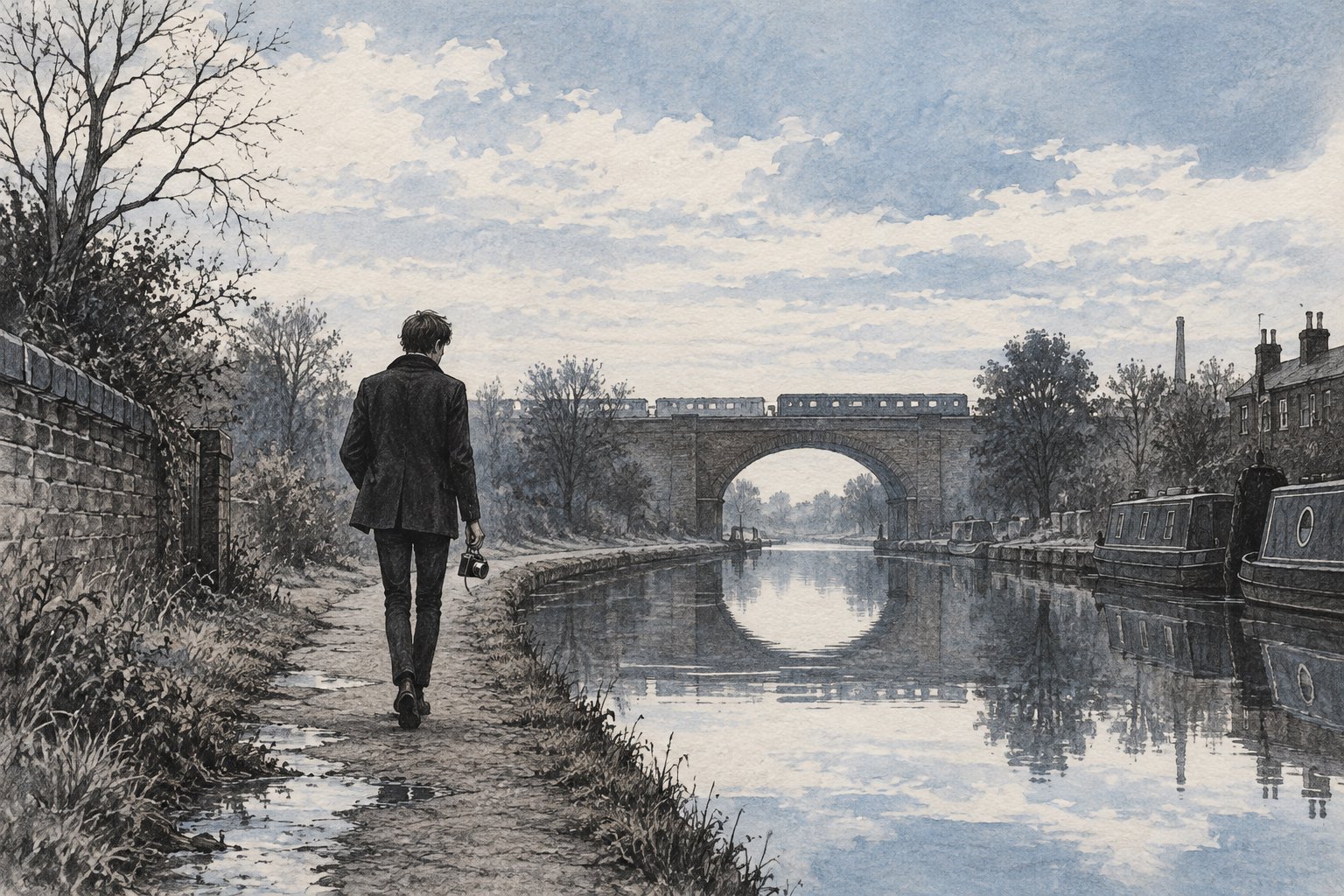
What moves me is that the escape does not instantly become fulfillment. Being left alone and feeling at home are different things. Ringo can step outside the machinery of celebrity without discovering a ready-made alternative to belonging to the band.
The landscape helps communicate that difference. Space can release a character from pressure, but it can also expose his isolation—a principle explored in our commentary on how filming locations shape character and belonging. Here, the quieter surroundings ask us to watch a person who no longer has three companions setting the rhythm beside him.
The performance restores connection, not complete freedom
The eventual television performance supplies the pleasure the story has repeatedly delayed. My reading is that the music gives the group a shared purpose that supervision alone cannot provide. Performing is work, but it is also where their coordination becomes expressive rather than merely logistical.
The audience matters to that resolution. Fans create pressure, yet their excitement also completes the performance. Reducing them to an obstacle would flatten the film’s central relationship. Our examination of what an audience’s emotional response can reveal considers a related distinction: feeling helps explain a performer’s public connection without telling the whole private story.
A small in-joke, and a larger challenge for the biopic
One background joke rewards a second look. The descriptions of the grandfather as clean play against Wilfrid Brambell’s association with Steptoe and Son, where his character was called a dirty old man. The reference is documented in the [Janus Films restoration press kit](https://s3.amazonaws.com/criterion-production/janus_promo_packages/811-/HDN_presskit_5-12-14_original.pdf). It is a casting joke rather than a hidden Beatles-history clue.
The deeper pleasure of A Hard Day’s Night is watching people remain unpredictable inside a system that needs them to be recognizable. That makes the reported recreation more than an opportunity for nostalgia. Keoghan, Quinn and Dickinson are revisiting an image whose energy comes from resistance to being fixed in place. The most rewarding new interpretation would preserve that restlessness: the feeling that these men still have somewhere to go, and something to say that nobody has prepared for them.
Original content by this site's editorial team. Published: September 20, 2026 at 17:38:22 PDT (Los Angeles time)