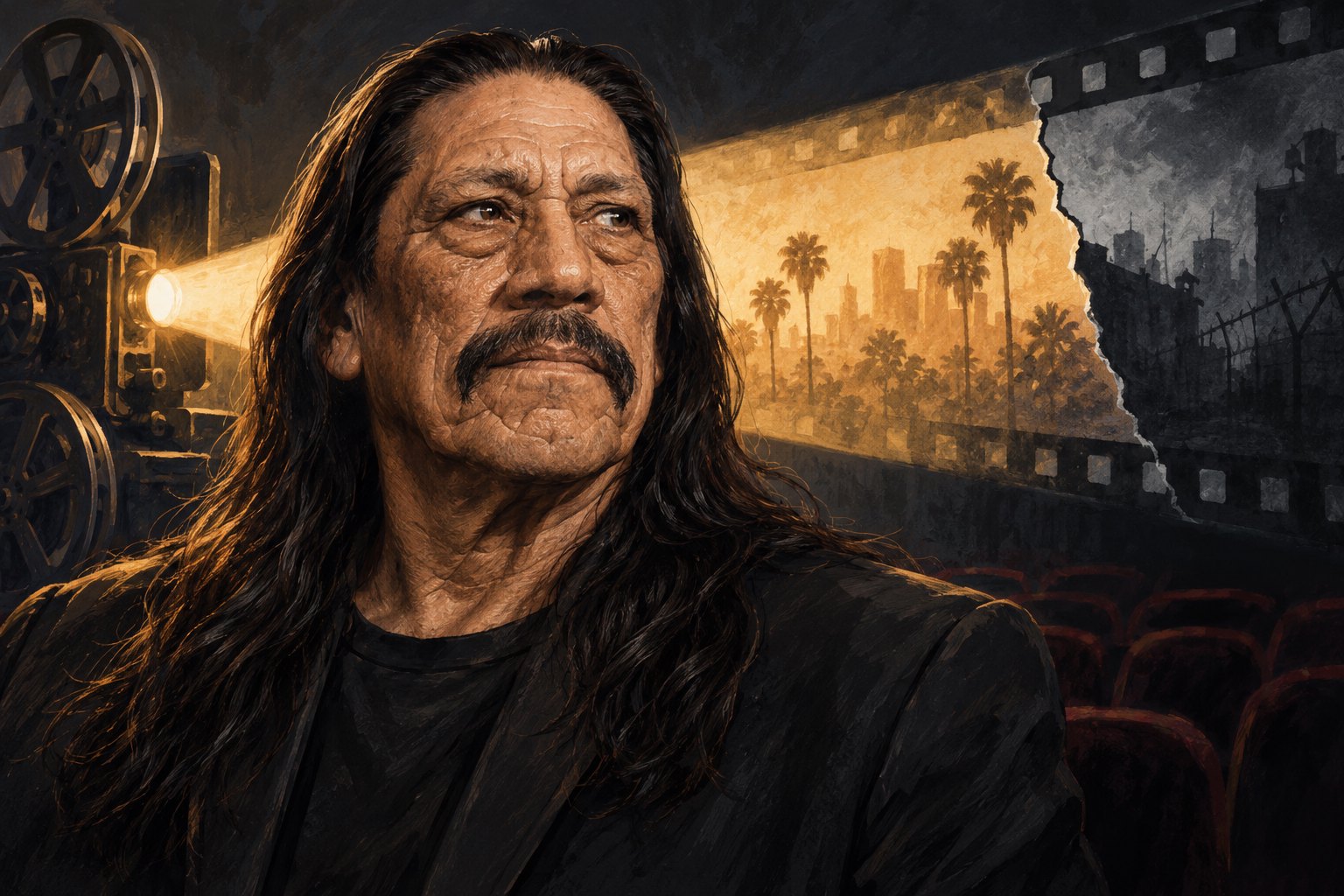
Danny Trejo says he is not pro-ICE after backlash over a Ben Shapiro movie, according to TMZ. His response addresses the immediate question about his personal position. It also leaves a separate, legitimate question for moviegoers: what does an actor’s participation contribute to a project whose associations have become part of the argument around it?
The distinction matters. Accepting a role does not automatically establish agreement with every idea connected to a production. At the same time, audiences can reasonably scrutinize professional choices without claiming access to an actor’s private convictions. Trejo’s denial deserves to be understood on its own terms; the artistic and ethical implications of participation require their own evidence.
This is film commentary about the controversy, rather than a review of the movie’s performances or completed story. It contains no plot spoilers.
What Trejo’s denial answers—and what it leaves open
The reported denial answers a question about Trejo’s stated politics. It should not be expanded into a detailed position on immigration enforcement, a repudiation of everyone involved in the movie, or an explanation of his contractual decisions. Those are different claims. A short public response cannot responsibly carry all of them.
Likewise, backlash is not proof that the inference prompting it was correct. An audience reaction can identify a real concern while overstating what a casting decision demonstrates. Someone can object to an actor helping a project reach viewers without establishing that the actor personally endorses its perceived message.
My view is that the most useful criticism begins with the choice and its consequences. Asking what Trejo’s involvement adds to the production is more productive than declaring his denial meaningless. It makes room for accountability while keeping the discussion anchored to something observable: participation.
Why a familiar actor’s presence carries meaning
Actors contribute more than dialogue and physical movement. Familiar faces bring expectations into a theater. Depending on the viewer, a performer can suggest toughness, humor, reliability, vulnerability, or a connection to earlier movies. Casting puts those expectations to work before the new character has done anything.
That helps explain why disputes about film participation can feel personal. A viewer may have attached affection or trust to a performer and then encounter a professional association that complicates that relationship. The feeling can be sincere even when the conclusion drawn from it needs qualification.
In Trejo’s case, the important analytical question is whether viewers are judging his stated beliefs, his decision to participate, or the meaning they expect the film to communicate. Those judgments may overlap, but they do not require identical evidence. His response bears directly on the first. The second concerns his work. The third ultimately requires attention to the movie.
Celebrity familiarity also creates a temptation to fill gaps with assumptions. Our discussion of the limits of interpreting a public figure’s response considers a related editorial problem: recognition does not give an audience complete knowledge of the person speaking.
The character’s viewpoint is where criticism should get specific
A serious assessment of the movie’s politics would need to examine how it organizes sympathy. Which character gets an interior life? Whose fear becomes suspense? Who receives an opportunity to explain a decision, and who appears only as an obstacle? These are concrete questions about storytelling, not shortcuts based on the cast list.
For Trejo’s performance, the relevant inquiry would begin with the character’s goals and choices. Does the character act independently, challenge another person’s account, or exist mainly to confirm someone else’s righteousness? Does the film allow uncertainty to remain, or make every conflict resolve in favor of a predetermined judgment? Without established scene-level evidence, assigning any of these functions to his role would be speculation.
Character dialogue also needs context. A forceful speech can express a character’s belief without representing the movie’s final judgment. Another scene may contradict it. A reaction shot can undermine it. Consequences can expose its limitations. That is why quoting an isolated line—even a memorable one—is a weak substitute for examining the dramatic structure around it.
No dialogue is reproduced here as evidence of the film’s position. The same standard applies to purported hidden references or Easter eggs: interpretation needs something identifiable on the screen.

Performance, authorship, and endorsement are different contributions
Acting requires inhabiting perspectives a performer may not share. That is a basic condition of dramatic work. Treating every role as autobiography would make it difficult to discuss performances of cruelty, fanaticism, cowardice, or moral confusion with any precision.
Still, the distinction between actor and character does not answer every objection to taking a job. A performance helps bring a production into existence. A recognizable name may help attract attention. Viewers are entitled to consider those contributions when deciding whether to support a project.
The stronger argument therefore avoids both automatic absolution and automatic identification. Trejo’s personal position can differ from what audiences believe a production represents, while his involvement can remain a reasonable subject of criticism. Accepting the possibility of that difference does not settle the ethical question; it makes the question more accurate.
Nor does an association with Shapiro, by itself, establish how every scene functions. The surrounding controversy can guide questions a critic asks, but it cannot supply answers about editing, characterization, pacing, or dramatic credibility. A review still has to demonstrate its conclusions.
How viewers can assess the controversy without losing the movie
For readers deciding what to make of Trejo’s response, three distinctions offer a practical starting point:
- Separate statements from inferences. His reported denial establishes his stated position. Claims about hidden motives require additional evidence.
- Separate participation from total creative control. Taking a role is a meaningful choice, but it does not establish responsibility for every production or storytelling decision.
- Separate a viewing decision from a review. You can decline to support a project because of its associations without claiming to have evaluated its artistic execution.
That last distinction protects the reader as much as the filmmaker. A useful review explains what a movie does and how it does it. A statement of personal support or opposition serves a different purpose. Both can be expressed clearly without borrowing authority from the other.
Our commentary on what makes a film’s explanation convincing approaches the same critical principle from another direction: a strong reaction should lead to closer examination of the argument, its evidence, and its omissions.
The deeper issue is who controls a performance’s meaning
The Trejo controversy exposes a tension built into filmmaking. An actor can explain personal intentions, but cannot dictate everything audiences take from a performance. Filmmakers shape those meanings through context; viewers bring their own experiences and expectations. Publicity and controversy add another layer before the viewing even begins.
My judgment is that Trejo’s denial should be heard clearly, while his professional choice remains open to specific criticism. Neither requires pretending to know more than the evidence supports. The eventual artistic question is more demanding than whether a familiar actor appears in a disputed project: does the film give its characters enough humanity and independence to test its ideas, or merely use them to deliver conclusions?
That question can only be answered through the work itself. It is also where film criticism can contribute something that the backlash alone cannot.
Original content by this site's editorial team. Published: October 10, 2026 at 12:35:56 PDT (Los Angeles time)