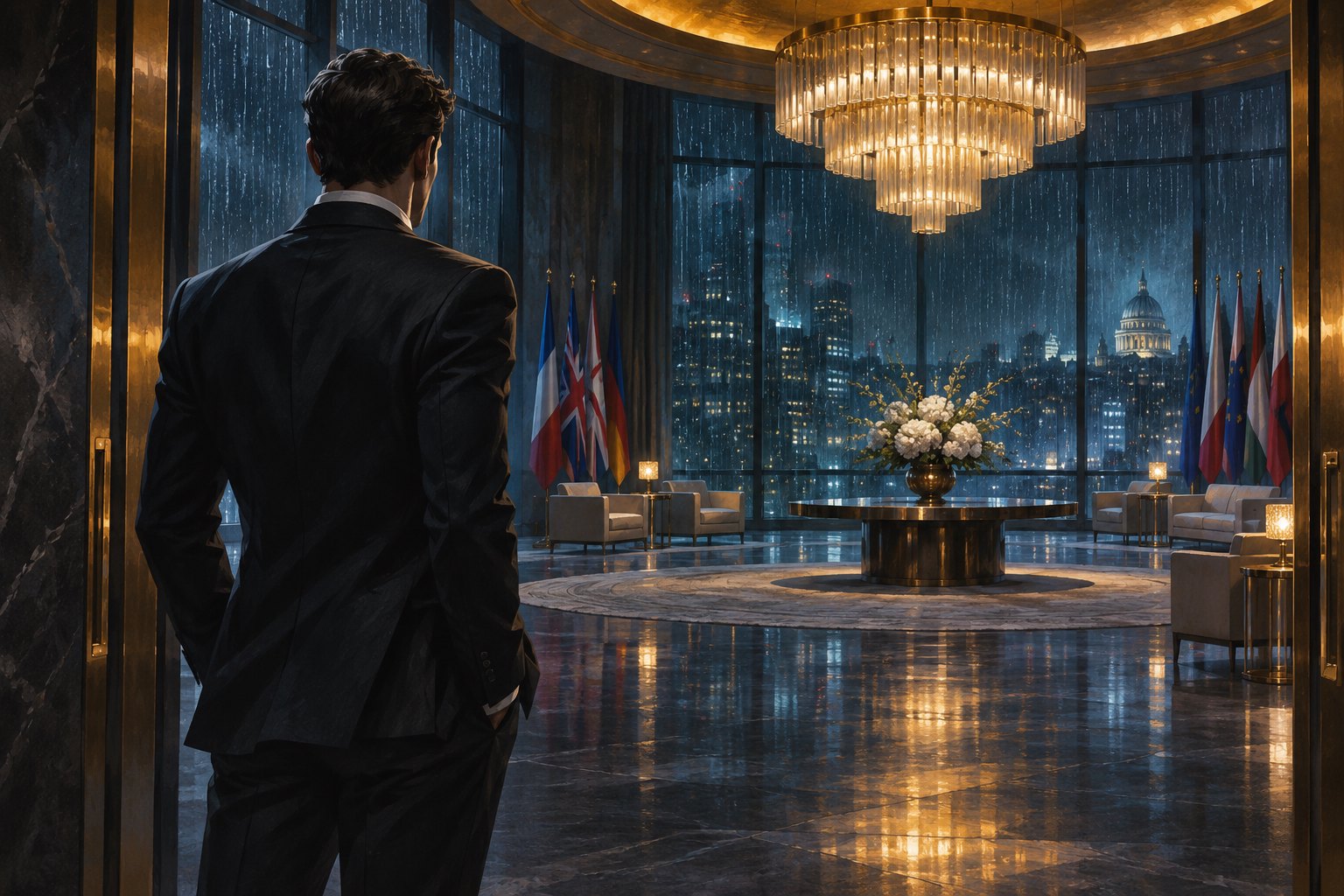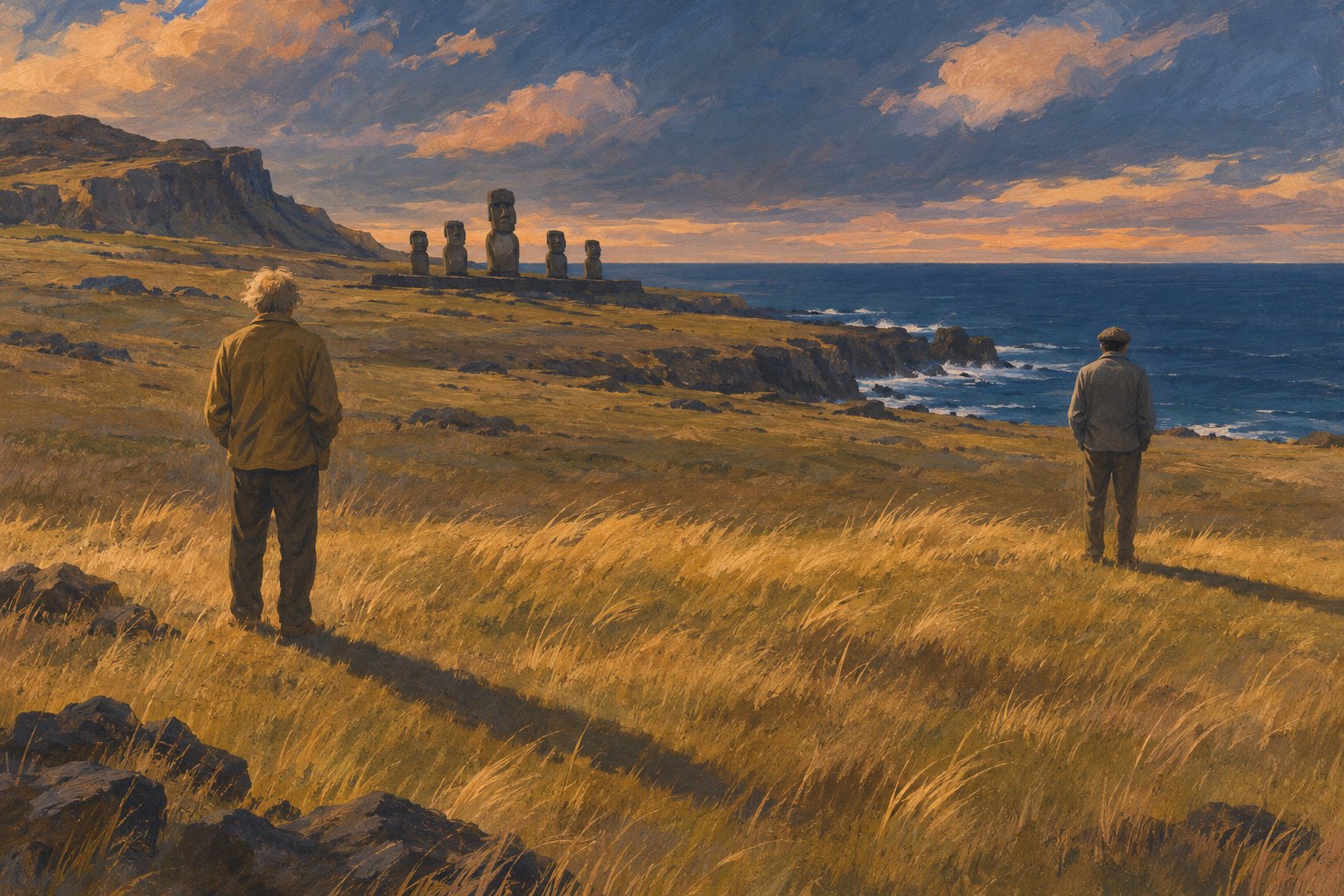
Wild Horse Nine puts a difficult question inside a friendship: what does loyalty mean when the person you love has done terrible things? Martin McDonagh’s dark comedy follows CIA partners Chris and Lee to Easter Island, where professional secrecy collides with personal vulnerability. Its most provocative subject is the temptation to mistake affection for moral innocence.
John Malkovich plays Chris, Sam Rockwell plays Lee, and Steve Buscemi plays their bureau chief, MJ. Searchlight identifies McDonagh as writer and director and lists November 6, 2026, as the theatrical release date. The story unfolds shortly before the 1973 Chilean coup. [Searchlight’s official film information](https://www.searchlightpictures.com/wild-horse-nine)
Spoiler notice: This analysis discusses illness, coercion, religious themes, and a late-film conversation. It draws on documented scenes and published dialogue; it does not offer a firsthand assessment of the complete film’s performances or editing.
Chris: A Man Who Wants to Control His Final Account
Chris is terminally ill and has decided to write his memoirs. For MJ, an experienced operative becoming indiscreet represents a threat. For Chris, the same impulse suggests a struggle over who gets to tell his story. John Mulderig’s Catholic Review account establishes that conflict and describes Lee as both Chris’s colleague and closest friend. [Catholic Review’s review](https://catholicreview.org/movie-review-wild-horse-nine/)
My reading is that the memoir matters because confession and self-justification can look remarkably similar. A person can disclose wrongdoing while still arranging every detail around his own importance. Remembering victims is different from remembering oneself as the man who decided their fate.
That distinction gives Chris’s situation its sting. Illness makes his vulnerability immediate, but vulnerability does not automatically produce honesty. An audience can feel compassion for his fear without accepting his preferred version of his life. The useful question is whether he wants to acknowledge what happened or retain authorship over what it means.
From Chris’s perspective, speaking may feel like freedom after years of professional concealment. From everyone else’s perspective, his words carry consequences he cannot simply declare finished. His story belongs partly to the people whose lives his work altered.
Lee: When Caring Becomes Another Assignment
AFI’s account describes the partners as facing surveillance from their own institution, with regret and mortality shadowing their journey. That makes their companionship structurally unstable: the organization that employed them also watches them. [AFI’s film description](https://fest.afi.com/2026/special-screenings-2026/wild-horse-nine/)
Lee therefore occupies the story’s most uncomfortable position. He has personal knowledge of Chris that no superior can reproduce, yet that intimacy makes him useful to the institution. Knowing how to reassure someone also means knowing where he is vulnerable.
For me, this is where the premise becomes more interesting than a conventional betrayal thriller. A betrayal usually marks the moment when trust breaks. Here, trust itself can become a means of control. The companion who understands your habits is also the person best positioned to manage you.
The distinction between supporting someone and protecting his excuses is worth watching throughout their exchanges. Our discussion of destructive loyalty in Basket Case approaches a related problem: devotion can be emotionally sincere while helping harm continue.
Faith and the Search for an Exception
Chris’s Catholicism complicates his fear of death. Catholic Review reports that he asks Lee to kill him so that he can avoid a prolonged decline without committing suicide himself. The request exposes a disturbing separation between the act he wants and the responsibility he hopes to escape.
My interpretation is that Chris approaches conscience with habits learned from delegated violence. He looks for a procedure that will make the outcome permissible. Yet moving an action into another person’s hands does not remove his participation in it.

Another exchange compresses the emotional problem into a few words. One character calls the island a “lonely place to die”; the reply is “lonely everywhere to die.” Those lines are documented in Plugged In’s scene account. [Plugged In’s review](https://www.pluggedin.com/movie-reviews/wild-horse-nine-2026/)
The response refuses the comfort of relocation. Beautiful surroundings cannot perform the work of reconciliation. Read through Chris’s anxiety, the island offers distance from familiar obligations without guaranteeing distance from himself. That makes the religious imagery more interesting as a source of unresolved pressure than as a promise that forgiveness has already arrived.
The Students Interrupt the Agents’ Private World
The official synopsis identifies Chris’s developing bond with two rebellious students, played by Mariana di Girolamo and Ailín Salas, as a destabilizing element of the trip. Their presence matters because the agents’ relationship could otherwise become a closed conversation: two professionals explaining themselves to someone who already understands the rules.
An outsider can interrupt that comfortable shorthand. Terms such as duty, necessity, and national interest sound different to someone expected to live with their consequences. My reading of this dramatic arrangement is that Chris encounters a perspective his professional friendships allow him to evade.
There is also a critical test here. Young people should have interests beyond helping an older man feel redeemable. A sympathetic encounter becomes morally thin if its only function is to improve the protagonist’s self-image. The richer question is whether he can recognize a future that matters independently of his own impending absence.
That attention to whose understanding shapes a story connects with our analysis of perspective in spy-film storytelling. Access to an agent’s thoughts creates intimacy; it need not establish that his account is sufficient.
The Horse’s Perspective Changes the Question
In a late conversation reported by the Associated Press, Chris proposes a Western told from a horse’s perspective. Lee answers, “There’s no way I’m seeing that Western.” [Associated Press review](https://apnews.com/article/0b906f9c404fb6da854bc9d4675b72a2)
I read the joke as a challenge to the audience’s own attention. A familiar adventure changes when its viewpoint shifts toward a creature that carries people through danger without deciding the destination. The rider’s courage may no longer be the central fact. Exposure, exhaustion, and powerlessness become visible.
Applied to Chris and Lee, that shift asks us to look beyond the fascination of damaged professionals. Their friendship deserves scrutiny and may invite compassion, but the people affected by their work cannot be reduced to background material for their regrets.
Remorse Is a Beginning, Not a Settlement
The strongest interpretive approach to Wild Horse Nine is to keep tenderness and accountability in view together. Chris’s fear can be real. Lee’s attachment can be real. Neither feeling settles what they owe other people.
That is the deeper tension beneath the comic exchanges: becoming frightened of judgment is not the same as becoming responsible. The meaningful measure of change is whether a person finally allows another life to matter beyond its usefulness to his own story. Read that way, the film’s central friendship becomes a demanding moral question rather than an automatic argument for forgiveness.
Original content by this site's editorial team. Published: November 16, 2026 at 14:27:00 PST (Los Angeles time)