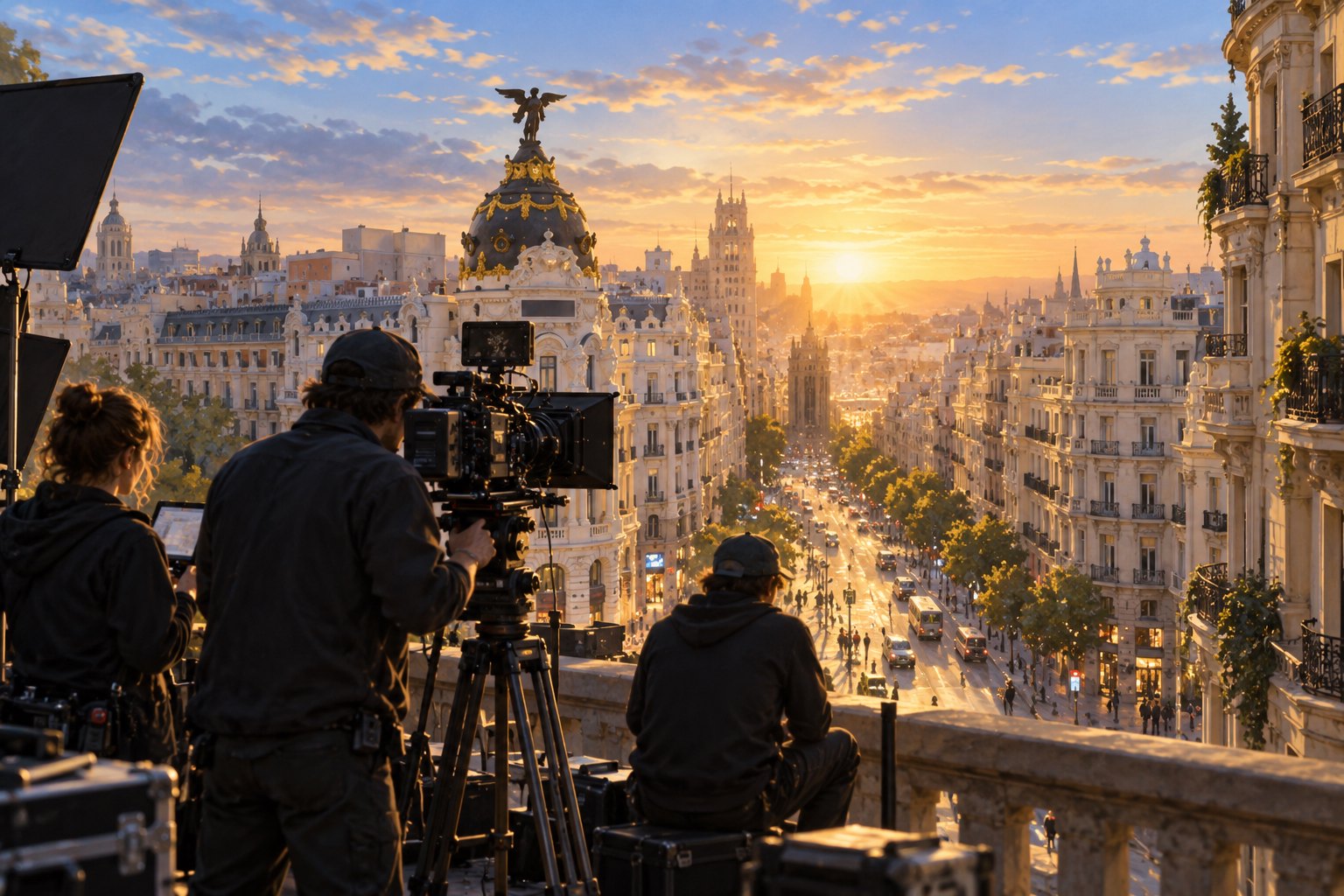
Madrid’s appeal to filmmakers involves more than a handsome skyline. A city must accommodate the work behind the image: equipment, street access, schedules, and the coordination that allows a scene to happen. The Hollywood Reporter’s coverage of Woody Allen and other prominent filmmakers shooting in Spain’s capital brings that relationship into focus. Madrid is attracting attention as both a filming destination and a potential subject.
The record has a specific meaning. Madrid Film Office estimates that the city hosted at least 71 feature films in 2025, exceeding the previous benchmark of 47 in 2022. Its annual account also records more than 4,115 support services for productions. These are indicators of production activity and institutional involvement, rather than ticket sales or critical acclaim. [Madrid Film Office’s annual production account](https://madridfilmoffice.com/en/madrid-consolidates-its-leadership-as-a-filming-location-with-71-feature-films-shot-in-2025/)
For moviegoers, the interesting question comes after the location decision: what will filmmakers do with Madrid once the cameras arrive? This is production commentary, not a review of Allen’s forthcoming film. A shooting location cannot establish a movie’s plot, dialogue, performances, or quality.
What Madrid’s filming record actually tells us
A feature-film count measures how many projects used a city for filming. It does not establish that every production shot there from beginning to end, that every story takes place there, or that every finished movie prominently identifies its locations. Those distinctions matter when a city’s production success becomes an entertainment headline.
The increase nevertheless points to a broader base of activity than one famous director’s arrival. Allen provides a recognizable name through which readers can approach the story, but a record built across many films cannot be explained by his presence alone. The more useful subject is the relationship between individual productions and a city capable of receiving them.
There is also a difference between attracting a shoot and earning a lasting place in film culture. The former can be counted when production takes place. The latter depends on what audiences eventually see and remember. A street becomes memorable because something happens there: a decision, a betrayal, a reunion, or an awkward silence that changes a relationship.
Why practical support matters as much as scenery
The support-services figure helps explain why Madrid’s appeal deserves to be discussed in practical terms. It documents activity behind the scenes, although it does not tell us why any particular director chose the city. Assigning a single motive—cost, weather, architecture, or personal affection—to every filmmaker would oversimplify a decision that can involve competing needs.
Consider a hypothetical conversation filmed on a busy sidewalk. The creative requirement might be simple: two actors walking without interruption. The production requirement is considerably more demanding. The crew needs workable access, usable sound, consistent light, and enough control to repeat the movement. A beautiful location becomes valuable when the production can actually make the intended scene there.
That is why a functioning production destination offers something different from a collection of attractive views. For filmmakers, practical confidence can create room for creative decisions. Time spent resolving avoidable logistical problems is time unavailable for another performance, a different camera position, or a more ambitious sequence.
This is an explanation of how location decisions can work, rather than a claim about Allen’s private reasoning. Our coverage of Allen’s new film, its cast, and its sales announcement addresses the project itself. Madrid’s production story asks a separate question: what can the place contribute beyond making the shoot possible?
A city becomes dramatic through its characters
My critical preference is for films that let geography affect behavior. A location earns its place when it changes how someone moves, what they notice, or what they can conceal. Recognizable architecture can establish a setting in seconds; character experience gives that setting emotional meaning.
Imagine two fictional people on opposite sides of a balcony threshold. One has the security of a private room. The other waits in public, visible to passersby. Before either speaks, the arrangement establishes an imbalance. Who is being admitted? Who must wait? Who can end the encounter simply by stepping back?

That imagined situation is not a scene from Allen’s film. It illustrates the standard by which a Madrid setting could be assessed: does the physical space participate in the drama? An apartment, a doorway, or a crowded pavement can communicate intimacy and exclusion more precisely than a sequence of sweeping skyline shots.
A visitor and a resident might also experience the same street differently. The visitor sees possibility; the resident remembers an argument or calculates the time needed to get home. A film can make those perspectives coexist through framing, duration, and performance. The city then acquires meaning through the people occupying it.
Distance is especially useful. A wide shot can make someone appear free, isolated, or exposed, depending on what the scene has established. Our analysis of distance in Cameron Winter at Carnegie Hall explores a related question about how space shapes intimacy. In an urban narrative, the relationship between a person and their surroundings can carry just as much weight.
When a beautiful location becomes a distraction
The risk for a highly visible filming destination is that recognition becomes the scene’s main event. The camera pauses to admire a view, but the characters gain nothing from being there. A location may look magnificent while contributing little to the story’s movement.
Beauty itself is not the problem. A romantic film can make a city seductive because its protagonist is susceptible to that seduction. A comedy can use an elegant setting to sharpen someone’s embarrassment. The issue is whether the image expresses a perspective or merely interrupts the action to present an attraction.
For viewers assessing a Madrid-set film, three questions offer a useful starting point:
- Whose experience controls the view? Notice whether the camera shows what a character values, fears, or overlooks.
- Does the location change the encounter? Look for ways that access, noise, crowds, or distance affect what people can do.
- Does returning to a place reveal a change? The same street can feel different after a relationship breaks down, even when its appearance stays identical.
The achievement beyond the record
Madrid’s production record establishes an industrial achievement. Its artistic significance will emerge film by film. Celebrity participation can draw attention, but the lasting test is whether those productions allow the city to become specific, inhabited, and emotionally consequential.
For Allen and the other filmmakers associated with this story, that is the compelling possibility. Madrid can supply more than somewhere attractive to stand. It can give characters places to belong, places they cannot enter, and familiar corners they no longer know how to face. When a film makes those distinctions matter, a location survives in the audience’s memory as part of a life.
Original content by this site's editorial team. Published: October 2, 2026 at 03:05:22 PDT (Los Angeles time)