Ray Tintori, the music video director and filmmaker whose work included videos for MGMT and Arcade Fire and a contribution to Beasts of the Southern Wild, has died at 43, according to Variety. He died in New York. The New York City Office of Chief Medical Examiner said his death remains under investigation and the cause is unknown.
Those facts deserve to stand without speculation. For viewers encountering his name through this news, they also provide an entry into a career that crossed music videos and feature filmmaking—forms that can make an invented world feel immediate through rhythm, texture, and unexpected images.
One meaningful way to remember a filmmaker is to return attentively to the work. In Tintori’s case, Beasts of the Southern Wild offers that opportunity, provided the distinction between contribution and authorship remains clear: Benh Zeitlin directed the film, which he wrote with Lucy Alibar. Tintori worked on it; the movie’s individual creative decisions should not automatically be attributed to him.
A remembrance grounded in the work
A list of collaborators can establish professional reach, but it cannot substitute for looking closely. Music videos and feature films ask different things of an audience. A video can build an entire emotional landscape within a song; a feature must allow that landscape to develop through choices, relationships, and consequences.
That connection makes Beasts of the Southern Wild a particularly rewarding film to revisit here. Its imagery invites wonder, yet its strongest passages draw their force from a child’s attempt to understand an unstable parent and a threatened home. The spectacle matters because someone needs it to mean something.
Spoiler warning: The following review discusses Hushpuppy’s relationship with her father, the aurochs, and the film’s ending.
Hushpuppy sees a world that adults cannot explain
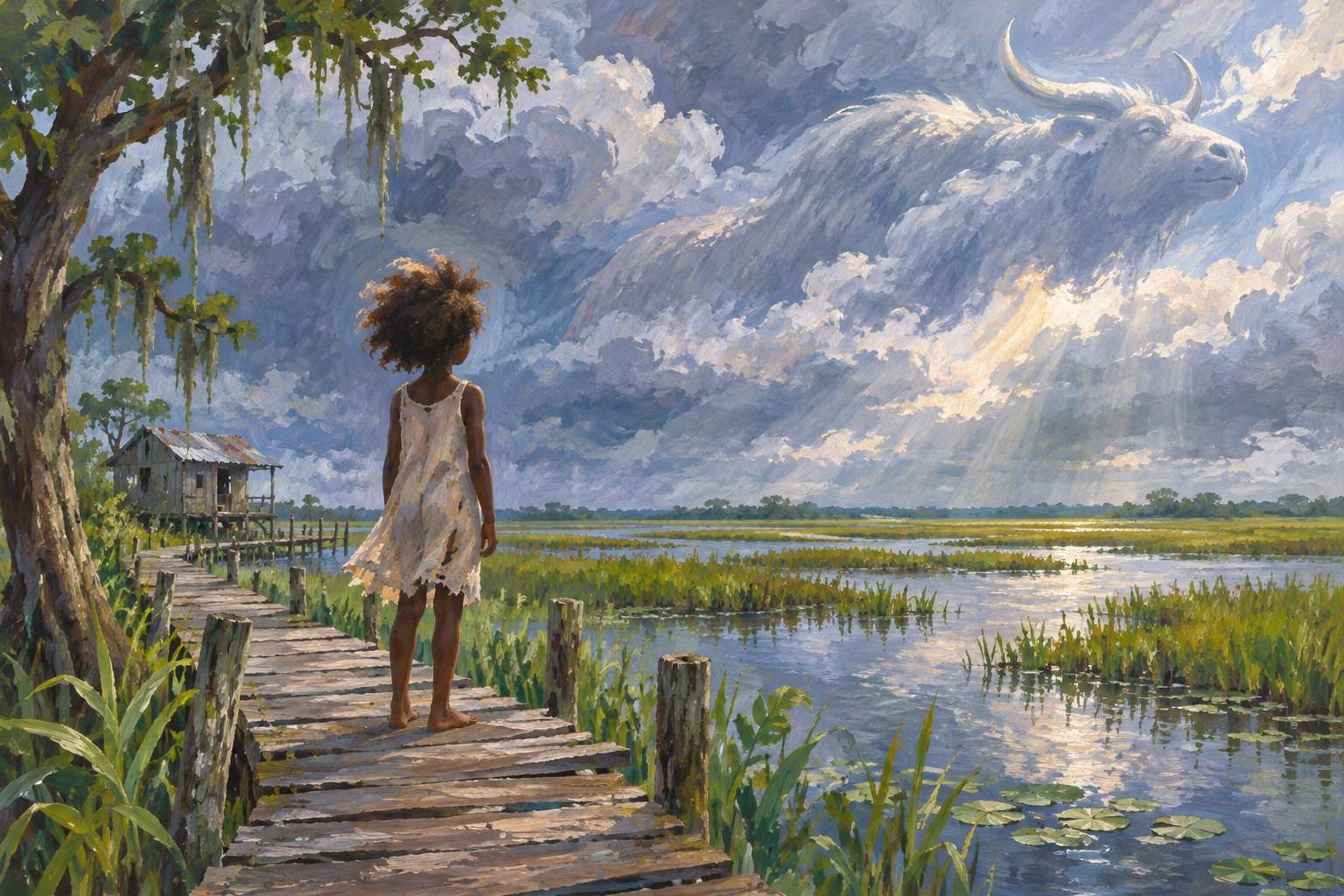
Hushpuppy, played by Quvenzhané Wallis, lives with her father, Wink, played by Dwight Henry, in the isolated bayou community known as the Bathtub. A storm threatens their home while Wink’s failing health threatens the relationship around which she has organized her life. Environmental danger and private fear become almost impossible for her to separate.
What makes her perspective compelling is its mixture of observation and invention. She listens to living creatures and searches for connections. She is trying to understand how bodies work, why people disappear, and whether the world has rules she can learn. Her imagination supplies explanations where adult communication fails.
To my eye, this is the film’s most persuasive achievement. Hushpuppy’s voice does not simply decorate the landscape with poetic language. It shows the labor of a child making a usable picture of reality from incomplete information. The world feels enormous because she has been given so little help interpreting it.
There is also a painful limit to that resourcefulness. When a child believes everything is connected, she can mistake proximity for responsibility. A parent’s distress can feel like something she caused or must repair. The film’s cosmic scale becomes intimate: saving the world and keeping her father are emotionally adjacent tasks.
Wink’s love carries a frightening demand
Wink believes survival requires toughness. His parenting turns ordinary encounters into tests of strength, and his fear often arrives disguised as anger. From his perspective, preparing Hushpuppy for a world without him is an urgent responsibility. From hers, the preparation can feel like another form of danger.
The film is strongest when those perspectives remain in tension. Understanding his terror does not make his behavior harmless. Hushpuppy needs practical knowledge, but she also needs reassurance, consistency, and permission to be afraid. His determination to make her self-sufficient can deny her the care that would help her feel secure.
Henry’s performance gives that contradiction weight. Wink’s physical insistence on authority exists alongside a body that cannot sustain it. His confidence becomes increasingly difficult to separate from desperation. The father who wants to appear indestructible is also a man struggling to face what his daughter will lose.
That distinction between protective intention and emotional consequence also runs through our analysis of Katniss’s protective instincts. In both stories, survival becomes dramatically interesting when it costs the person doing the protecting something they cannot easily name.
The Bathtub is a home, not an easy answer
The Bathtub’s communal energy gives Hushpuppy reasons to love her surroundings. Its gatherings, improvised structures, and shared defiance make belonging visible. The film understands that a place can be materially precarious and emotionally indispensable at the same time.
My reservation is that its exhilaration sometimes makes deprivation look too beautiful. Resourcefulness deserves recognition, but hardship does not become desirable because people answer it creatively. Viewers can admire the community’s bonds while questioning the conditions under which those bonds must function.
The same tension shapes the characters’ resistance to leaving. Safety, viewed from outside, may seem like a straightforward matter of relocation. From within Hushpuppy’s experience, departure threatens the relationships and routines that tell her who she is. The film makes that resistance comprehensible without resolving every question it raises about adult responsibility.
This is where the movie rewards a more demanding response than uncomplicated admiration. Loving a home need not mean believing that everything about life there should remain unchanged. Hushpuppy’s attachment is emotionally convincing even when the adults’ decisions invite scrutiny.
The aurochs give fear a shape
The enormous aurochs bring the film’s imaginative logic into view. Their approach gives physical scale to forces Hushpuppy cannot control: upheaval, vulnerability, and the prospect of losing Wink. They make dread something she can eventually stand before.
When she tells an aurochs, “You’re my friend, kind of,” the qualification matters. She does not erase the creature’s strangeness or pretend danger has become comfortable. She finds a relationship to it. For me, the moment works because courage emerges as recognition rather than invulnerability.
Her next declaration, “I gotta take care of mine,” shifts the emphasis from confrontation to obligation. The dramatic destination is care. She turns toward her father with an understanding of strength that is gentler than some of the lessons he has taught her.
Our reading of Bruce Wayne’s changing idea of strength considers a related distinction: an imposing image becomes meaningful when it changes what a character does for another person.
What remains after the spectacle
The deepest movement in Beasts of the Southern Wild is Hushpuppy’s passage from trying to control catastrophe to learning how to meet loss without abandoning connection. Her father dies. Imagination cannot reverse that fact, but it helps her give experience a form she can carry.
That is why I find the film moving even where its romanticism troubles me. Its images do more than announce wonder. They express the distance between what a child can endure and what she can explain. The ending leaves her with a voice and a community, while allowing the absence at its center to remain an absence.
Returning to the film after the news of Tintori’s death should not turn its story into a prediction about his life. It offers something more grounded: an occasion to notice the collaborative work behind an unforgettable screen world. His reported death leaves questions that should remain unanswered until there are facts. The work invites a different response—attention to what was made, how it feels, and why viewers continue to carry it with them.
Original content by this site's editorial team. Published: November 16, 2026 at 18:36:38 PST (Los Angeles time)