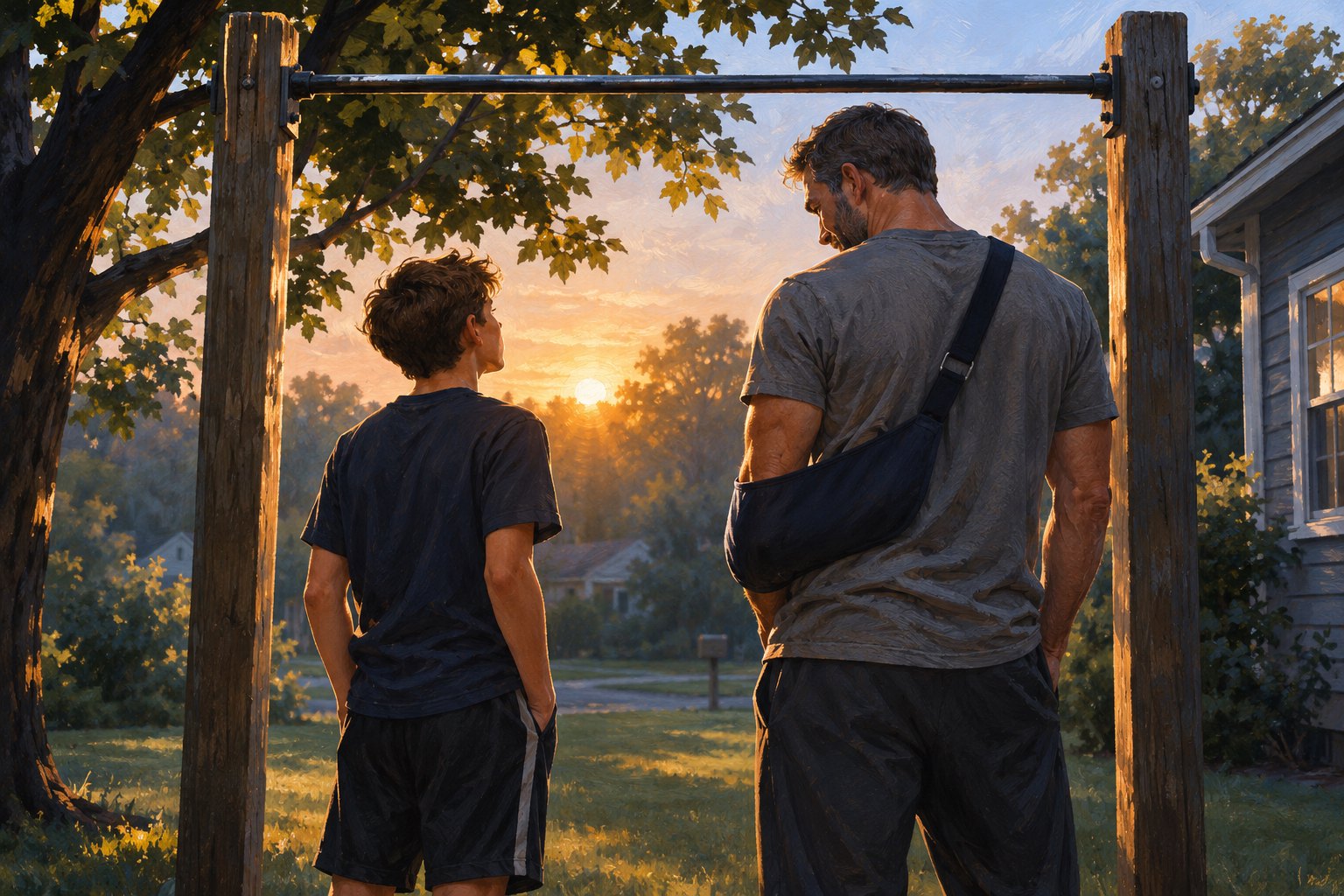
Chris Pratt’s Way of the Warrior Kid has a more interesting conflict than its inspirational premise initially suggests. A bullied boy needs to discover what he can do; his injured uncle needs to accept what he temporarily cannot. Those journeys could produce a moving account of mutual dependence. The problem is that the story’s spectacular demonstration of courage threatens to overwhelm its quieter argument for compassion.
Pratt plays Jake opposite Jude Hill’s Marc, with Linda Cardellini as Marc’s mother, Sarah. McG directs Will Staples’ adaptation of Jocko Willink’s novel. Apple lists its streaming release as November 25, 2026, and describes Jake’s summer training program as an education in courage rather than simply fighting. [Apple’s official film information](https://www.apple.com/tv-pr/originals/way-of-the-warrior-kid/)
Spoiler warning: This character-focused analysis discusses the training, emotional turning points, and ending. Plot details and dialogue are drawn from published accounts; the interpretations below are our own.
Marc’s Real Opponent Is the Identity He Has Accepted
Marc’s predicament extends beyond being physically outmatched. He struggles at school, feels socially inadequate, and approaches change as something that happens to other people. Jake’s arrival introduces a different possibility: skills can be learned, and present limitations need not become permanent definitions.
“I don’t think I’m ever gonna change,” Marc says. That line, documented in Paul Asay’s review, identifies the emotional problem more clearly than any exercise routine. Marc has begun treating his unhappiness as evidence about who he is. Even his embarrassment about Jake’s visit reflects the fear that someone impressive will confirm his worst opinion of himself. [Paul Asay’s account of Marc’s dialogue and circumstances](https://www.pluggedin.com/movie-reviews/way-of-the-warrior-kid-2026/)
From Marc’s perspective, a training program offers something unusually reassuring: a task with an answer. Friendship and acceptance are unpredictable. Practice promises a relationship between effort and improvement. That makes the premise emotionally understandable without making physical transformation a complete solution.
The distinction matters. A child can benefit from becoming stronger while already deserving safety and respect. Any reading of Marc’s progress should preserve that starting point. Otherwise, an encouraging story risks implying that the original version of the boy was the problem.
Jake Can Teach Discipline More Easily Than He Can Accept Limits
Jake’s authority comes with an internal contradiction. He can offer Marc structure, but his own recovery requires patience that determination cannot replace. Zachary Lee’s review describes his eagerness to return to service despite medical and professional resistance, alongside a performance that frequently retreats into motivational sayings. [Zachary Lee’s review](https://www.rogerebert.com/reviews/way-of-the-warrior-kid-chris-pratt-apple-tv-film-review-2026)
“Discipline equals freedom” is the film’s compact statement of Jake’s philosophy. Applied to practice, it makes sense: developing a skill can expand your choices. Applied to injury, however, it needs qualification. Sometimes discipline means stopping, accepting assistance, or allowing recovery to proceed without treating every delay as a personal defeat.
That tension gives Pratt’s role its most promising dimension. Jake is a mentor whose advice should also confront him. If Marc must learn that difficulty does not prove inadequacy, Jake must learn that usefulness does not disappear when his body refuses an assignment.
The dramatic opportunity is reciprocity. Marc should eventually be able to offer something Jake lacks, rather than merely become a smaller version of him. This is where the relationship can grow beyond instruction and into trust.
The People Around Marc Complicate the Training Story
Sarah’s position deserves attention because the summer takes place within a family, not an isolated exercise program. She recognizes that Marc needs another trusted adult and asks Jake to help. Later, Marc offers his uncle an opportunity to talk about the painful mission he has been carrying privately. These developments make care a shared activity rather than a resource supplied by one invulnerable man.
Read together, those actions suggest a richer definition of competence. Sarah notices a need. Jake commits time. Marc learns to listen. None of those contributions is interchangeable with winning a physical contest.
This also provides a useful connection to our analysis of friendship beyond the caregiver role in All of a Sudden: relationships become more interesting when the person receiving help can also give something meaningful.
My reservation is about emphasis. A story can acknowledge emotional support while making athletic achievement its most conspicuous evidence of growth. Viewers should ask which accomplishments the narrative invites them to celebrate most enthusiastically, and which forms of care it allows to remain ordinary.
The Rescue Ending Both Clarifies and Distorts the Message
The ending turns Marc’s development into an emergency test. A school-bus accident amid a forest fire requires him to help others, including Kenny, the boy who has bullied him. His fear of jumping into water becomes part of the escape. Dustin Rowles’ account also records Marc’s explanation for helping Kenny: “Because we’re more alike than you think.” [Dustin Rowles’ review and description of the climax](https://www.pajiba.com/film_reviews/review-way-of-the-warrior-kid-starring-chris-pratt.php)
That choice gives the training an ethical purpose. Marc’s abilities become valuable because he uses them on behalf of someone who has hurt him. The reversal matters more than simply establishing that he can now defeat Kenny.
Yet the scale of the emergency creates a competing implication. An ordinary child’s progress receives validation through extraordinary heroism. The emotional question—can Marc regard himself differently?—becomes entangled with a much louder question about whether he can save lives.

Our reading of growing up in The Transformers: The Movie explores another story that tests a young character through sudden responsibility. Here, the uncomfortable question is how much proof a vulnerable boy must provide before the narrative lets him feel sufficient.
Why the Film Can Encourage Some Viewers and Frustrate Others
The response is not uniformly hostile. John Clyde praises Pratt and Hill’s relationship and the film’s encouragement of confidence, while acknowledging heavy-handed lessons and an extravagant finale. His response establishes a plausible reason for enjoying the movie: familiar inspirational storytelling can still provide emotional satisfaction. [John Clyde’s review](https://www.ksl.com/article/51648147/review-way-of-the-warrior-kid-is-an-old-fashioned-family-movie-with-some-worthwhile-lessons)
For viewers seeking an earnest mentor story, the recognizable progression may be part of the attraction. Those wanting more complicated character drama may find that the transformation arrives with too much explanation and too decisive a demonstration.
My reading falls between dismissal and endorsement. The premise contains a worthwhile understanding of mentorship, but the ending places enormous weight on visible achievement. Encouragement becomes less persuasive when it seems to require a spectacular success story.
The Deeper Meaning: Strength Should Make Room for Dependence
The most valuable interpretation of Way of the Warrior Kid begins with the fact that both central characters need help. Marc’s vulnerability is obvious; Jake’s is harder to reconcile with his authority. Their relationship matters when it gives each permission to be unfinished.
Seen that way, the title’s promise can mean something more generous than producing a tougher child. Courage includes accepting instruction, acknowledging pain, and choosing compassion when resentment would be understandable. Marc’s moral development is meaningful because he gains choices about how to treat others.
The film’s central weakness is its urge to prove those lessons through exceptional action. Its strongest underlying idea asks for less spectacle and more recognition: people deserve care before they become impressive, and becoming capable should deepen their connection to others.
Original content by this site's editorial team. Published: November 27, 2026 at 21:32:23 PST (Los Angeles time)