All of a Sudden brings an unusually demanding question to a story of friendship: how do you care for someone without allowing their needs to become your entire understanding of them? Ryusuke Hamaguchi’s drama follows Marie-Lou, who runs an elder-care facility, and Mari, a Japanese theater director living with cancer. Their connection makes an absorbing subject for character analysis because both women must negotiate the distance between helping another person and truly knowing her.
Hamaguchi co-wrote the film with Léa Le Dimna. Its official running time is 196 minutes, so viewers should expect an extended encounter with conversation, work, and uncertainty. The central premise and credits are confirmed in the [Cannes film profile](https://www.festival-cannes.com/en/f/soudain/).
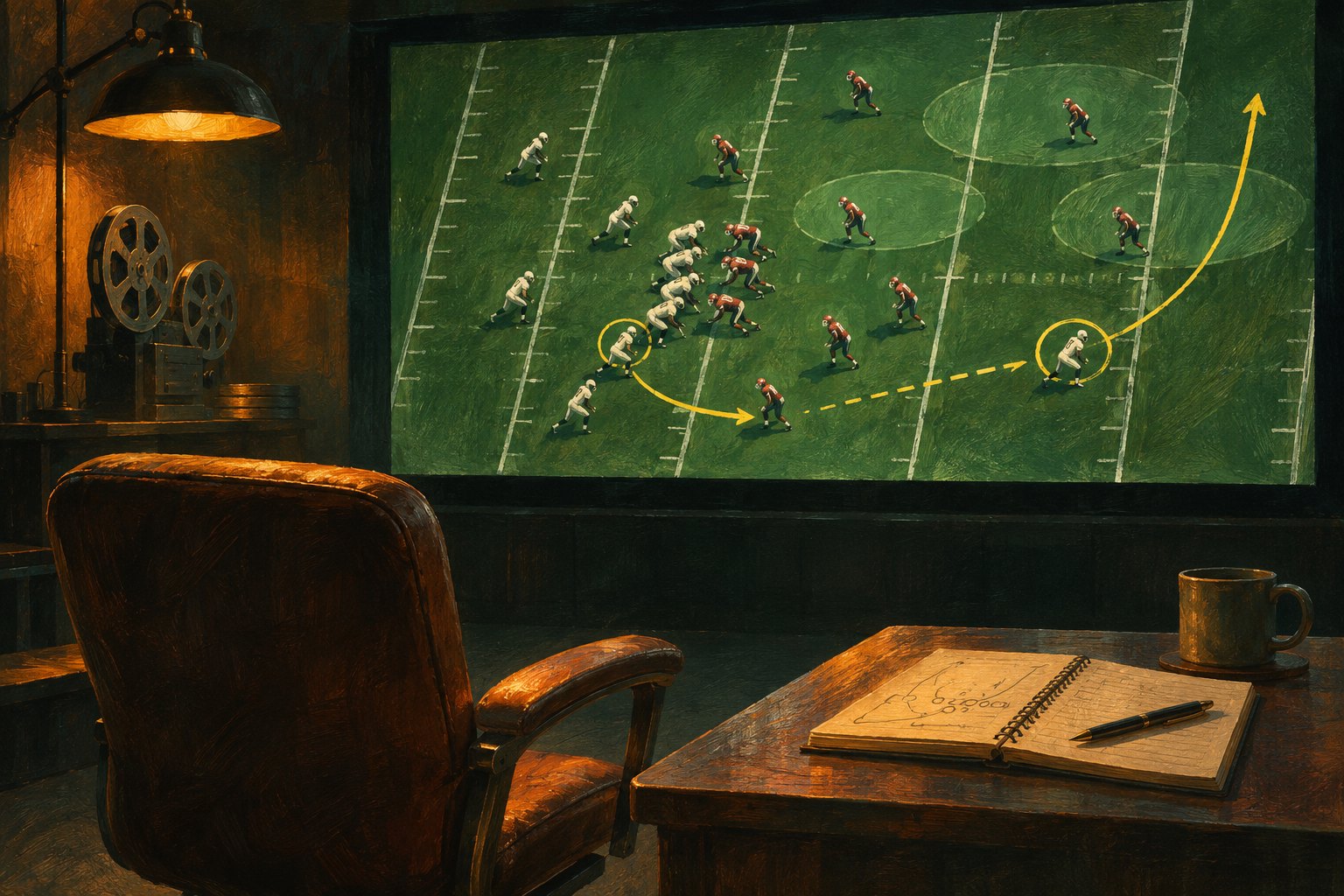
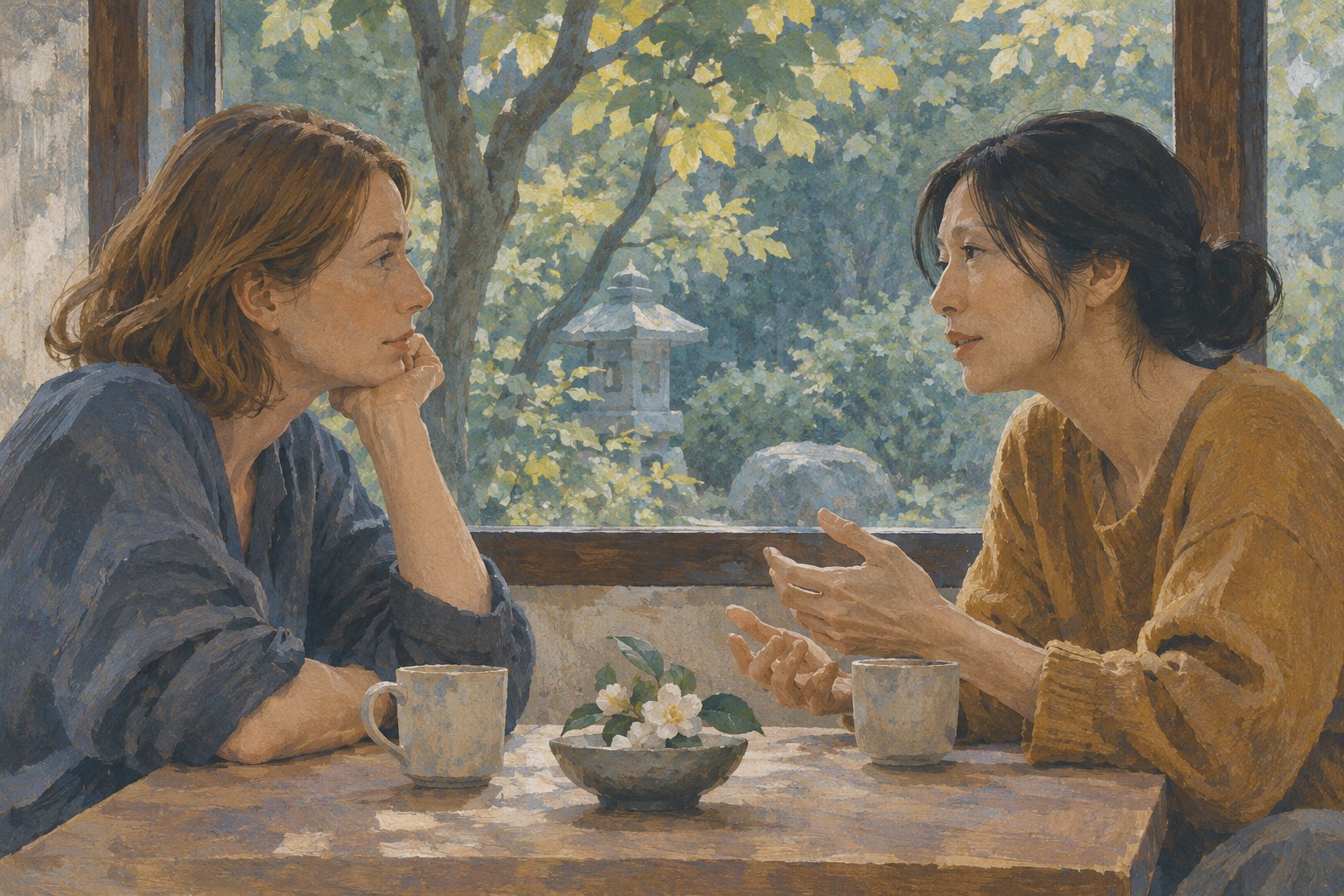
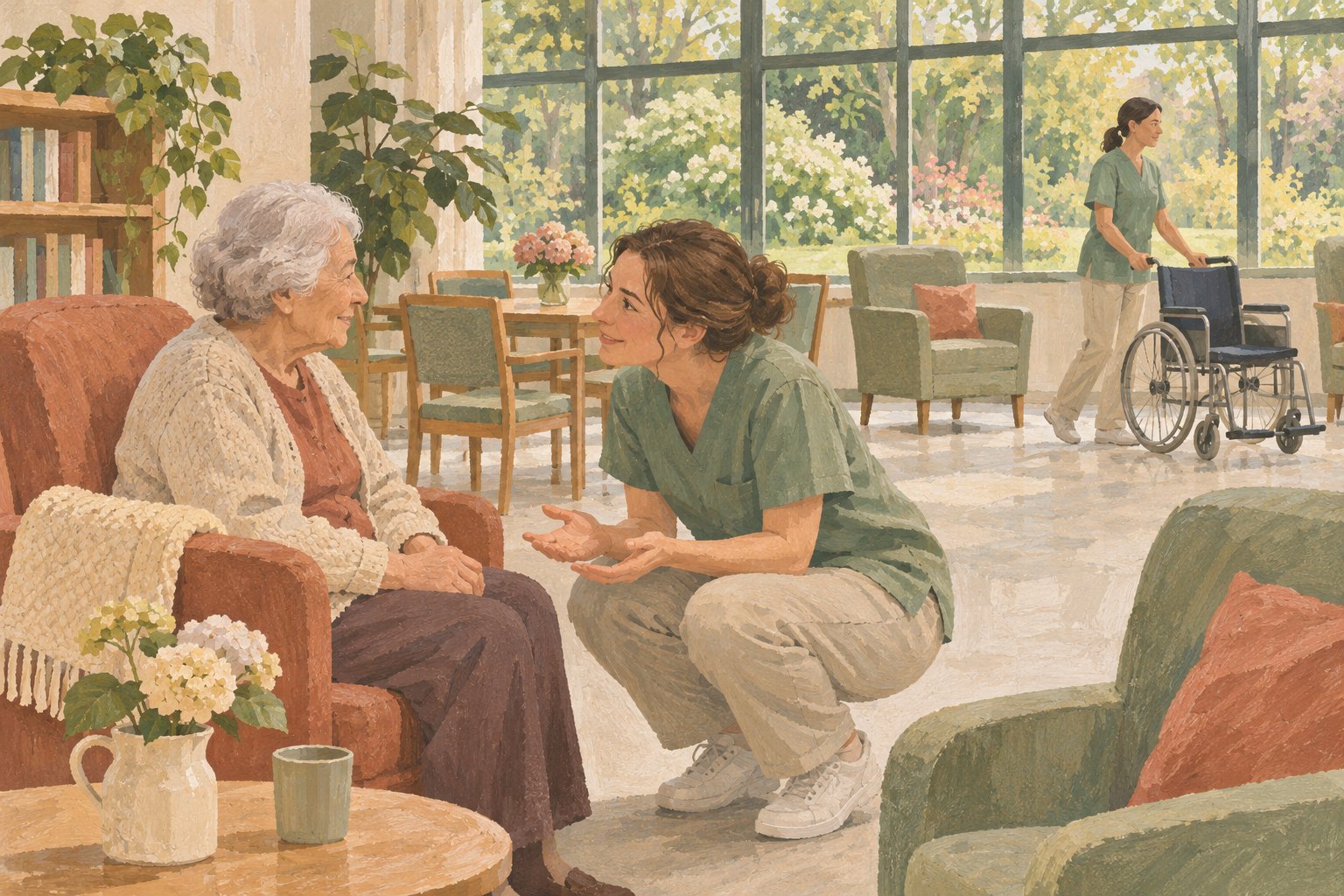
Spoiler note: The discussion below covers the women’s meeting, Mari’s illness, and selected theater and workplace scenes. It leaves the final developments undisclosed. The accompanying artwork consists of thematic illustrations, not film stills.
Film Summary: A Chance Meeting Becomes a Shared Life
Marie-Lou, played by Virginie Efira, encounters Mari, played by Tao Okamoto, after stopping to help Tomoki, an autistic young person separated from his companions. Tomoki’s grandfather Gorô is an actor working with Mari. The encounter leads Marie-Lou to the theater and, eventually, into a friendship that changes the emotional context of her working life.
Mari’s illness gives their growing attachment an uncertain horizon. Meanwhile, Marie-Lou is trying to change how residents are treated at her facility. Theater and caregiving gradually meet when Mari and Gorô bring their work into the home. These narrative connections are detailed in [Matt Zoller Seitz’s review](https://www.rogerebert.com/reviews/all-of-a-sudden-ryusuke-hamaguchi-film-review-2026).
My reading of this structure is that the initial act of assistance matters as much as the coincidence. Marie-Lou’s professional instincts open a relationship that cannot remain professional. She begins by identifying somebody who might need help; what follows requires her to recognize that she also needs companionship.
Marie-Lou: Compassion Has to Include the People Providing It
Marie-Lou promotes Humanitude, an approach emphasizing personal contact and residents’ dignity. Cannes’ account of the production identifies this philosophy as central to the film and confirms that filming took place in an actual elder-care facility, with residents and employees participating. That setting gives the institutional questions a concrete foundation. [Cannes production account](https://www.festival-cannes.com/en/2026/the-making-of-soudain-all-of-a-sudden-by-ryusuke-hamaguchi/)
The most useful way to assess Marie-Lou is to take both her ambition and her colleagues’ objections seriously. Staff members worry about training, available working time, and safety. Their reservations complicate the tempting assumption that a humane idea becomes practical simply because somebody believes in it strongly enough.
For me, this is the film’s richest ethical tension. An institution can praise individual attention while arranging work so that employees cannot consistently provide it. A manager’s willingness to sacrifice her own rest does not automatically make that sacrifice a reasonable expectation for everyone else.
Marie-Lou’s friendship therefore carries a practical challenge: can she accept care without converting it into another responsibility? Reading her through that question keeps her from becoming merely an exemplary administrator. Her aspirations remain admirable, but her own needs belong inside the ethical system she wants to build.
Mari: A Diagnosis Cannot Describe a Whole Person
Mari’s position is different. She knows that her remaining time is uncertain, yet continues making theater and seeking intellectual companionship. One brief declaration captures her determination: “I resist. That’s who I am.” The line is reproduced in [Steve Pond’s review](https://www.thewrap.com/creative-content/movies/all-of-a-sudden-review-ryusuke-hamaguchi-cannes/).
I read that resistance as a claim to authorship over her identity. Illness affects her possibilities, but it cannot explain every interest, decision, or attachment. Her artistic work matters because it remains something she chooses, rather than something imposed by a diagnosis.
This also complicates Marie-Lou’s position. Professional experience may help her recognize vulnerability, but friendship asks for something less orderly than competent assistance. Mari can challenge her, surprise her, and offer something she lacks. Their connection gains meaning through that reciprocity.
The distinction recalls the question behind our discussion of why character choices must remain central to adaptation: a story becomes thinner when people function only as illustrations of its themes. Mari needs to remain an artist and a friend as well as a person confronting death.
Theater Makes Room for an Unplanned Presence
A revealing episode occurs when Tomoki joins Gorô onstage. His grandfather incorporates his presence into the performance instead of treating him as an interruption that must be removed. The scene offers a concrete example of accommodation within the film’s larger argument about attention.
My interpretation is that Gorô demonstrates a flexibility that institutions often struggle to permit. A plan exists, but the plan can respond to the person in front of him. The performance retains its purpose while changing its immediate form.
There is also a limit to treating this as a metaphor: Tomoki deserves consideration as a person within the story, beyond what his presence teaches the adults. The strongest reading holds onto both levels. His relationship with his grandfather matters in itself; its implications for Marie-Lou’s work follow from that relationship.
When Conversation Becomes the Main Event
The women’s dialogue includes the deceptively simple question “Who are you?”, documented in [Allyson Johnson’s review](https://butwhytho.net/2026/11/all-of-a-sudden-2026-review/). It asks for more than a profession or medical history. In this relationship, an answer must remain open to revision as the women learn about each other.
That is also the appeal—and potential difficulty—of the film’s extended conversational form. Viewers seeking swift developments may find its intellectual exchanges demanding. My critical reservation concerns the balance between articulating an idea and letting behavior complicate it. A conversation becomes dramatically valuable when it changes what a character can admit, request, or understand.
Length alone does not establish depth. As our assessment of film series that become exhausting to finish argues in a different context, sustained attention needs emotional development. Here, the strongest reason to stay is the changing relationship between two people whose available time cannot be guaranteed.
A Deeper Reading: Care Without Ownership
The most persuasive interpretation of All of a Sudden is that care requires accepting another person’s independence even when dependence increases. Marie-Lou cannot make Mari’s life predictable. Mari cannot ensure that their friendship will have the duration either woman wants. What they can offer is a relationship in which neither is reduced to the service she provides or the help she requires.
That makes the film a promising choice for viewers drawn to morally complicated character drama and sustained dialogue. Its central question reaches beyond illness: when we believe we understand someone, do we keep listening? The friendship matters because it allows both women to remain unfinished people, still capable of changing each other.
Original content by this site's editorial team. Published: November 27, 2026 at 15:53:06 PST (Los Angeles time)