The Mosquito Bowl carries a particular weight for John McConnell, a 102-year-old World War II veteran living in Long Beach. Bob Bauman, portrayed by Bill Skarsgård, was someone McConnell knew and admired before the war. That connection gives this story of athletes becoming Marines a different scale: a historical casualty was once a young man who stopped to run alongside a neighborhood teenager.
Peter Berg’s film follows four college football stars whose lives change after Pearl Harbor. McConnell’s recollection offers a valuable way into its central tragedy. Before these men became subjects of remembrance, they had talent, friendships, and futures that seemed available to them.
Historical spoilers follow. This is a critical reading of the film’s verified premise and the personal history surrounding it, rather than a firsthand assessment of the finished film’s performances, editing, or dialogue.
The person behind the character
In Barbara Kingsley-Wilson’s reporting for the Long Beach Post, McConnell remembers running with Bauman, whose surname the newspaper also spells Baumann, near Chicago in 1942. The older athlete was a Wisconsin football standout. McConnell remembered their shared mile as an unexpectedly demanding one. He would never see Bauman again.
McConnell was also close to Bauman’s younger brother, Frank. The two learned of Bob’s death in Okinawa while returning home on leave. McConnell did not experience combat himself; his connection to this loss came through friendship and the family left behind. At the time of the interview, he planned to see the movie with his son.
His description of Bauman is wonderfully direct: “he was a local hero.” Those words restore something that military narratives can compress. A person’s importance begins before enlistment, before a defining battle, before anyone knows that a life will become a story.
Four athletes facing a different kind of uncertainty
Netflix’s official introduction identifies the central quartet as John McLaughry, played by Nicholas Galitzine; Bob Bauman, played by Skarsgård; Tony Butkovich, played by Ray Nicholson; and Dave Schreiner, played by Tom Francis. Adapted from Buzz Bissinger’s nonfiction book, the film follows their movement from college football into Marine training and combat.
That progression establishes a strong dramatic tension. Athletic accomplishment encourages belief in preparation: practice improves execution, discipline makes a team more dependable, and exceptional ability can change an outcome. War places those expectations under pressure. A person can prepare thoroughly, act courageously, and still have no control over what happens next.
This is an interpretation of the premise, not a claim that all four men share an identical psychology. Their athletic backgrounds provide a common starting point, but a convincing ensemble story needs differences within that experience. Confidence, ambition, responsibility, and fear mean little dramatically unless they belong to recognizable individuals.
McConnell’s memory helps articulate the standard. We should be able to imagine Bauman outside the events that made him historically significant. The shared run supplies an ordinary social presence: someone admired from a distance who became, briefly, a companion.
Why the football game matters beyond its score
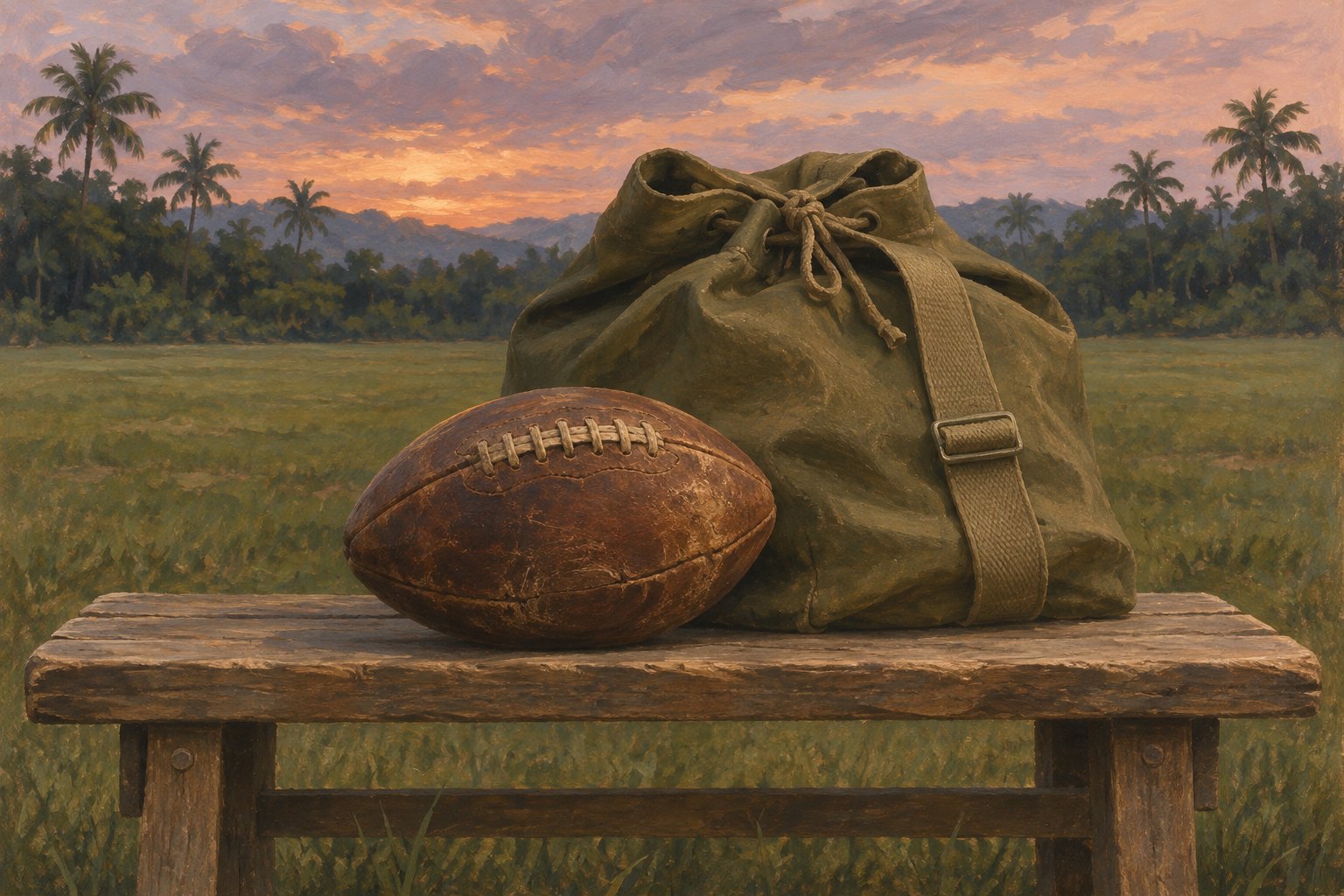
Imagine Entertainment’s synopsis places the game during preparations for the invasion of Okinawa. For many of its participants, it will be their last. That knowledge changes the audience’s relationship to every familiar sports-story expectation.
A conventional football drama can build toward a result that settles its major questions. Who deserves to lead? Can rivals cooperate? Will the team prove itself? Here, even a satisfying answer cannot settle what lies ahead. The game belongs to a larger story whose consequences cannot be contained within rules or a final whistle.
My reading is that the football premise matters most as an expression of continuity. These men have entered military life, but the identities they developed before it have not disappeared. Playing allows them to exercise skills, habits, and competitive instincts that remain their own.
There is an important distinction between recognizing the game’s later significance and assuming the players experienced it entirely as a farewell. Audiences know more about the historical outcome than the young men could. A thoughtful viewing should leave room for their immediate experience: the pleasure of competition, the desire to perform well, the absorption of playing.
That is also why scale alone cannot establish emotional importance. As our discussion of how an epic earns emotional investment argues, large events become meaningful through the people experiencing them. Here, the essential stakes exist before the battle begins.
Personal memory changes what viewers notice

A viewer approaching a war film through personal memory may pay attention differently from someone encountering its subjects for the first time. A famous historical event can become secondary to whether a gesture, relationship, or moment of ease makes a person feel recognizable.
That does not make personal recollection a complete test of a film’s historical accuracy. Memory and dramatization have different limitations. It does, however, suggest a useful question: does the movie encourage us to understand its people beyond the roles that history assigned them?
The same concern informs our commentary on cinema’s ability to preserve neighborhood memory. Local knowledge notices relationships that broad narratives can overlook. A national story describes service and sacrifice; someone who knew a participant remembers how that person entered a room or offered companionship.
McConnell’s recollection should also remain distinct from the screenplay. His words are testimony outside the film, not dialogue to place in an actor’s mouth. Their power comes partly from that independence: they enlarge the context without needing to become another dramatic scene.
The deeper tragedy is the future that disappears
The most compelling interpretation of The Mosquito Bowl begins with the lives its central men expected to continue living. Their athletic promise makes those possibilities visible, but fame should not determine the value of the loss. An unrealized professional career is one part of a future that might also have contained work, friendship, family, and decades of ordinary change.
This is where McConnell’s connection becomes especially moving. A surviving acquaintance can grow old while someone remembered remains young. Cinema can give that younger person movement and a voice again, but it cannot provide the years that were taken away.
The football game therefore invites a reading beyond heroic preparation. It represents time spent living: an activity with immediate pleasures and frustrations, valuable even without the tragedy that followed. Recognizing that value keeps remembrance from reducing every earlier moment to a warning of death.
For viewers, that is the strongest reason to approach this story through its people. The historical outcome matters. So does the young athlete who once had enough time, energy, and generosity to share a mile with a boy who looked up to him.
Original content by this site's editorial team. Published: November 9, 2026 at 03:12:52 PST (Los Angeles time)