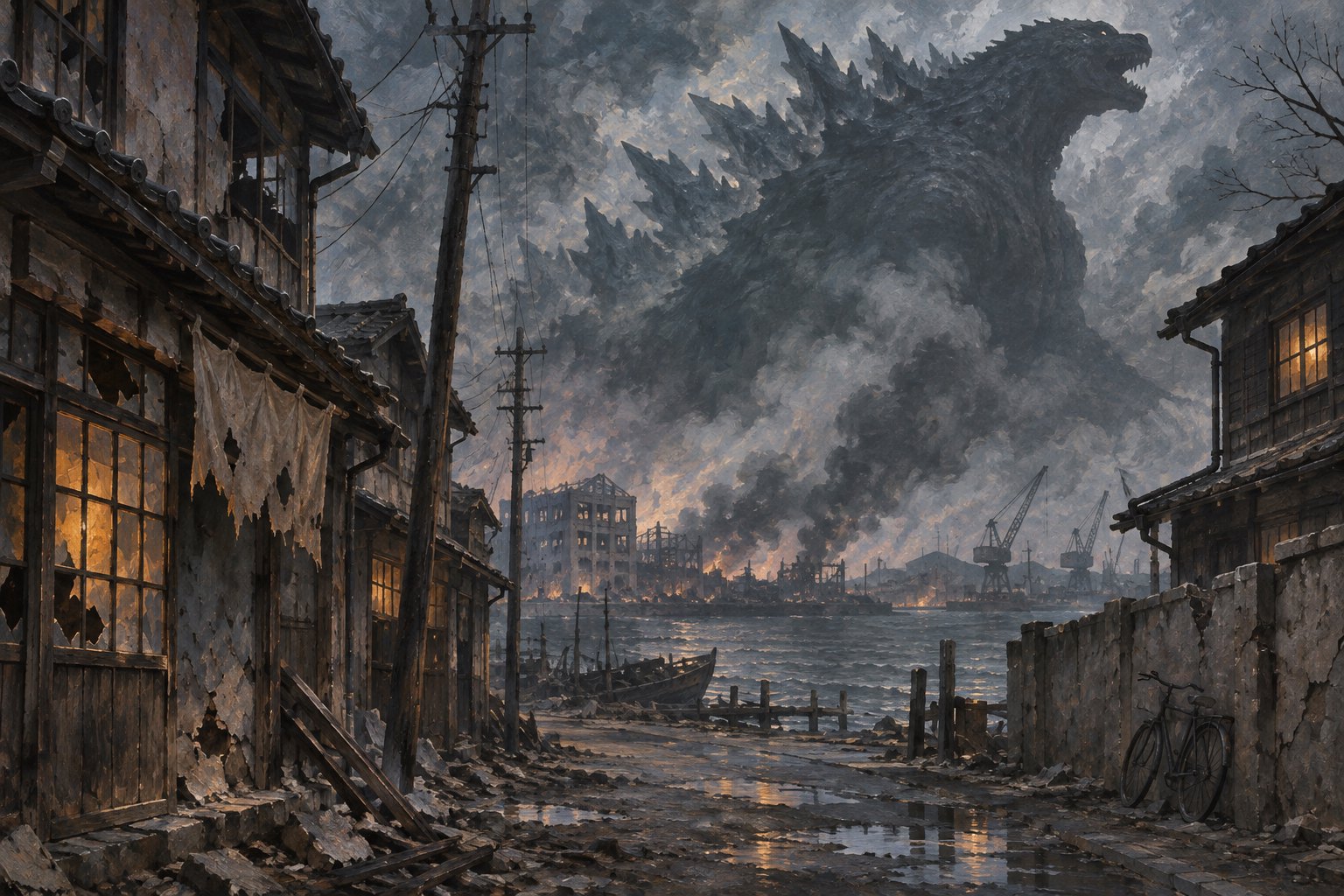
Godzilla Minus Zero presents a particularly cruel problem for a monster-movie hero: saving the world can mean abandoning the person who makes that world worth saving. Koichi Shikishima has a family to protect, but protecting them offers no simple instruction about whether he should leave or stay. Read through that conflict, the sequel’s central question becomes compellingly uncomfortable: when does sacrifice stop being an act of love?
Major spoilers follow, including the ending. This character-focused analysis draws on published accounts of the finished film; it is not a firsthand screening verdict. Its judgments concern the story’s ethical tensions rather than unverified claims about individual performances or technical execution.
Koichi’s New Life Changes the Meaning of Duty
Written and directed by Takashi Yamazaki, the sequel takes place in 1949. Koichi, played by Ryunosuke Kamiki, is now married to Noriko, played by Minami Hamabe, and they are raising Akiko. Ghidorah’s attack brings another emergency into this fragile domestic recovery, and Kenji Noda seeks Koichi’s help. These circumstances are established in [Sight and Sound’s account of the film](https://www.bfi.org.uk/sight-and-sound/reviews/godzilla-minus-zero-thrilling-mega-monster-romp).
For Koichi, competence creates an obligation that other people can invoke. He has useful experience; therefore, someone will ask him to risk himself again. Yet being useful in a crisis does not cancel his responsibilities at home. His dilemma exposes something action movies often simplify: the person best equipped to undertake a dangerous mission may also have excellent reasons to refuse it.
My reading is that parenthood makes his heroism harder to measure. Bravery cannot be assessed only by how close he gets to death. It also depends on whether he treats returning as part of the mission. Akiko gives that distinction a human consequence. A child cannot live on the public honor attached to a missing parent.
Noriko Makes the Disaster Personal—and Political
Noriko’s connection to Godzilla turns her survival into something other people can exploit. Godzilla’s cells remain in her body, and a resonance device uses that connection to attract the creature. The mechanism and its role in the climax are described in [GamesRadar+’s ending explanation](https://www.gamesradar.com/entertainment/sci-fi-movies/godzilla-minus-zero-ending-explained-ghidorah/).
That premise creates a disturbing conflict between a person’s value and her usefulness. Noriko matters as a mother, partner, and survivor. To anyone interested in controlling Godzilla, however, her body becomes strategic equipment. The danger is therefore larger than another attack: survival itself can become grounds for losing control over her future.
Her concern also extends beyond her own household. “Japan is full of children like Akiko,” she tells Koichi, a line recorded in [Plugged In’s discussion of the film](https://www.pluggedin.com/movie-reviews/godzilla-minus-zero-2026/). It prevents the family’s moral importance from becoming exclusive. Their child deserves protection, but so do children without parents capable of demanding it.
The resulting tension is stronger than a straightforward argument for self-sacrifice. Noriko can recognize a responsibility to others without surrendering her right to exist for herself. A story that takes her seriously must hold both ideas together.
Murakami Confuses Remembering with Retaliation
Kanji Murakami’s grief leads toward a different response. Having lost his family in Hiroshima, he imagines directing Godzilla against New York. The apparent attack belongs to his revenge fantasy rather than an actual destruction of the city, according to the same GamesRadar+ account.
That distinction matters. The fantasy exposes the destination of his anger before the story allows it to become an accomplished fact. He wants suffering to travel outward, toward people who can be made to experience an equivalent terror. But equivalent suffering cannot restore the people he lost.
In my interpretation, Murakami’s mistake is to treat memory as a debt payable through somebody else’s pain. His grief deserves recognition; his proposed answer requires resistance. Those positions are compatible. A film need not deny the reality of an injury to reject the violence committed in its name.
Noriko’s predicament sharpens that rejection. If her survival becomes a means of delivering his revenge, he reproduces the logic that makes individual lives expendable. His moral test is whether he can relinquish the power to impose his loss on strangers.
What the Monster Fight Can—and Cannot—Resolve
The plan to bring Godzilla and Ghidorah together converts catastrophe into a tactical possibility. The characters are attempting to redirect forces they cannot safely master. As Murakami puts it, the creatures are “beyond our comprehension,” a phrase quoted in [Moviefone’s review](https://www.moviefone.com/news/movie-review-godzilla-minus-zero/).
That admission complicates the pleasure of watching a monster become useful. Godzilla’s ability to fight another threat does not make him trustworthy. Temporary alignment is not friendship, and survival purchased through greater destructive power remains precarious.
This is where perspective matters. From a distant vantage point, the conflict can resemble a contest between impressive creatures. From the characters’ position, every tactical success carries the possibility of another disaster. Our discussion of how point of view shapes horror explores the same underlying principle: danger acquires meaning through the limits of the person experiencing it.
The narrative also carries a structural risk. When several characters embody different forms of trauma, conversations can become explanations of themes rather than encounters between distinct people. The strongest test is whether their beliefs produce difficult choices. Noriko’s threatened autonomy and Murakami’s temptation toward revenge meet that test more directly than a general declaration that war is terrible.
Akiko Gives the Ending Its Measure of Victory
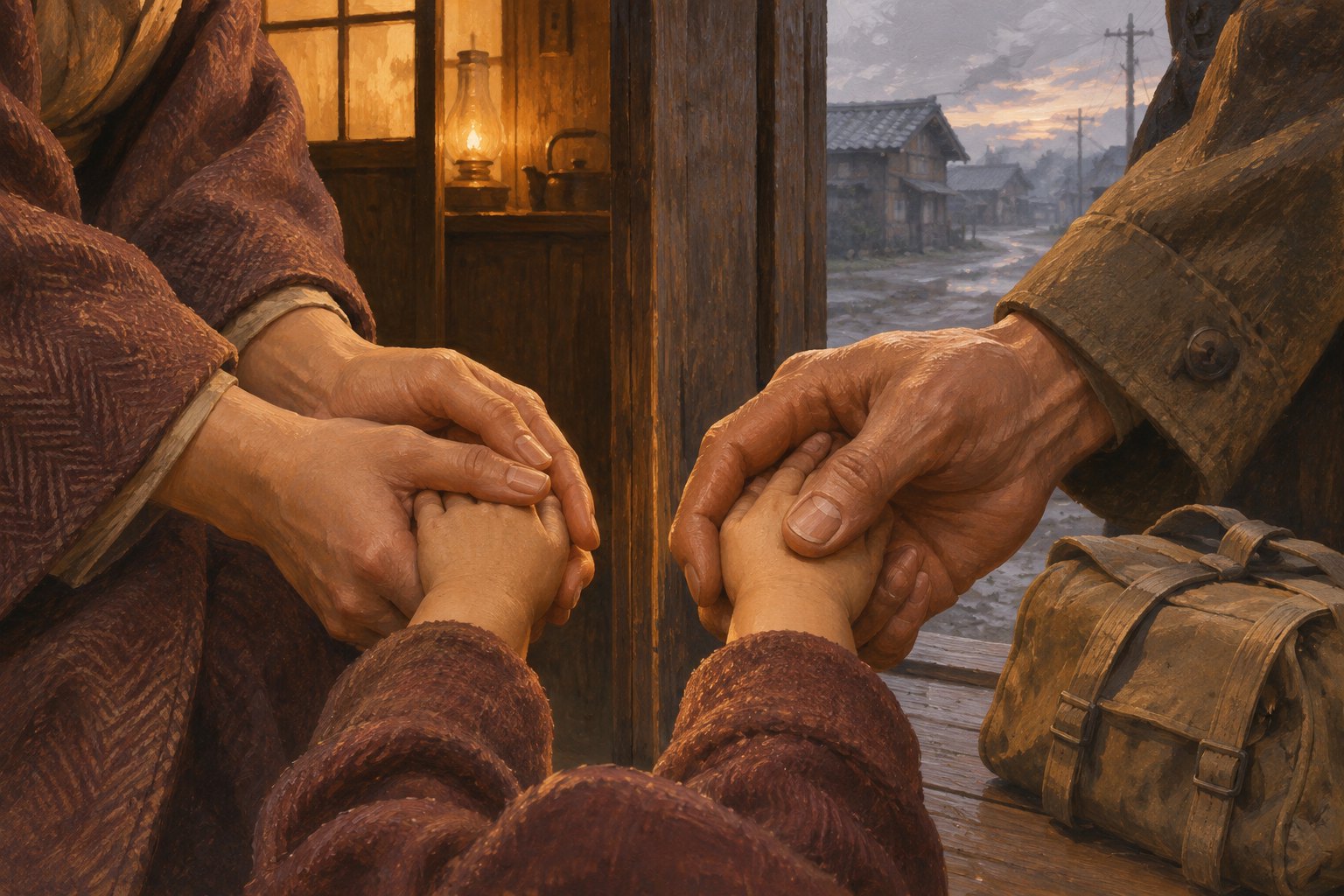
After the battle, Koichi and Noriko consider leaving Akiko behind for her safety, then choose to escape with her. That final decision refuses to treat the child’s emotional life as a secondary consideration. Safety matters, but so does the harm inflicted by another separation.
“Have a safe trip,” Akiko says—a phrase discussed in [Film Colossus’s analysis](https://filmcolossus.com/godzilla-minus-zero-explained/) as a promise of return taught to her by Noriko. Its force comes from its ordinariness. A familiar farewell becomes a child’s attempt to keep the adults accountable to coming back.
My judgment is that this is the story’s most persuasive answer to its own scale. Akiko cannot evaluate military strategy or the management of catastrophic power. She can identify what abandonment would mean to her. Listening to that knowledge gives the adults a responsibility that grander arguments can obscure.
The Deeper Meaning: Survival Must Remain Human
Where our earlier coverage of Godzilla Minus Zero and international audiences considered the film’s public reach, its character drama asks what remains valuable after the spectacle ends.
The answer I find most convincing is the freedom to remain a person rather than a resource: Koichi more than a pilot, Noriko more than a biological connection, Akiko more than a reason adults give for their decisions. Murakami’s corresponding challenge is to remember the dead without recruiting the living into endless retaliation.
That makes the family’s departure an appropriately limited victory. Togetherness cannot guarantee security. It does, however, reject the assumption that love is best demonstrated through disappearance. The future these characters defend becomes meaningful only if they allow themselves to inhabit it.
Original content by this site's editorial team. Published: November 9, 2026 at 01:18:25 PST (Los Angeles time)