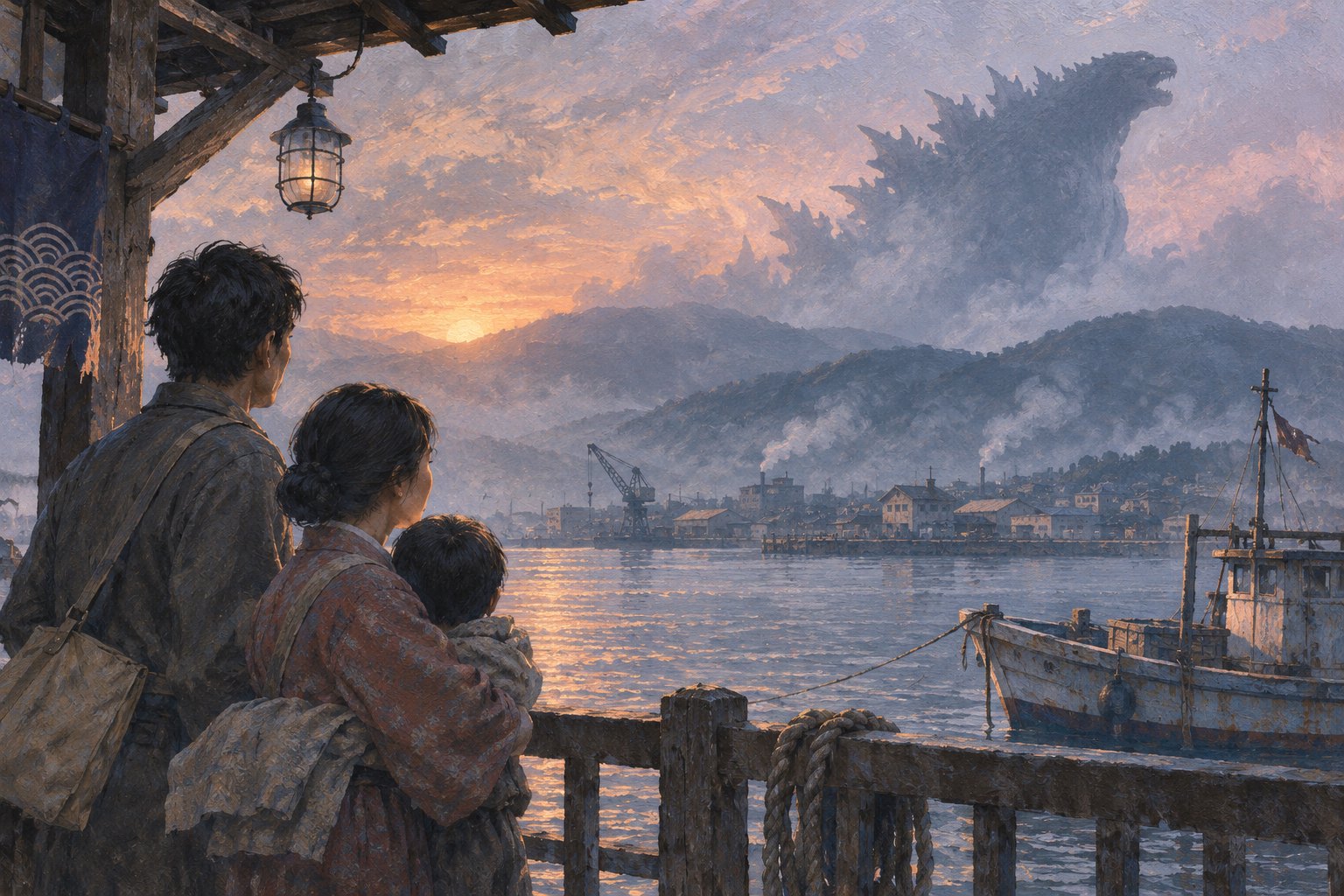
Takashi Yamazaki is discussing his new movie, Godzilla Minus Zero, in NPR coverage. For viewers invested in his approach to Godzilla, the most interesting question is what another encounter with catastrophe can reveal about the people living through it. A monster can return with renewed force. A character’s hard-won understanding of life deserves more careful treatment.
That question begins with Godzilla Minus One, whose emotional force rests on a survivor learning that staying alive does not require an apology. Revisiting its characters offers a useful lens for approaching Yamazaki’s new film. The discussion below is retrospective criticism and an argument about expectations, rather than a review claiming firsthand knowledge of Minus Zero or a reconstruction of Yamazaki’s interview.
Spoiler warning: Major plot developments and the ending of Godzilla Minus One follow.
Shikishima’s survival is the story’s central conflict
In Minus One, Koichi Shikishima abandons his kamikaze mission and survives an encounter with Godzilla at an island base. He returns to a devastated Tokyo carrying guilt. His subsequent connection with Noriko and the orphaned Akiko creates the possibility of a family, but having somewhere to belong does not immediately make him feel entitled to belong there.
My reading is that this tension gives the film its strongest dramatic structure. Shikishima can perform useful work and accept practical responsibilities while remaining emotionally committed to his own punishment. That contradiction makes him more interesting than a hero simply waiting to recover his courage. Competence and recovery are separate things.
It also establishes a demanding standard for Minus Zero. A continuation can expose someone to renewed fear without pretending their earlier growth never happened. The revealing question would be how a survivor uses what he has learned when reassurance becomes impossible. Repeating his original crisis would be easier; allowing him to respond differently would give the earlier film lasting consequences.
Noriko makes a future feel specific
Noriko’s importance in Minus One extends beyond her relationship with Shikishima. She takes responsibility for Akiko and helps build a household amid deprivation. Where his guilt turns attention toward what cannot be repaired, her caregiving makes immediate demands: a child needs protection, and tomorrow requires preparation.
Her insistence, “Everyone who survived the war is meant to live,” expresses the film’s ethical center. The wording makes survival a shared condition. Shikishima does not need to prove that he alone deserves an exemption from suffering.
For me, the domestic scenes are essential because they give the spectacle an address. Destruction threatens a particular arrangement of people who have begun depending on one another. A skyline can communicate scale; an interrupted household communicates what that scale costs.

That is also where a new film could deepen this storytelling. Giving a caregiver independent choices, conflicting obligations, or a desire beyond keeping others safe can expand the drama. These are possibilities for judging character development, not claims about Noriko’s role in Minus Zero. The distinction matters: affection for a character should sharpen expectations rather than supply imaginary scenes.
Godzilla turns private fear into public danger
The Ginza attack in Minus One, during which Noriko is apparently killed, brings Shikishima’s fragile domestic future into direct collision with Godzilla. The sequence matters emotionally because the audience already understands what he believes he stands to lose.
In my interpretation, the monster’s dramatic function is to make security feel impossible. A person can rebuild a home, find work, and begin caring for someone, yet remain vulnerable to forces beyond any individual’s control. That makes the film’s hope difficult and therefore valuable.
There is a related problem in horror: how can a film use grief without reducing it to a convenient source of shocks? Our analysis of grief and emotional traps in 1408 approaches that question from another genre tradition. For Yamazaki’s new movie, the useful critical test is whether danger changes a character’s decisions and relationships. Spectacle gains meaning when its consequences survive the sequence itself.
The ending changes what heroism requires
The climax of Minus One sends Shikishima toward Godzilla in an explosives-laden aircraft. Crucially, he survives by ejecting. Noriko is subsequently revealed to be alive, and their reunion gives the film an emotional resolution beyond the monster confrontation.
The ejection mechanism is a small technical detail with enormous dramatic weight. To my mind, it changes the meaning of the action. Shikishima can undertake something dangerous without making his death the measure of its sincerity. The possibility of returning home belongs inside the plan.
This is why another installment faces a challenge that cannot be solved simply by increasing the threat. Once a story has made survival meaningful, a later sacrifice needs its own moral and dramatic reasoning. Familiar imagery alone cannot do that work.
The broader issue resembles the one explored in what another Downton Abbey film would owe its characters: continued storytelling should make earlier change consequential. Audiences can accept another disruption while still expecting a previous resolution to have mattered.
What to look for in Godzilla Minus Zero
A character-centered assessment of Yamazaki’s new movie should begin with choices. Who identifies the danger? Who decides what is worth risking? Who gets to disagree? These questions reveal whether human characters shape the action or merely explain it between appearances by the monster.
Perspective matters just as much. An action sequence can establish geography clearly while leaving its emotional viewpoint vague. The most involving scenes make us understand what a particular person knows, misunderstands, or cannot bear to witness. Technical scale and personal perspective can reinforce one another.
Finally, the aftermath deserves attention. A conversation after an escape, a changed relationship, or a newly accepted responsibility can reveal more about a film’s priorities than the size of its climactic destruction. These are standards for criticism, not predictions about the new film’s contents.
Survival should open a story forward
Near the end of Minus One, Noriko asks, “Is your war finally over?” The question directs attention toward Shikishima’s inner life at the moment when a monster movie might otherwise declare victory.
I read that ending as permission to imagine an ordinary future. Its emotional promise is not that danger has disappeared forever. It is that a survivor may finally participate in life without treating happiness as an offense against the dead.
That is the most compelling lens for Godzilla Minus Zero as Yamazaki discusses his new work. Another catastrophe can test that permission, complicate it, or reveal its limits. The richest continuation would make the effort of living feel newly significant—and give the people beneath Godzilla’s shadow futures worth considering.
Original content by this site's editorial team. Published: November 8, 2026 at 06:33:27 PST (Los Angeles time)