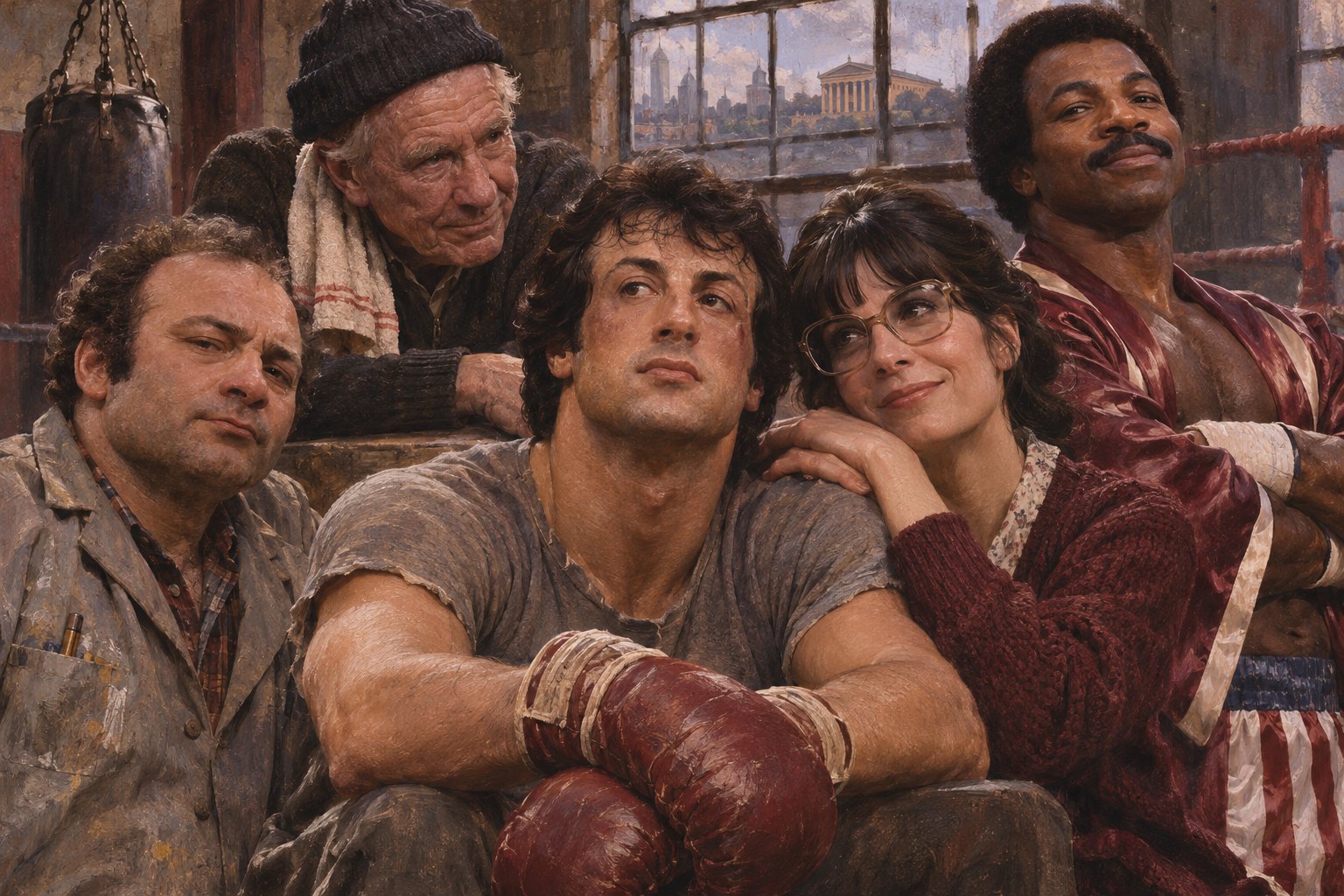
The original Rocky cast did not leave the franchise together. Carl Weathers’ last newly performed chapter as Apollo Creed came in Rocky IV; Talia Shire and Burgess Meredith returned through Rocky V; Burt Young and Tony Burton stayed through Rocky Balboa. Sylvester Stallone’s latest released performance as Rocky remains Creed II.
Those endpoints tell a surprisingly intimate story. What begins in 1976 as one Philadelphia fighter’s opportunity becomes a series about the people who recognize him, challenge him, and eventually leave him behind. Looking back at the actors means watching that community change, not simply comparing younger and older faces.
Spoilers follow for the Rocky films and the first two Creed movies. Here, a final appearance means an actor’s last newly filmed performance in the role, rather than later reuse of footage, photographs, or a character’s name.
The original cast’s last performances at a glance
- Sylvester Stallone — Rocky Balboa: Rocky (1976) to Creed II (2018).
- Talia Shire — Adrian Pennino Balboa: Rocky (1976) to Rocky V (1990).
- Carl Weathers — Apollo Creed: Rocky (1976) to Rocky IV (1985).
- Burt Young — Paulie Pennino: Rocky (1976) to Rocky Balboa (2006).
- Burgess Meredith — Mickey Goldmill: Rocky (1976) to a newly filmed flashback in Rocky V (1990).
- Tony Burton — Tony “Duke” Evers: Rocky (1976) to Rocky Balboa (2006).
Sylvester Stallone: Rocky learns to leave the spotlight
In the original film, directed by John G. Avildsen and written by Stallone, Rocky’s most revealing quality is his discomfort with being dismissed. His rambling conversations and awkward jokes suggest someone trying to keep an interaction alive because silence might confirm that nobody cares.
That is why his wish to “go the distance” matters more than the championship. Apollo offers him a commercial opportunity; Rocky privately turns it into a test of whether his life has value. Stallone makes that ambition feel painfully modest. Rocky is asking for evidence that he belongs in the room.
By Creed II, the performance depends on a different kind of restraint. Rocky can guide Adonis without claiming his victory. “It’s your time” becomes an acknowledgment that love sometimes means stepping away from the center of the picture.
His subsequent reunion with his son and first meeting with his grandson complete that movement. The fighter who once needed an arena to establish his worth now has unfinished business at a family doorway. For me, that is a more satisfying destination than another championship celebration.
Talia Shire: Adrian becomes the person who sees clearly
Shire’s Adrian begins as a woman whose brother and surroundings leave little space for her voice. Her early reserve is not an absence of personality. Watch how carefully she measures attention: being noticed can feel threatening when humiliation has become familiar.
The original romance is moving, but it also deserves scrutiny. Rocky’s persistence, especially during their apartment encounter, can feel uncomfortable. Shire’s hesitant physical responses keep the scene from becoming an uncomplicated fantasy of a confident man rescuing a shy woman. Adrian’s comfort and agency matter.
At the championship fight’s conclusion, Rocky’s repeated cry of “Adrian!” redirects the film away from the judges. Apollo wins the decision; Rocky searches for the person whose presence makes the experience meaningful.
By Rocky V, Shire plays Adrian as the family’s clearest observer. She recognizes that Rocky’s investment in Tommy Gunn is damaging his relationship with his son. Her strength lies in understanding the difference between nurturing someone and using that person to recover a lost identity.
Adrian has died before the events of Rocky Balboa. That later absence should not obscure how active she was. She was never merely a memory that motivated a boxer; she could contradict him while he was alive to hear it.
Carl Weathers: Apollo’s confidence becomes his vulnerability
Weathers introduces Apollo as both an accomplished athlete and an expert producer of his own public image. Choosing an unknown challenger allows him to sell a patriotic spectacle while expecting to control its outcome. His mistake is underestimating how seriously Rocky will take the invitation.
The performance works because Apollo’s theatricality does not erase his ability. Rocky’s endurance threatens a champion who has earned his status, making their rivalry more interesting than a simple contest between virtue and arrogance.
When Apollo becomes Rocky’s trainer in Rocky III, Weathers preserves the competitive spark. Friendship grows through shared work rather than a complete personality change. He remains proud, demanding, and alert to what the other fighter lacks.
In Rocky IV, that pride becomes fatal during the exhibition against Ivan Drago. My reservation is that Apollo’s death narrows a charismatic character into the catalyst for Rocky’s next ordeal. The later Creed films find richer consequences in his absence: his son must live with a public legend he never knew privately.
Burgess Meredith: Mickey’s final appearance comes after his death
Mickey dies in Rocky III, but Meredith’s final newly filmed performance arrives in the memory sequence in Rocky V. Separating those events is essential to understanding his place in the series.
In the first film, Mickey’s offer to manage Rocky is complicated by years of neglect. Rocky understandably questions why this attention arrives only after a title opportunity. Meredith lets authority and desperation occupy the same body: Mickey wants to help, but he also wants one more chance to matter.
The Rocky V flashback recasts that relationship as emotional inheritance. Rocky remembers more than technical instruction. He remembers someone insisting that he could endure. Meredith’s rough voice becomes a form of reassurance that Rocky can carry beyond the trainer’s lifetime.
Burt Young and Tony Burton: two kinds of loyalty
Young’s Paulie is difficult company from the beginning. His cruelty toward Adrian and resentment of Rocky’s opportunities give the original film an abrasive domestic reality. Young makes him recognizable without making his conduct acceptable.
By Rocky Balboa, Paulie carries the weight of shared history. His relationship with Rocky includes grief, irritation, and the uncomfortable knowledge that time does not automatically repair how people have treated one another. The performance gives their companionship texture that uncomplicated encouragement could never provide.
Burton’s Duke offers a different presence. Beginning in Apollo’s corner and later training Rocky, he embodies practical knowledge. His authority comes from reading bodies, limitations, and danger. In Rocky Balboa, preparing an aging fighter requires adapting the work to the man who actually exists.
These supporting performances demonstrate why recognizing the people who shape a movie’s impact matters. Rocky’s emotional world depends on voices that do not sound like his own.
What the cast’s departures reveal about Rocky
My strongest reason to revisit the original remains its understanding that self-respect develops through relationships. Training changes Rocky’s body, but Adrian, Mickey, Paulie, and Apollo change what he believes his effort means.
The sequels are most persuasive when they allow those relationships to evolve. That is also the central challenge in letting familiar characters grow across an expanding series: another installment needs to alter the emotional situation, not merely increase the spectacle.
Viewed together, the cast’s final performances turn Rocky into a story about accepting limits. Mentors die. Partners disappear. Friends age. Younger fighters inherit the ring. Rocky’s deepest achievement is learning that stepping outside it does not make him nobody again.
Original content by this site's editorial team. Published: November 8, 2026 at 03:22:04 PST (Los Angeles time)