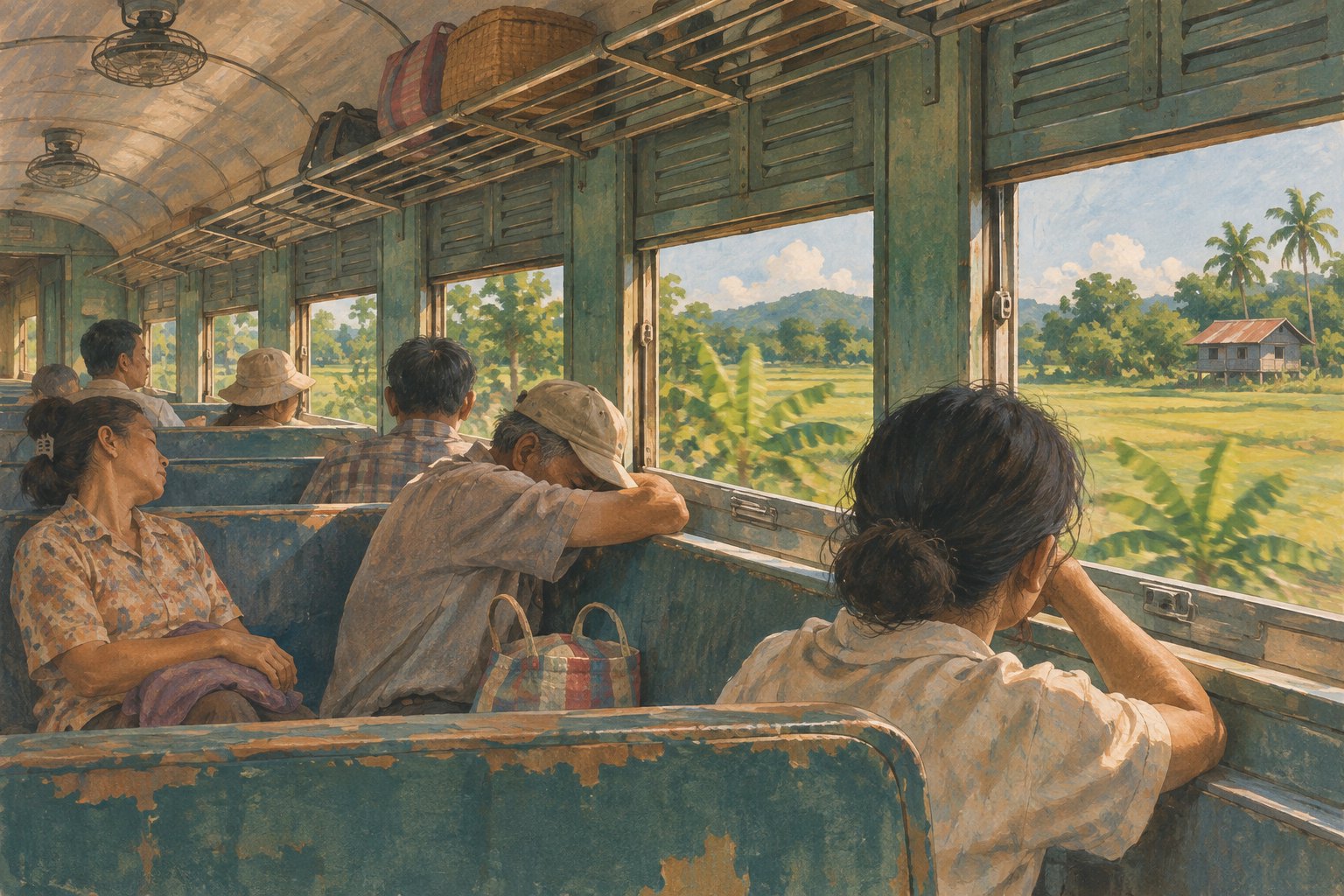
Sompot Chidgasornpongse makes an ordinary train journey a compelling starting point for thinking about cinema: people share a direction without sharing a destination, a purpose, or the same degree of comfort. For readers discovering his name through Tone Glow’s Film Show 076: Sompot Chidgasornpongse, his documentary Railway Sleepers offers a concrete introduction to that idea. Its subject is everyday travel, but its implications reach into labor, class, privacy, and the ways strangers occupy a common world.
This is a critical guide to the film’s documented structure and subjects, rather than a recap of the Film Show conversation or a firsthand screening review. It discusses observational situations and formal design.
A Journey Built From Years of Observation
Railway Sleepers runs 102 minutes and constructs the experience of traveling through Thailand across two days and two nights. That apparent continuity is an editorial creation: Grasshopper Film describes footage gathered over eight years across every active railway line in the country. The result brings many separate encounters into the shape of one journey. [Grasshopper Film’s film description](https://grasshopperfilm.com/film/railway-sleepers/)
This distinction matters because a documentary’s chronology can feel natural even when it is carefully assembled. The passengers need not have occupied the same train, or even traveled in the same year, to become neighbors within the film. Editing establishes their proximity. What looks like a temporary traveling community is also an argument about whose experiences belong beside one another.
My reading of this structure is that arrival becomes less significant than coexistence. A conventional journey story often measures progress through obstacles overcome. Here, the journey creates time in which people can simply remain visible. Sitting, waiting, looking, and resting become sufficient reasons for a camera to stay.
Passengers Who Do Not Owe Us a Character Arc
The film’s production synopsis emphasizes ordinary conversation, movement through the carriage, exchanged looks, and sleep. In his accompanying statement, Chidgasornpongse describes the train’s human arrangement directly: “We cross paths as we move ahead in similar directions but with different destinations.” These are the director’s words about the project, not dialogue from the film. [At A Time Pictures’ synopsis and director’s statement](https://www.atatimepictures.com/about-the-film.html)
That observation provides a useful alternative to treating documentary participants like fictional characters. A passenger does not need a revealed secret, a dramatic confession, or a transformative decision to justify our attention. Someone’s significance can reside in the particular way they inhabit a seat or negotiate a shared environment.
True/False’s festival description identifies children doing homework, a tired body resting against a vibrating compartment, and a traveler absorbed by the landscape. These details suggest distinct relationships to the same journey: time for work, time for recovery, and time for looking. [True/False’s program note](https://truefalse.org/film/railway-sleepers/)
From the children’s perspective, travel does not necessarily suspend obligation. Homework continues while the surroundings move. From the exhausted traveler’s perspective, the carriage becomes somewhere to recover. For the person watching outside, it offers a changing field of attention. These are interpretations of visible activities, not claims about private thoughts or personal histories.
The distinction is essential. Looking closely at a person should make us more sensitive to what we cannot know about them. Our discussion of documentary subjects and their agency explores a related concern: visibility has value when people retain their individuality within the larger argument.
One Railway, Unequal Experiences
The railway’s shared movement can conceal very different material conditions. Grasshopper Film describes spacious first-class sleeping accommodations alongside crowded carriages farther back. That contrast gives the film’s social portrait a physical vocabulary: room to stretch out, distance from other bodies, and access to privacy.
Read through the passengers’ needs, space becomes something more consequential than production design. Rest requires somewhere to put a tired body. Privacy requires a boundary other people cannot continually cross. The ability to treat a journey as pleasurable leisure depends partly on how much discomfort someone has paid to avoid.
It would be reductive to assign moral worth according to ticket class. The richer interpretation concerns the conditions surrounding each person. Travelers may share the same motion while experiencing radically different versions of the trip. Equality of direction does not produce equality of experience.
This is also where the familiar romance of train travel needs scrutiny. A picturesque window view can coexist with crowding and fatigue. An attentive reading keeps both in sight. The countryside is beautiful; the body looking at it still has needs.
Why Sleep Belongs at the Center
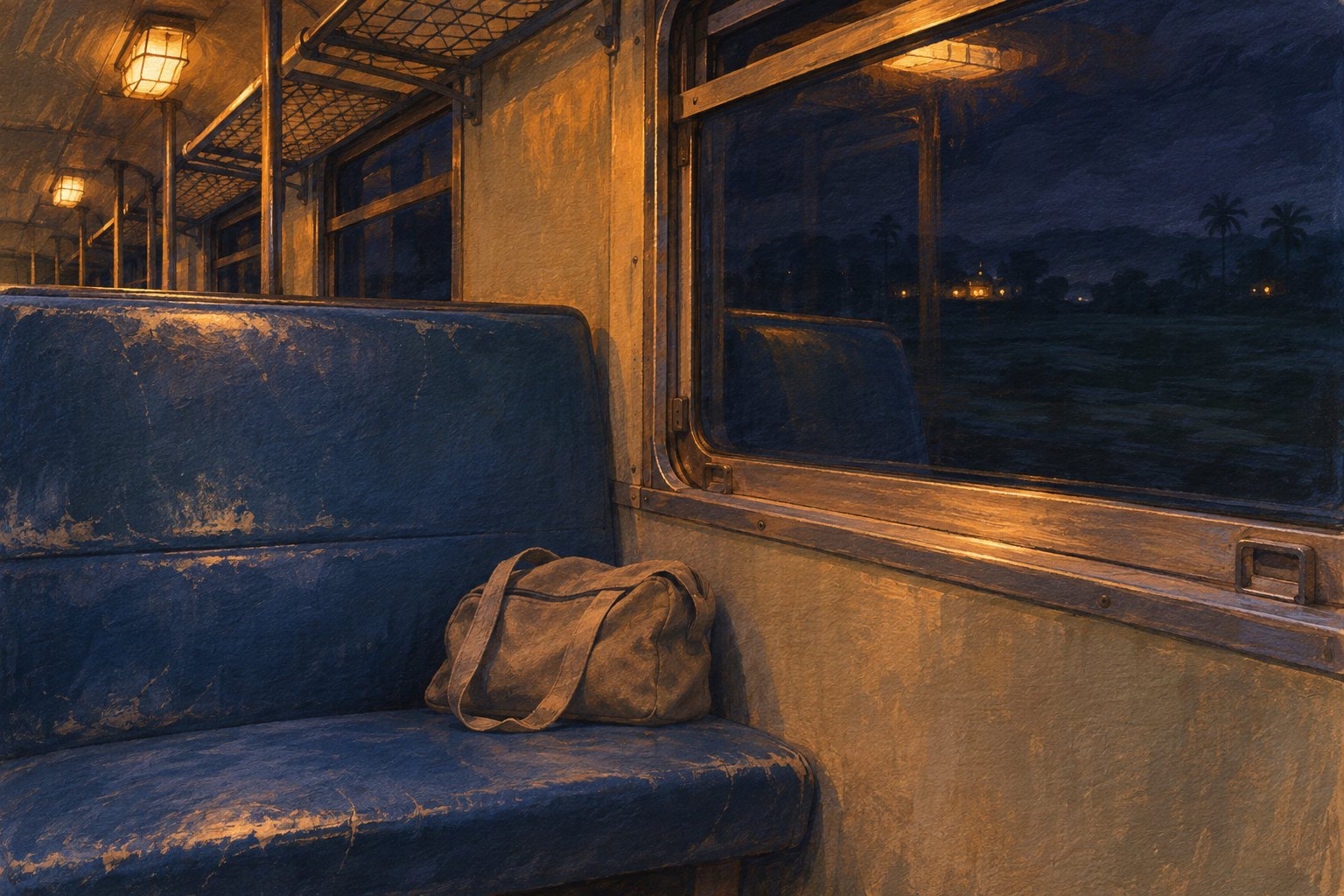
Sleep is an especially revealing subject because it interrupts the expectation that people should continually communicate something. A sleeping passenger cannot explain a feeling for our benefit or organize an experience into an anecdote. The viewer encounters vulnerability without receiving an interpretation from the person onscreen.
That makes rest a useful center for reading Railway Sleepers. Sleep depends on trust, exhaustion, available room, and the ability to withdraw from surrounding activity. Within a public carriage, an intensely private necessity must accommodate other people’s presence.
There is an ethical question here for the audience as well. Does watching someone rest produce care, curiosity, or a sense of entitlement to their intimacy? Observational cinema cannot resolve that question merely by avoiding narration. The viewer still chooses whether to see an individual or a convenient emblem of hardship.
The importance of preserving a person beyond the condition being depicted also informs our character-focused discussion of Tangles. The settings differ, but the critical responsibility is comparable: someone’s vulnerability should deepen our attention without swallowing their identity.
How to Read the Film’s Quiet Details
The most productive approach to this kind of documentary is to notice relationships before searching for a message. Who has space? Who is occupied? Who can turn outward toward the landscape, and who must attend to something immediately in front of them? These questions connect form to everyday experience without requiring invented backstories.
It also helps to distinguish what an image shows from what its placement suggests. A person resting is an observable subject. A contrast between that person and another traveler is an editorial relationship. A conclusion about inequality is an interpretation that should remain accountable to those details.
No verified passenger dialogue is quoted here. A memorable sentence should never be supplied merely because a review convention demands one. In this film’s documented design, gestures and arrangements provide substantial material for criticism without being converted into speeches.
The Deeper Meaning: Sharing Time Without Sharing a Life
For me, the strongest interpretive possibility in Railway Sleepers is the tension between connection and separateness. The railway brings people together, but proximity does not erase differences or make anyone fully knowable. A camera can record a shared interval while acknowledging that each life extends beyond it.
Chidgasornpongse’s assembled journey therefore invites a particular kind of attention: patient enough to notice ordinary activity, precise enough to recognize unequal conditions, and modest enough to leave some questions unanswered. The passengers’ lives need not converge into a single lesson. Their temporary coexistence is already a subject large enough for cinema.
Original content by this site's editorial team. Published: November 11, 2026 at 07:41:57 PST (Los Angeles time)