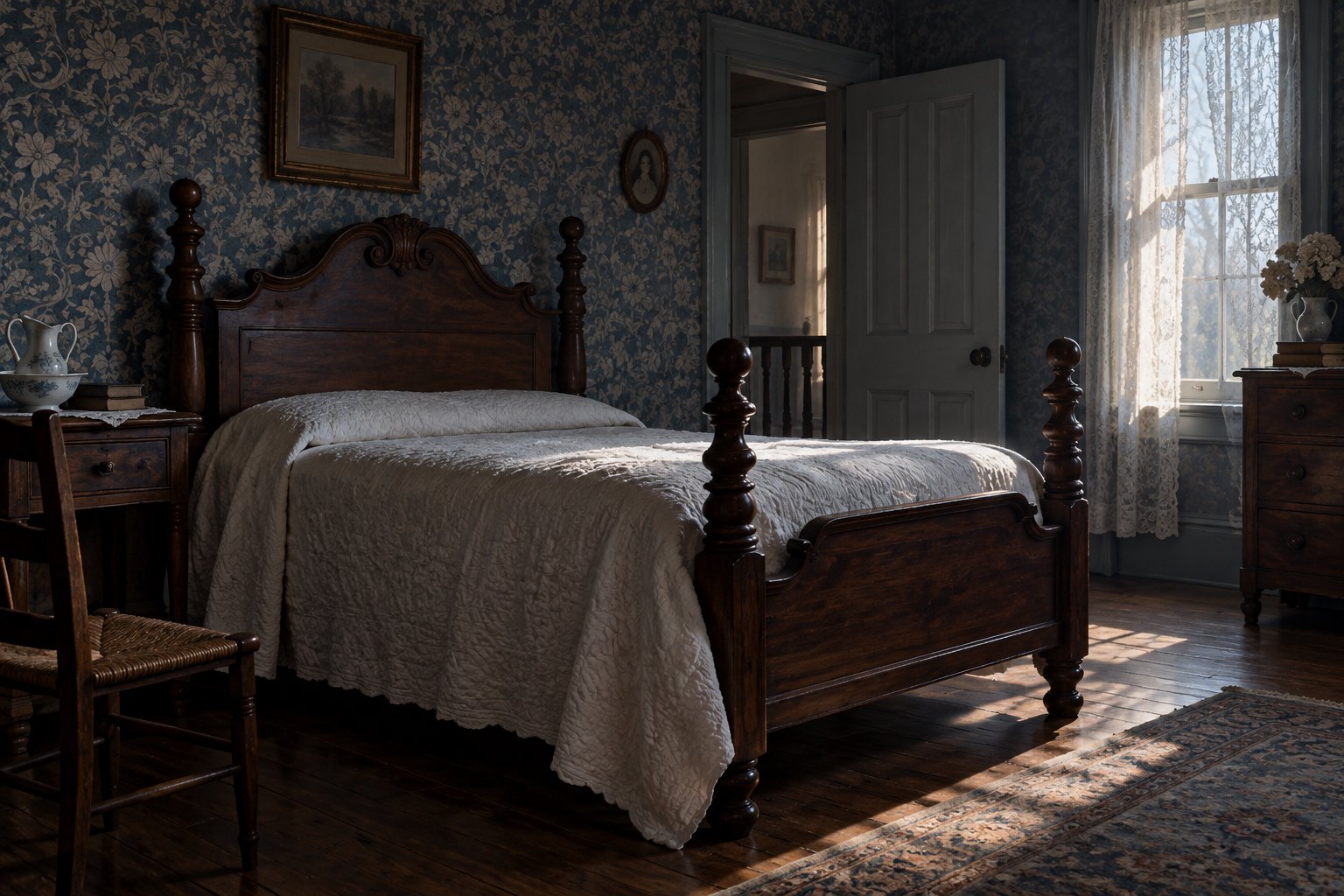
Sleeping in the room where Lizzie Borden’s stepmother was murdered promises an unusually intimate encounter with a notorious crime. The CBS News account places that overnight experience at its center. Yet the premise immediately invites a distinction: occupying the space where violence happened can change how someone feels about the past without establishing anything new about the violence itself.
For viewers drawn to the Borden story through true-crime television, that distinction matters. A room can make history feel close, immediate, and frightening. It cannot independently explain a person’s intentions. The most interesting critical question is therefore what this kind of encounter helps us notice—and what our appetite for a compelling story encourages us to imagine.
This is an analysis of the overnight-reporting premise and its implications for screen storytelling, rather than an episode review. It contains no dramatized plot spoilers.
What the overnight premise actually establishes
The central reported circumstance is straightforward: the CBS News account describes sleeping in the room where Lizzie Borden’s stepmother was murdered. That gives the article a physical point of entry into the case. It does not, by itself, establish a new solution, a supernatural encounter, or a discovery about the identity of the killer.
Those distinctions should shape expectations before the story becomes a mental movie. A firsthand account can establish what its narrator experienced during a visit. A historical conclusion requires supporting evidence. Fear, even when sincerely described, belongs to the former category.
There is also a crucial difference between reading an overnight account and having the experience oneself. The reader receives a selected sequence of observations. Choices about what appears first, which detail receives emphasis, and when information is withheld all influence the effect. That makes the premise especially relevant to film criticism: storytelling starts before anyone adds a soundtrack.
The visitor becomes the audience’s stand-in
An overnight visitor supplies a ready-made viewpoint. Readers can imagine arriving, settling into an unfamiliar space, and attempting the ordinary act of sleep while carrying extraordinary knowledge about the location. These are possibilities built into the premise, not claims about particular moments in the CBS account.
The emotional mechanism is strong because sleep involves surrendering attention. A visitor who knows a room’s association with murder may become unusually attentive before doing so. In cinematic terms, the audience already has the information necessary to regard an otherwise unremarkable setting with apprehension.
My judgment is that this approach works best when the visitor remains an observer whose reactions have limits. If personal unease becomes the story’s governing authority, the historical subjects risk becoming supporting characters in somebody else’s frightening night. The visitor gets an emotional journey; the victim gets a location.
A more revealing approach would keep asking what the experience changes in the observer’s understanding. Does it make an abstract account of violence feel human? Does it expose an expectation of entertainment? Either could be meaningful. Neither requires presenting an unsettling sensation as historical proof.
Giving Lizzie’s stepmother more than a role in Lizzie’s story
The phrase identifying the victim through her relationship to Lizzie is efficient: it connects an individual to the name readers recognize. But it also reveals a storytelling imbalance. Lizzie commands attention even in an account whose defining location belongs to her stepmother’s death.
A character-centered reading should notice that imbalance without filling it with invented biography. We cannot infer the stepmother’s private thoughts, emotional state, or daily relationships from the fact that someone later slept in the room. Sympathy becomes less trustworthy when it supplies imagined interiority and quietly passes it off as knowledge.
Still, a critic can ask how a story distributes attention. Does the victim register as a person, or mainly as the reason a bedroom is frightening? Does the narration acknowledge the difference between a visitor’s temporary discomfort and another person’s death? Those questions concern the work’s perspective, not a demand that every true-crime story adopt the same tone.
The ethical issue resembles the distinction explored in our analysis of how attention to individual lives changes a documentary’s moral perspective. In the Borden setting, the relevant question is whose experience remains visible when a place becomes the attraction.
Why a real room feels more persuasive than a set
A historic location carries an authority that a constructed set must work to achieve. Viewers may scrutinize a film’s wallpaper or furniture for authenticity while accepting the emotional meaning of an actual room almost instantly. Physical presence can make interpretation feel like observation.
But even a real location reaches an audience through framing. A wide shot might emphasize the room’s ordinary domestic scale. A close shot might isolate a doorway until it seems threatening. These are illustrative filmmaking choices, not descriptions of footage from the overnight report.
That difference between physical setting and narrative effect also informs our commentary on what real locations contribute to screen storytelling. A place supplies material; the camera determines how we encounter it.
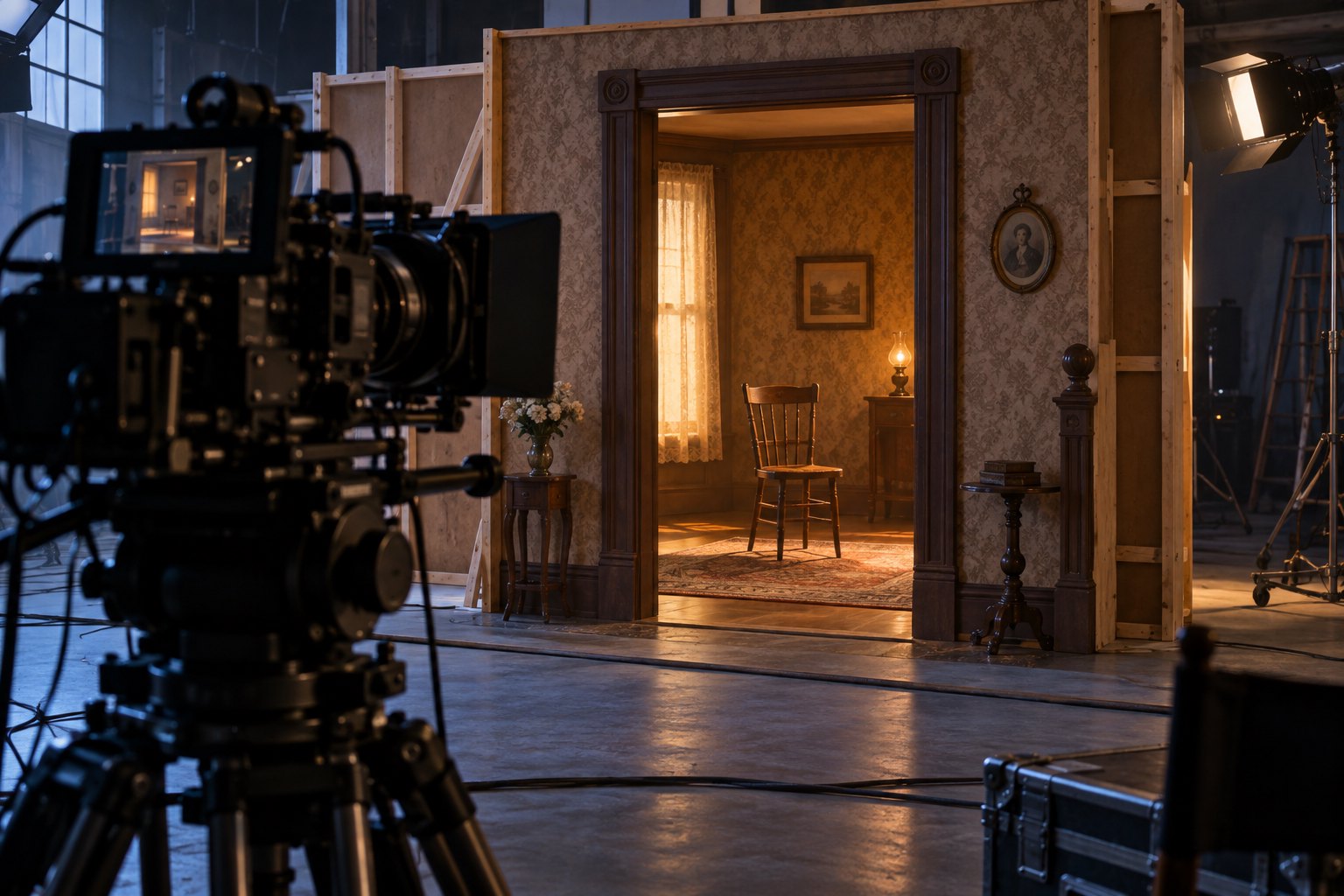
The illustrations here are conceptual, rather than reconstructions of the Borden room or images from a production. That distinction is part of the same principle: a convincing image should not acquire documentary authority simply because it looks plausible.
What to watch for in a Borden screen adaptation
The overnight story offers a useful lens for approaching a dramatization, but it cannot establish that dramatization’s scenes, dialogue, performances, or historical accuracy. Those require examination of the work itself. Memorable lines deserve close reading only when their wording and context can be verified.
For viewers, three questions help separate characterization from suggestion:
- Whose knowledge shapes the scene? A character’s suspicion is not automatically the story’s confirmed account of events.
- What makes the moment feel convincing? Performance, music, editing, and production design can create certainty without adding evidence.
- Who receives an inner life? Notice which characters have motives and contradictions, and which exist mainly to provoke another character’s reaction.
These questions allow room for imaginative drama. Fiction can propose interpretations, explore uncertainty, and build psychological tension. The critical responsibility is to recognize those achievements as dramatic choices before treating them as historical findings.
The deeper meaning of spending the night
The most compelling interpretation of the Borden-room premise concerns the desire behind the visit. Entering a place associated with violence offers a sense of contact with something otherwise unreachable. It turns historical distance into a bodily experience: being present, remaining there, and eventually leaving.
My view is that the premise has greatest value when that encounter produces humility. A visitor may gain a sharper awareness that the crime happened within a human environment. The room’s emotional force need not resolve every question to matter.
For film and television, that is a demanding standard. The strongest treatment would make us feel the setting’s significance while preserving the distinction between what characters believe, what a storyteller suggests, and what evidence establishes. A room can hold our attention. Understanding the people connected to it requires more than spending the night.
Original content by this site's editorial team. Published: September 17, 2026 at 10:05:38 PDT (Los Angeles time)