Quentin Tarantino plans to publish a Cliff Booth novel before the Brad Pitt and David Fincher movie streams on Netflix, according to Variety. For viewers who first encountered Cliff in Once Upon a Time in Hollywood, that order creates an intriguing possibility: meeting him through prose before watching Pitt make him readable—or unreadable—again.
The publishing announcement establishes a new book alongside the forthcoming film; it does not establish how closely their scenes, revelations, or perspectives will match. The publisher describes the novel as Tarantino’s own treatment of the story. [Publisher’s announcement](https://www.streetinsider.com/Business%2BWire/Quentin%2BTarantino%2Bto%2BRelease%2BSecond%2BNovel%2C%2BTHE%2BADVENTURES%2BOF%2BCLIFF%2BBOOTH%2C%2BThis%2BDecember/27061321.html)
The more interesting critical question is what happens when a character whose appeal depends on withheld information becomes the center of attention. Cliff’s silences are part of his characterization. Explaining them could deepen him, but explanation alone would not necessarily make him more compelling.
Spoiler warning: The following retrospective discusses major events and the ending of Once Upon a Time in Hollywood. It is not a review of the forthcoming novel or movie.
Cliff Booth’s real job is keeping Rick Dalton upright
In Tarantino’s 2019 film, Cliff is Rick Dalton’s stunt double, driver, helper, and friend. Rick worries about what the industry thinks of him. Cliff spends much of his day making Rick’s life function. Their relationship turns ordinary practical assistance into the movie’s emotional structure.
From Rick’s perspective, every professional setback threatens his identity. From Cliff’s, the next task remains manageable: drive somewhere, fix something, return at the end of the working day. Pitt makes that difference visible through relaxed posture and unhurried responses. Rick seems to require an audience even when he is falling apart; Cliff appears comfortable without one.
That apparent self-sufficiency makes his encouragement unusually effective. Before Rick goes to work, Cliff tells him, “You’re Rick fucking Dalton. Don’t you forget it.” The line gives Rick something practical to carry onto the set: a version of himself that somebody still believes in. The exchange follows Rick’s acknowledgment that there is no stunt work for Cliff that day, which makes the generosity more pointed. [Film dialogue transcript](https://www.springfieldspringfield.co.uk/movie_script.php?movie=once-upon-a-time-in-hollywood)
My reading is that Cliff’s appeal begins here, before any display of physical prowess. He does not need to turn another man’s insecurity into a contest. Yet this friendship also involves employment and dependence. Rick’s troubles can cost Cliff his livelihood, whether Cliff complains or not.
Pitt’s charm leaves a moral question open
The film also raises the suspicion that Cliff killed his wife. Its brief boat scene does not show a completed act that settles what happened. That distinction matters: the uncertainty belongs to the film’s construction, and a reading of this film should preserve it.
Cliff can be attentive toward Rick while remaining deeply troubling as a person. His competence gives the audience reasons to trust him in a crisis. His history gives us reasons to question what that trust means.
Pitt’s performance lets those responses coexist. A small smile can register as warmth, amusement, or the confidence of someone who expects to control the situation. The viewer supplies part of the interpretation, often because the actor is so enjoyable to watch.
This is where a Cliff-centered novel becomes especially interesting. Prose can disclose motives that a face conceals, but it can also expose the stories people tell themselves. A fuller account would be valuable if it complicates our judgment. A simple explanation that makes every unsettling detail harmless would sacrifice something essential.
At Spahn Ranch, familiarity becomes a trap
Cliff’s visit to Spahn Ranch places his confidence inside an environment the audience experiences as threatening. He arrives with a personal connection to the place and wants to check on George Spahn. That concrete objective matters: he is not entering the scene with the viewer’s broader understanding of where the film’s historical references lead.
The sequence stretches the distance between what Cliff believes he can handle and what we fear might happen. His directness meets evasiveness. His willingness to keep walking makes a simple visit feel like an escalating challenge.
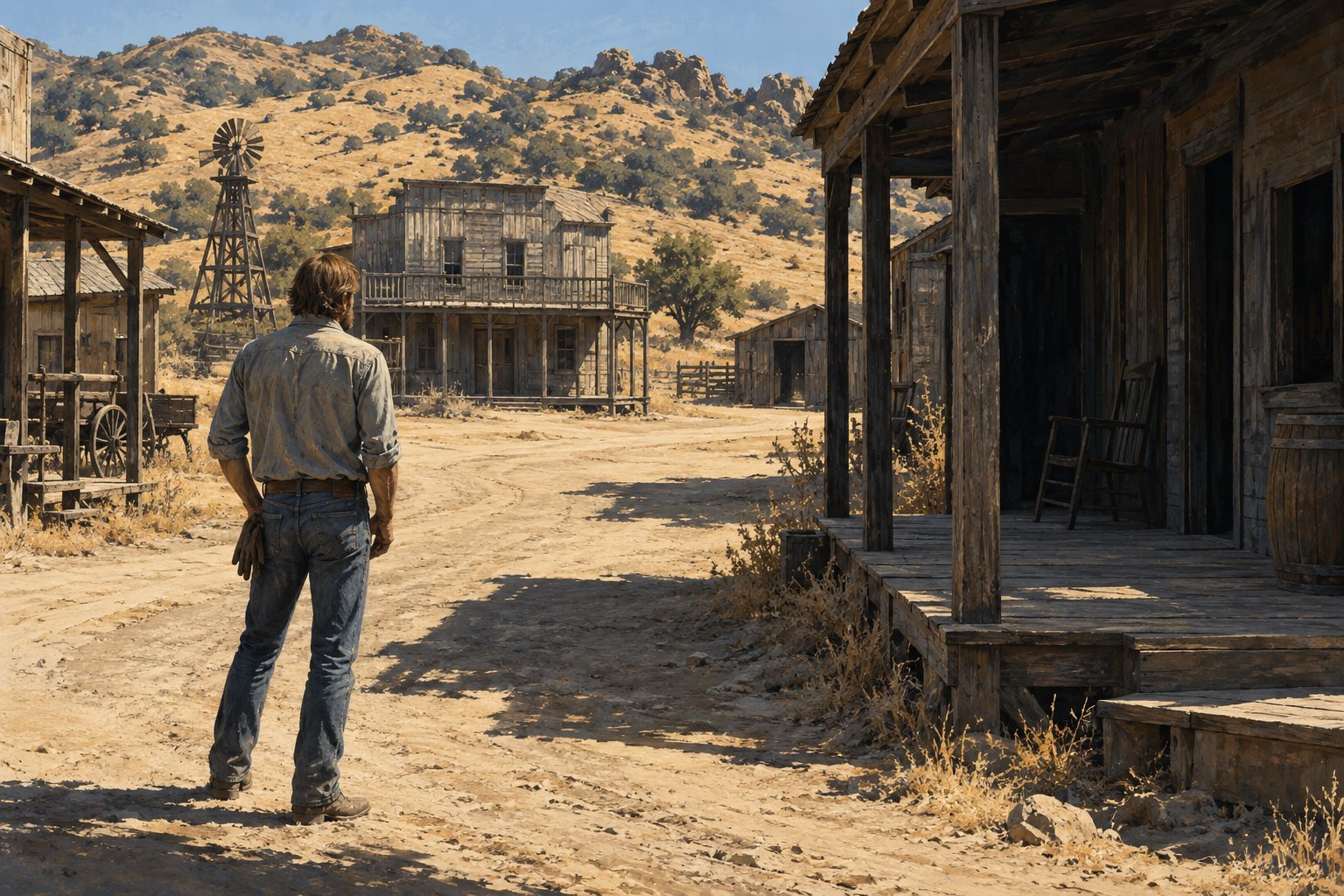
The setting carries much of that pressure. A place associated with making Westerns becomes somewhere Cliff must navigate an actual confrontation. The connection between geography and dramatic behavior also informs our commentary on what a real location contributes to a movie: a convincing space gives characters meaningful distances to cross and thresholds to hesitate before.
For me, the ranch passage is the strongest argument that Cliff can sustain extended attention. The suspense depends on watching him assess people, decide what matters, and proceed. It does not require constant access to his thoughts.
The ending turns a supporting worker into a protector
During the final home invasion, Cliff and his dog, Brandy, fight the attackers inside Rick’s house; Rick subsequently uses a flamethrower against the attacker who reaches his pool. The fictional intervention prevents the historical outcome associated with Sharon Tate’s home. Cliff is taken away for treatment, while Rick receives an invitation from his neighbors. [Film plot reference](https://en.wikipedia.org/wiki/Once_Upon_a_Time_in_Hollywood)
The division of action extends the friendship’s everyday arrangement into grotesque fantasy. Cliff handles danger close up. Rick supplies the spectacular flourish. A stunt double’s profession—absorbing physical risk while somebody else occupies the spotlight—becomes the basis of an alternate-history rescue.
That is also where my admiration becomes uneasy. The film makes Cliff’s violence useful and exhilarating without resolving every concern surrounding him. His effectiveness in this emergency cannot answer all the questions about his past.
The distinction is central to any future assessment of the character: helping someone establishes a meaningful action, not a complete moral biography. An audience can appreciate the rescue and still resist treating charisma as proof of innocence.
What reading Cliff before watching him could change
A novel encountered before the Netflix release may establish expectations about Cliff’s motives, temperament, and inner life. Readers could then interpret Pitt’s pauses through information they already possess. Viewers coming directly to the movie may experience those same pauses as unanswered questions.
Neither approach is inherently superior. But it is worth noticing whether a scene communicates its meaning through performance and staging, or whether familiarity with another version is doing the explanatory work. Each version should earn its emotional effects.
For Fincher’s film, the useful critical question will be how Cliff behaves when attention remains on him. Does he reveal himself through choices? Can his relationships challenge his self-image? Those are standards for judging the finished work, not predictions about its plot. They connect with our discussion of why character development matters more than an impressive creative lineup.
A small verbal callback contains the larger character
One rewarding detail to notice on a rewatch is Cliff’s repeated “I try.” He uses it early when his friendship is praised and again near the ending when Rick thanks him. The understated response survives everything the film puts between those moments.
That repetition offers a deeper interpretation of Cliff than invulnerability alone. He organizes himself around being useful to someone, yet usefulness does not make him fully knowable. The affection is tangible; the uncertainty remains.
The forthcoming novel’s most promising possibility is therefore not simply more information about Cliff Booth. It is another way to examine the gap between being a dependable friend and being a good man. The original film gives that gap warmth, humor, and menace. Any return to Cliff will be more interesting if it recognizes how much lives there.
Original content by this site's editorial team. Published: September 17, 2026 at 10:41:03 PDT (Los Angeles time)