
Patrick Stewart has died at 86, as reported by The Hollywood Reporter. His association with Captain Jean-Luc Picard in Star Trek and Professor Charles Xavier in X-Men made him a familiar embodiment of thoughtful leadership. Yet some of his most compelling screen work comes when those characters lose their composure, misjudge a situation, or need someone else to help them.
Two films make an especially revealing double feature: Star Trek: First Contact and Logan. Their circumstances differ enormously, but both ask what remains of a respected leader when authority stops protecting him. Stewart answers through anger, embarrassment, stubborn affection, and the effort of listening.
Spoiler warning: This retrospective discusses major developments in both films, including character deaths in Logan. The critical judgments below concern the performances and storytelling, rather than additional claims about Stewart’s death.
First Contact: Picard’s certainty becomes the danger
First Contact sends the Enterprise crew into Earth’s past to prevent the Borg from disrupting humanity’s first encounter with an alien civilization. The large-scale mission is easy to understand. Picard’s personal mission is considerably less straightforward: he wants to defeat an enemy that previously took possession of his body and identity.
That history changes how his authority feels. His knowledge of the Borg is useful, but his intimacy with their violence makes detachment impossible. Stewart lets the captain’s disciplined manner become a pressure vessel. The familiar precision remains, while the feeling underneath grows increasingly dangerous.
“The line must be drawn here” sounds like the declaration audiences expect from a decisive commander. In context, however, it exposes a man who has begun to confuse an operational boundary with an emotional one. The force of the delivery is thrilling; the judgment behind it deserves scrutiny.
This is the performance’s central achievement. Stewart makes Picard persuasive enough that viewers can understand why others would follow him, even as the film gives us reasons to question that loyalty. A less convincing captain would make the moral problem too easy.
Lily makes the captain listen
Lily Sloane matters because she can challenge Picard without sharing the reverence attached to his position. She encounters a man making decisions that affect other lives. His reputation does not settle the question of whether those decisions are sound.
Their confrontation turns the film’s literary connection to Captain Ahab into an accusation Picard cannot comfortably dismiss. Stewart’s anger is impressive, but the quieter adjustment afterward is more revealing. He must recognize himself in an interpretation he dislikes.
For me, that makes First Contact more satisfying than its action alone would suggest. The captain’s recovery depends on accepting criticism. His intelligence becomes valuable again when he stops using it to defend his grievance.
The relationship between public responsibility and private damage also runs through our discussion of James Stewart’s wartime experience and Hollywood homecoming. The circumstances are different, but both invite a closer look at the burdens concealed by a reassuring screen presence.
Logan: Charles Xavier still wants to matter
James Mangold’s Logan places Stewart’s Charles Xavier in a painfully reduced world. Logan cares for his ailing former mentor near the Mexican border, until the arrival of Laura, a young mutant, disrupts their isolation. The relationship has become practical and exhausting: protection means medication, shelter, patience, and arguments.
Stewart resists making Charles merely sweet or pitiable. He can be abrasive. He resents his circumstances and the limits imposed on him. His vulnerability does not erase the personality of someone accustomed to understanding a room before anyone else does.
“I always know who you are,” Charles tells Logan, before adding, “Sometimes I just don’t recognize you.” The distinction catches their relationship beautifully. Recognition involves more than identifying a face. Charles remembers a person capable of connection, while Logan increasingly organizes his life around withdrawal.
From Logan’s perspective, withdrawal offers protection. From Charles’s perspective, it has become another kind of confinement. Stewart gives the second position enough conviction that it cannot be brushed aside as sentimental confusion.
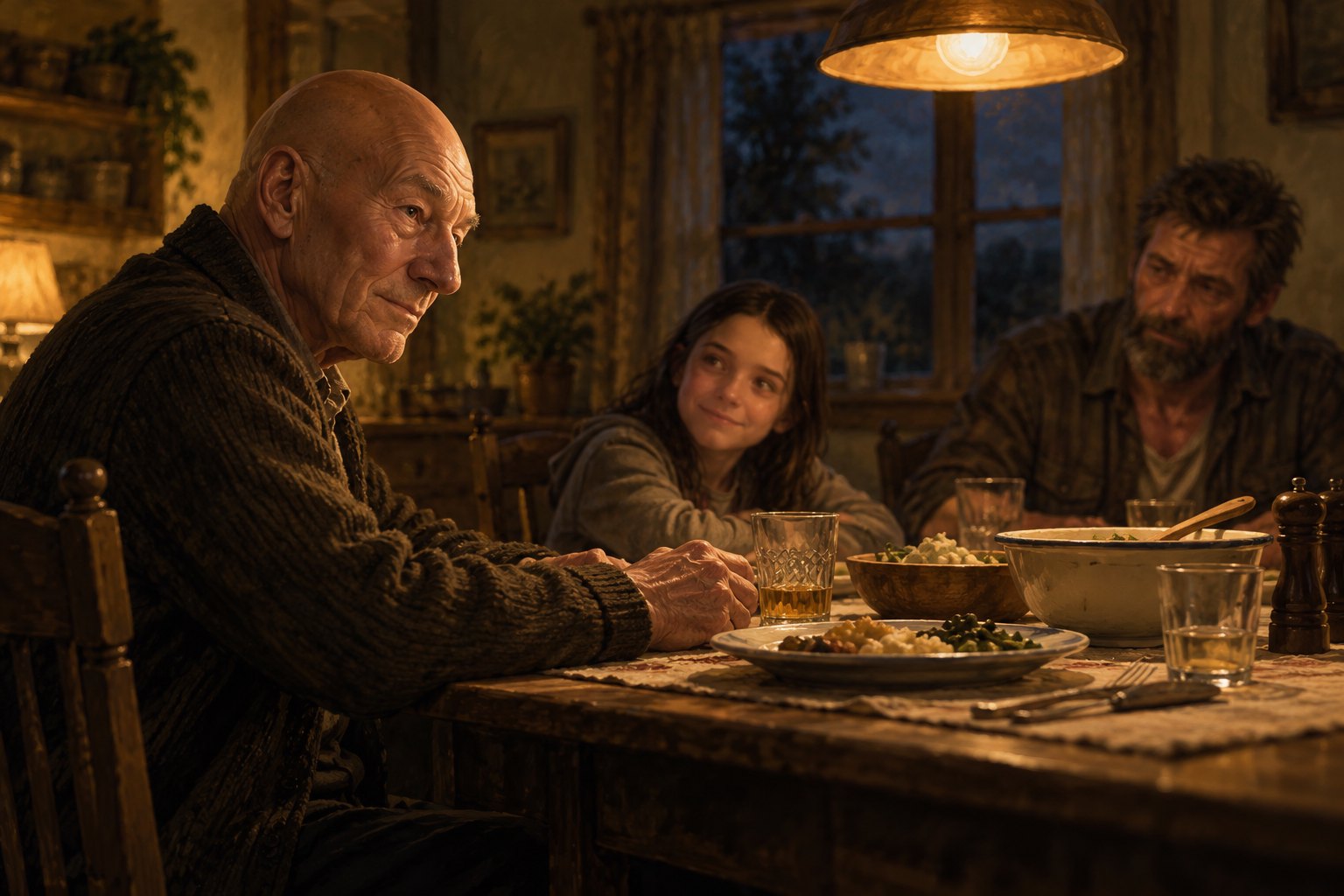
The farmhouse dinner is Charles’s version of victory
The meal with the Munson family briefly allows Charles, Logan, and Laura to participate in ordinary domestic life. Charles welcomes the opening. Logan remains alert to danger. Laura watches a form of togetherness that cannot be explained through combat or escape.
For Charles, the evening represents something worth pursuing in its own right. A shared table gives his ideals a physical shape. People make room, pass food, and attend to one another. The film’s most persuasive argument for community takes place at this modest scale.
Stewart makes Charles’s pleasure moving without making it entirely comfortable. The audience knows how precarious the arrangement is. His desire for a family evening can be emotionally right while remaining practically risky. The film allows both judgments to coexist.
That tension connects with the question of whether care can become control in our analysis of The Inventor’s Wife. Logan approaches the problem through caregiving: keeping someone safe does not automatically satisfy their need for dignity, participation, or choice.
A death that denies the comfort of a farewell speech
Charles’s encounter with X-24 is devastating because he initially mistakes the figure for Logan. His openness meets a familiar appearance emptied of the relationship that should make it safe. The scene turns recognition itself into a trap.
I find Stewart’s performance more affecting than the mechanism of the shock. The story risks making the farmhouse’s warmth seem like an invitation to punishment. Its violence is so emphatic that it can crowd out the subtler questions raised by the dinner.
Yet Charles remains more than the victim of that reversal. Stewart has already established his impatience, humor, dependence, and longing. The loss hurts because those contradictory qualities belong to a person, rather than because a franchise has removed a revered figure.
The deeper connection: goodness requires other people
Picard and Charles expose two limits of heroic self-sufficiency. Picard needs someone to interrupt his certainty. Charles needs people who will help him live without treating his continued existence as the whole purpose of care.
Stewart’s great contribution to these films is the credibility he gives that dependence. These men retain intelligence and moral seriousness while needing correction, assistance, and affection. Their dignity survives the acknowledgment of weakness.
Watching the films together, I find their strongest shared idea in the difference between having principles and practicing them. Picard must allow another person to change his mind. Charles must keep reaching toward companionship despite humiliation and fear. Neither achievement can be performed alone.
The Shane reference gives Charles an afterlife in the story
Logan includes an explicit reference to the Western Shane, which Charles and Laura watch. Laura later draws on that film at Logan’s burial. This is more than an Easter egg for movie enthusiasts: a shared viewing experience becomes language she can use when her own experience overwhelms her.
Charles’s influence continues through that act of attention. He has helped place a story within Laura’s reach, and she gives it new meaning. It is an apt final image for considering Stewart’s screen work: a performance remains available to another person, who may discover its deepest usefulness long after first encountering it.
Original content by this site's editorial team. Published: November 1, 2026 at 12:06:49 PST (Los Angeles time)