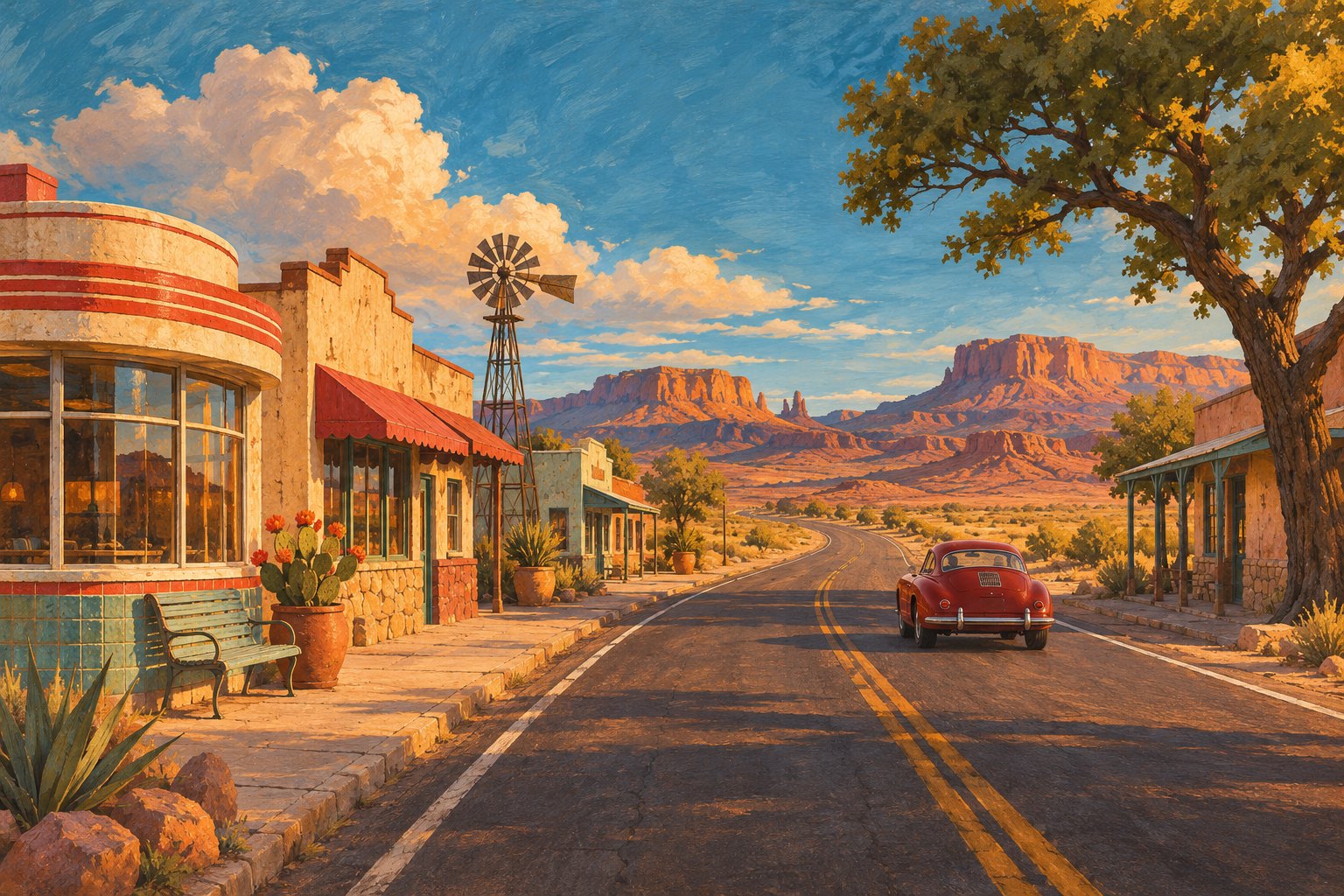
Route 66’s centennial brings the real-world inspiration behind Cars back into focus. NPR’s anniversary coverage visits Seligman, Arizona, identifying its connection to the fictional Radiator Springs. For viewers revisiting Pixar’s film, that connection offers a useful starting point: the town is much more than the place where Lightning McQueen learns manners. It gives the movie its most affecting subject—the experience of being passed by. [NPR’s centennial report](https://www.nhpr.org/2026-11-28/the-town-that-inspired-the-film-cars-celebrates-the-centennial-of-route-66)
Spoiler warning: This retrospective discusses the original film’s character arcs and ending.
My judgment is that Cars works best when it lets its residents challenge Lightning’s definition of success. The racing is lively, and the automotive jokes are plentiful, but Sally and Doc give the spectacle something worth returning to. Their attachment to a neglected place makes the centennial an especially revealing occasion to watch again.
The town is the story, not simply the scenery
Radiator Springs is fictional. Pixar describes its creation as growing out of research trips along Route 66, with the setting drawing on the high desert between Gallup and Kingman. That broader creative background matters: a real town’s connection to the film should not turn the animated community into a literal historical portrait. [Pixar’s account of the film’s setting](https://www.pixar.com/cars)
Within the movie, however, the town feels unusually specific. Its businesses are extensions of the residents’ personalities. A service offered at a tire shop or café also becomes a way of participating in communal life. The humor depends on these recognizable habits: expertise, pride, gossip, hospitality, and the hope that somebody new might finally stop.
That gives the centennial connection substance beyond nostalgia. A road can remain physically present while losing its place in other people’s lives. Cars makes that loss understandable through characters who still have something to offer, even when the wider world has stopped looking.
Lightning McQueen confuses movement with purpose
“I am speed,” Lightning tells himself. It is an excellent introduction because it sounds like confidence while revealing an alarmingly narrow identity. If speed defines him, then slowing down threatens his entire sense of worth.
Stranded in Radiator Springs and required to repair the road he damaged, he initially treats the town as an interruption. The dramatic joke is that he cannot imagine an experience becoming valuable unless it advances his racing career. A conversation is a delay; another car’s needs are a complication.
His roadwork is therefore a stronger device than a simple lecture about kindness. Repair demands time and care. He has to confront the difference between finishing something and doing it properly. The town becomes legible to him through the work he would rather avoid.
The film also asks its audience to undergo a smaller version of that adjustment. After the opening competition, the quieter middle can feel leisurely. Some comic business stretches the lesson, and viewers seeking constant racing may grow impatient. Yet the change in tempo has a purpose: we have to spend enough time in Radiator Springs to understand why leaving might hurt.
Sally sees a future where Lightning sees a dead end
Sally’s importance extends beyond her role as a romantic interest. She has chosen Radiator Springs, and her commitment gives her a perspective Lightning cannot initially understand. To him, an impressive life means reaching a more prestigious destination. To her, it means recognizing a place worth caring for.
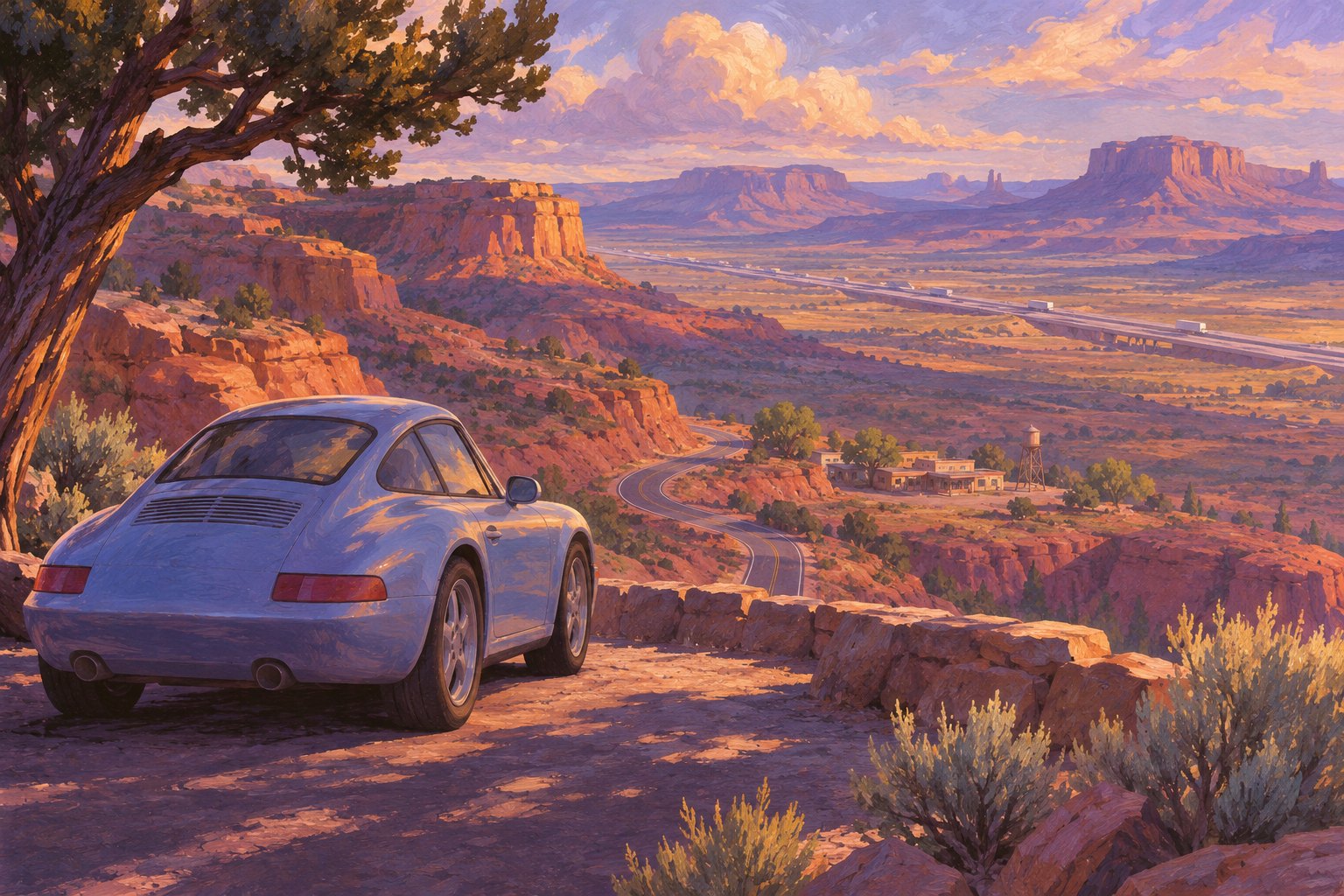
Her drive with Lightning changes the visual argument of the movie. Open space becomes something to notice rather than cross as quickly as possible. The road’s curves invite attention. Distance stops being merely the gap between a racer and his next opportunity.
Sally’s explanation of the bypass supplies the town with a history, but her hope for its recovery supplies the film with a future. She is not asking Lightning to admire a picturesque ruin. She wants a living community to flourish.
There is a limitation here: Sally often has to explain the film’s values while Lightning gets the more conspicuous transformation. Still, her conviction makes belonging feel like an active choice. That distinction also shapes our discussion of home and belonging in An American Tail: a destination acquires meaning through the relationships it makes possible.
Doc Hudson makes the town’s abandonment personal
Doc’s history gives the film its sharpest emotional parallel. A former racing champion discarded after a crash, he understands what it means to be treated as obsolete. His blunt recollection—“They quit on me”—cuts through Lightning’s assumption that talent naturally receives recognition.
Seen through Doc’s experience, Radiator Springs becomes more than a refuge from ambition. It is somewhere a person can remain useful after the institution that once celebrated him moves on. His judgment and knowledge retain their value even without an audience.
That does not make Doc automatically wise about everything. His hostility toward Lightning reveals how easily self-protection can become unfairness. The newcomer reminds him of a world that hurt him, and he lets that association shape his behavior.
This complication is essential. An entirely benevolent mentor would make Lightning’s education too easy. Doc also needs to reconsider himself: he must decide whether protecting his dignity requires keeping everyone at a distance. His eventual involvement in Lightning’s racing allows experience to become a gift again.
Mater offers friendship without a transaction
Mater approaches Lightning with an openness that the racing world rarely encourages. His friendship does not depend on securing a sponsorship or improving his status. For someone accustomed to performing importance, that uncomplicated interest is quietly destabilizing.
The broad comedy sometimes overwhelms this function. Mater can pull a scene toward a punch line just when the town’s melancholy is becoming interesting. But his emotional contribution remains clear: he gives Lightning practice at enjoying another person’s company without calculating an advantage.
The strongest character writing here lets friendship change what success feels like. That is also the question behind our analysis of mentorship and confidence in Way of the Warrior Kid: improvement becomes meaningful when it changes how someone relates to others.
The ending earns its emotion—and simplifies recovery
When Lightning sacrifices victory to help the wrecked King finish, the lesson finally becomes a choice with a cost. “It’s just an empty cup” revises his opening declaration. He can still love racing without letting the trophy determine another competitor’s worth. The film’s dialogue traces that movement from self-definition through speed to an understanding of responsibility. [Cars dialogue transcript](https://www.springfieldspringfield.co.uk/movie_script.php?movie=cars)
The moment works because compassion becomes visible behavior. Lightning does not simply announce that he has changed. He stops when everything in his old worldview tells him to keep going.
The town’s happy ending is easier to question. The film places enormous faith in the attention a celebrity can bring. As a fantasy of recognition, that is satisfying. As an account of community renewal, it is incomplete: affection and publicity are not the same thing as lasting stability.
That tension makes the Route 66 anniversary especially useful for interpreting Cars. The film celebrates places that deserve attention independently of whether a famous visitor discovers them. Its deepest insight is that neglect does not prove a lack of value. Sally already knows this; Doc has struggled to believe it about himself; Lightning finally learns to act on it.
A visual detail worth watching again
Look beyond the characters at the landscape. Pixar’s production account describes shaping the environment with automotive forms, allowing the world itself to echo its inhabitants. These visual jokes reward a slower look—the very habit Lightning needs to develop.
That is why the centennial feels like such a fitting invitation to revisit the film. Beneath the gleaming surfaces and noisy competition, Cars asks for a simple but demanding change of attention: notice the lives beside the road, and recognize that arriving first is only one possible reason to travel.
Original content by this site's editorial team. Published: November 28, 2026 at 15:24:48 PST (Los Angeles time)