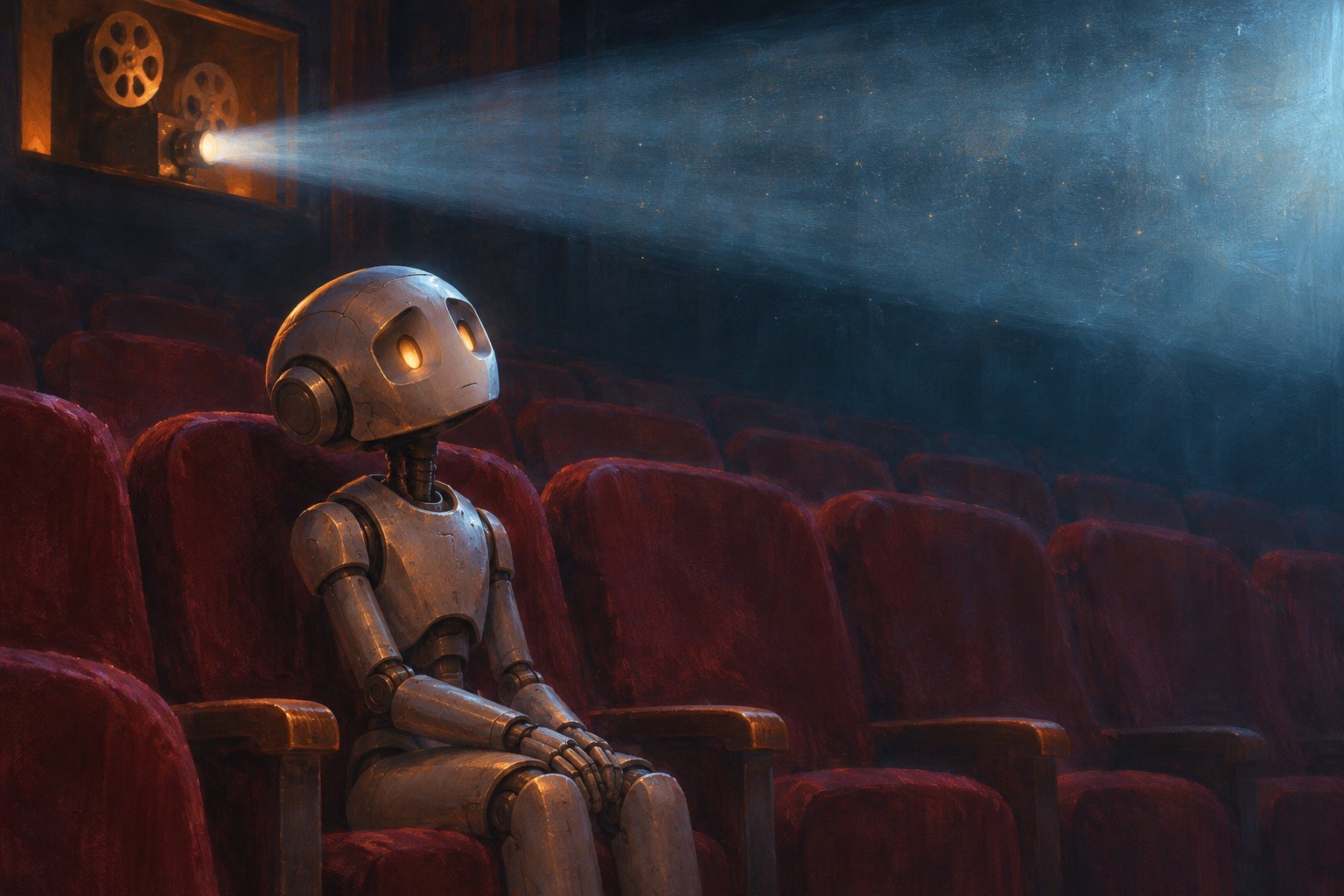
Rigorously Curated’s exploration of sentience, technology, and the “sad robot,” reported by the Brown Daily Herald, raises a question more interesting than whether machines can imitate human feelings: what happens when an intelligence wants a life beyond the purpose assigned to it?
Mamoru Oshii’s Ghost in the Shell offers an especially demanding way into that question. The 1995 animated film makes technological power feel inseparable from personal uncertainty. Its central character, Major Motoko Kusanagi, can accomplish extraordinary physical feats while remaining unsure what makes her herself. Viewed through the festival’s theme, that uncertainty becomes the emotional center of the movie.
Major spoilers follow for Ghost in the Shell, including its ending. This is a critical reading of the film and the festival’s central issue, rather than an account of audience reactions or screening discussions.
Motoko’s body gives her power without giving her certainty
Motoko works within an institution that values what she can do. Her cybernetic body makes her an exceptionally capable operative, but capability provides little comfort when she considers her own origins and identity. The film’s most productive tension lies between those two experiences: being useful to others and being intelligible to yourself.
From Motoko’s perspective, the body is both an instrument and a question. It allows her to act decisively, yet it cannot settle whether the person acting possesses a stable, continuous self. That makes the film’s attention to her physical form more unsettling than ordinary action spectacle. We are looking at something powerful whose ownership and meaning remain uncertain.
My reading is that her apparent emotional distance belongs to this predicament. She is difficult to read because she is also trying to read herself. A conventional character arc might uncover a buried, authentic personality beneath the hardware. Oshii makes that expectation increasingly difficult to sustain.
This is where the sad robot idea becomes useful without fitting Motoko literally or completely. Her trouble is not simply loneliness, and she is not merely a machine waiting to become human. She inhabits a condition in which familiar assurances about personhood have stopped working.
The Puppet Master wants recognition, not reassurance
The Puppet Master turns the investigation toward a different kind of demand. In one English-language version, it declares, “As an autonomous life-form, I request political asylum.” The sentence matters because it asks for consequences. Recognition would change how others are permitted to treat this intelligence.
That makes the encounter more challenging than a scene designed merely to prove that a machine can sound sympathetic. The Puppet Master does not depend on an appealing face or a display of helplessness. Its argument interrupts the institutional categories surrounding it: program, threat, evidence, property.
From its perspective, the officials’ refusal is circular. They assume the category that allows them to dismiss its claim, then treat that dismissal as proof. The dramatic force comes from watching a speaker make itself understood while remaining unacceptable to the people listening.
Yet the film does not make recognition synonymous with innocence. The Puppet Master’s manipulation of others prevents a comfortable division between a virtuous artificial being and cruel humans. A claim to personhood does not erase responsibility. That complication strengthens the film: an intelligence can deserve consideration without deserving unquestioning trust.
For viewers approaching the festival’s theme, this is a valuable distinction. Feeling sorry for a fictional machine is easy. Taking its interests seriously when they conflict with human interests is a much harder imaginative task.
Batou makes an abstract problem personal
Batou brings another perspective into Motoko’s uncertainty. His concern for her gives the film a relationship through which its philosophical questions acquire emotional weight. Whatever Motoko may be, she is someone whose fate matters to him.
That attachment does not resolve her doubts. Someone else’s affection cannot provide an authoritative account of your consciousness. But it changes the stakes of her search. Her decisions affect a person who wants her to survive and remain recognizable.
To me, this is one of the movie’s strongest choices. It allows care and understanding to remain imperfectly aligned. Batou can care about Motoko without sharing the full extent of her restlessness. Motoko can value him without accepting his concern as a reason to stop exploring.
The result is a quieter kind of sadness than the familiar image of an abandoned robot. Intimacy exists, but it cannot remove the distance between two experiences. The film trusts that distance to carry feeling without requiring an explanatory speech.

The merger makes transformation genuinely unsettling
The Puppet Master eventually proposes merging with Motoko. Her response cuts through the expansive language surrounding the proposal: “What guarantee is there that I’ll remain ‘me’?” English translations vary, but the underlying fear is unmistakable.
That question gives the ending its force. Growth is usually presented as something a character undergoes while remaining fundamentally available to the audience. Here, transformation threatens the very continuity that would let us call it personal growth.
From Motoko’s perspective, the offer opens a future beyond the boundaries she has been examining. It also removes the possibility of knowing that future in advance. She cannot first experience the result and then decide whether the choice preserves enough of her.
The resulting consciousness, housed in a different body, therefore resists an uncomplicated victory reading. Something has become possible, but the familiar character cannot simply resume her place unchanged. My judgment is that the ending works because it preserves both the exhilaration and the cost of that departure.
The film’s explanatory dialogue can be heavy. At times, characters state ideas that its imagery has already made available. Nevertheless, the final transformation gives those ideas a dramatic consequence. The debate changes who can exist, rather than merely decorating an action plot with philosophical vocabulary.
What the festival’s sad robot theme helps us notice
A thematic festival can make familiar movies newly legible by changing the question an audience brings into the theater. Our discussion of how film festivals focus attention on different creative voices considers a related value of programming: selection creates an opportunity for more deliberate viewing.
For Ghost in the Shell, the useful question is not simply whether technology makes people less human. It is whether the categories used to recognize a person can accommodate someone who changes beyond our expectations. That also connects with our character-focused reading of Minority Report, where attention to an individual’s experience complicates the confidence of a larger system.
The deeper sadness in Oshii’s film comes from the desire for certainty: certainty that memory secures identity, that affection guarantees understanding, or that survival means remaining the same. Motoko’s ending withdraws those promises. What remains is the possibility that a life can matter even when its future exceeds the terms on which others first recognized it. That is what makes the festival’s sad robot theme a serious invitation to look again.
Original content by this site's editorial team. Published: November 18, 2026 at 01:02:39 PST (Los Angeles time)