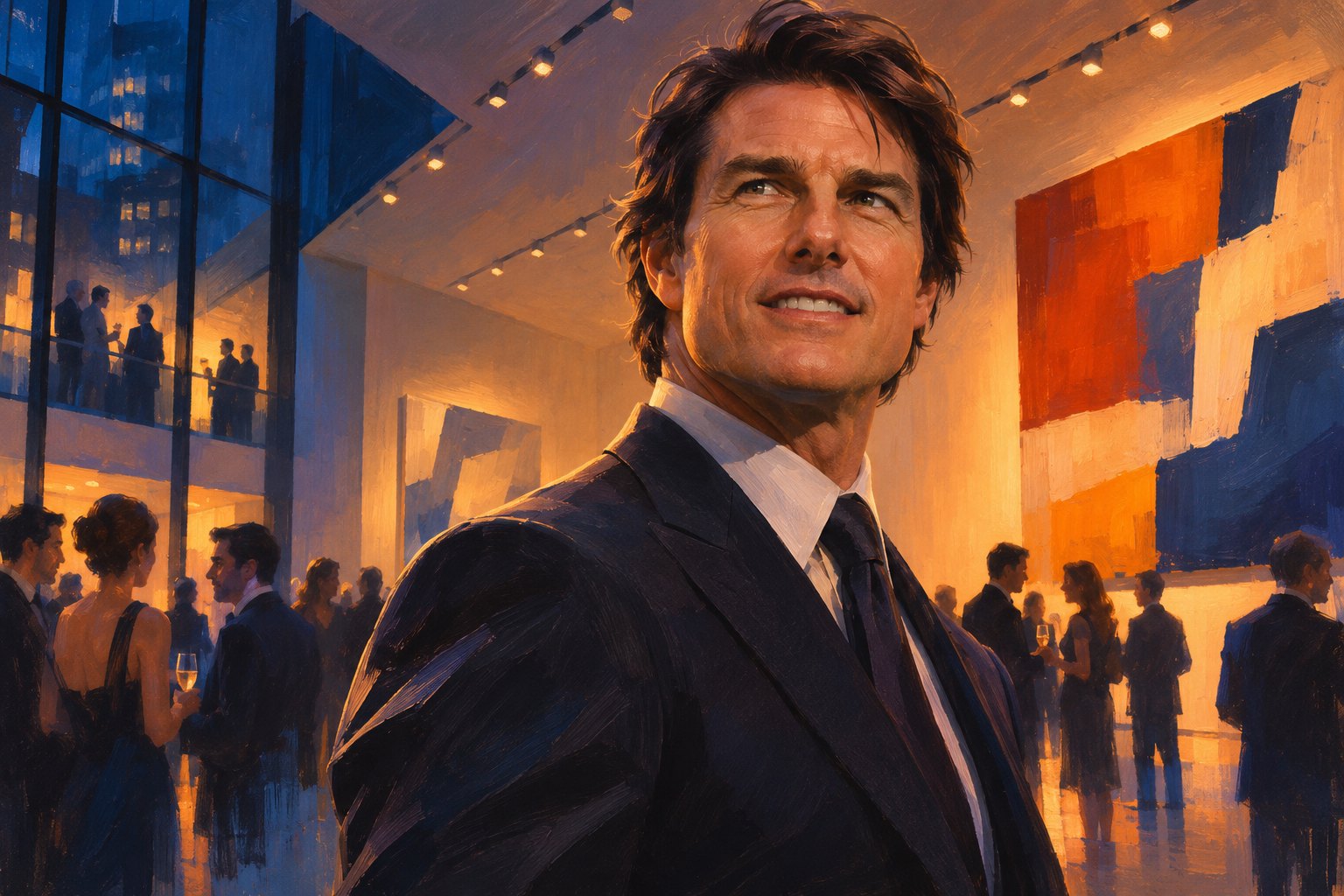
Tom Cruise’s appearance at MoMA, covered by The New York Times under the headline “Tom Cruise Parties at MoMA,” brings a familiar movie star into a setting that invites a different kind of attention. The immediate attraction is the celebrity sighting. For movie lovers, the more rewarding question is what happens when we look at Cruise’s performances with the patience we bring to an artwork.
The party headline alone does not establish conversations, announcements, or anyone’s intentions. It does, however, offer an occasion to reconsider the work behind the public image. Steven Spielberg’s Minority Report provides an especially revealing example: a film that uses Cruise’s authority and physical confidence to make a man’s collapse more disturbing.
Major spoilers follow for Minority Report, including its central mystery and ending.
Why a museum appearance invites a closer look
Celebrity coverage compresses a career into an instantly recognizable face. Film criticism has the opposite responsibility: to slow recognition down. What is an actor doing with posture, hesitation, or the space between a confident statement and an uncertain response?
A museum setting makes that distinction particularly suggestive. Popular entertainment can reward sustained attention without losing its pleasures. A chase can reveal a character’s mistaken assumptions. An effects sequence can expose a society’s priorities. The question is how those elements work together.
As our discussion of judging movies through their characters argues, prestige becomes more meaningful when we connect it to what actually happens onscreen. Cruise’s MoMA appearance supplies the occasion; his performance must supply the evidence.
John Anderton: a man who needs the system to be right
Released in 2002, Minority Report was Cruise’s first film with Spielberg. Its screenplay, by Scott Frank and Jon Cohen, adapts a story by Philip K. Dick. Cruise plays John Anderton, a leading officer in a Washington, D.C., police operation that arrests people for murders predicted by three psychically gifted people known as Precogs.
The premise becomes personal when Anderton is identified as a future killer. But the performance is compelling before that reversal. Anderton’s professional certainty is inseparable from the disappearance of his son. Preventing violence gives him a task he can complete when his own loss remains beyond repair.
My reading is that Cruise makes competence look like an emotional defense. Anderton moves decisively through his work because stopping would leave room for grief. His command of the images before him suggests mastery, yet the private man cannot arrange his memories into anything that restores his family.
This is a productive use of Cruise’s screen presence. The energy that often promises audiences a solution becomes a symptom of the problem. Anderton can keep moving, but movement alone cannot establish that he understands what he sees.
When the pursuer becomes the suspect
Once Anderton becomes a target, the movie’s spectacle acquires a cruel symmetry. Methods he accepted as necessary now threaten him. His objection begins with his own presumed innocence, forcing an uncomfortable question: why did uncertainty become urgent only when the accusation reached him?
Cruise does not need to make Anderton suddenly wise for the reversal to work. Fear comes first. The character wants an exception before he understands the larger injustice. That limitation makes him more interesting than a hero who instantly discovers the correct moral position.
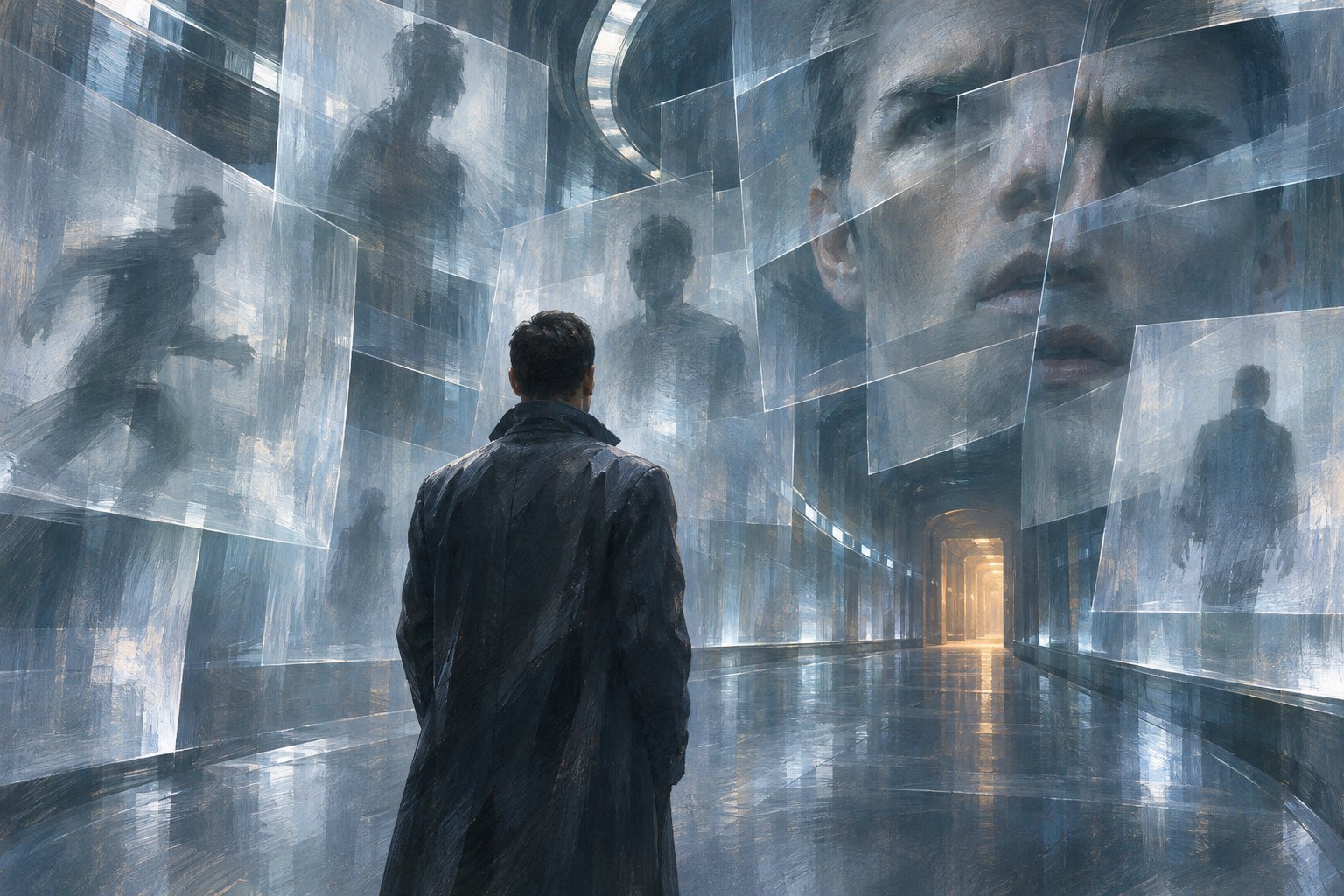
Spielberg’s pursuit sequences consequently function as arguments about power. The city offers extraordinary mobility while making anonymity increasingly difficult. Anderton’s body, usually his reliable instrument, becomes something that can be recognized, tracked, and cornered.
In my view, the film is strongest when action changes our understanding of its protagonist. The pleasure of watching Cruise escape remains intact, but escape no longer proves that his earlier beliefs were sound.
Agatha changes what the movie asks us to see
Samantha Morton’s Agatha is essential to that moral shift. Anderton initially needs her because he believes she may hold information that can clear him. His purpose remains practical: find the evidence, solve the problem, survive.
Yet Agatha cannot be reduced to the evidence she produces. Morton’s vulnerability makes the cost of the operation visible. The institution depends on a person whose experiences it processes as useful information, while giving her little control over her own existence.
Her question, “Can you see?”, reaches beyond the mechanics of prediction. Anderton spends much of the film examining images. Understanding another person requires something different from extracting a clue.
That distinction also gives the central partnership its emotional force. Cruise supplies urgency; Morton interrupts it. Her presence asks him, and the audience, to attend to suffering that cannot be solved simply by reaching the next destination faster.
The Leo Crow confrontation tests the performance
The encounter with Leo Crow brings Anderton’s grief and the predicted killing together. What seemed to be a problem of mistaken identification becomes a test of what he might do when offered an apparent explanation for his son’s disappearance.
Agatha’s insistence that he still has a choice matters because it challenges both his rage and his faith in prediction. The scene’s suspense depends on whether Anderton can resist the story forming around him.
Here, Cruise’s intensity serves the character particularly well. Determination can look heroic from a distance; up close, it can become frightening. Anderton’s emotional certainty threatens to substitute for understanding precisely when he most needs to distinguish them.
His decision not to carry out the intended revenge does not produce a clean escape from tragedy. Crow still dies. That complication keeps the scene from becoming a simple demonstration that good intentions erase consequences. Choosing differently matters, but it does not restore everything that manipulation has already damaged.
An ending about the limits of certainty
The exposure of Lamar Burgess connects personal corruption with an institution invested in appearing infallible. The ending therefore asks more than whether Anderton can clear his name. It asks what happens when preserving confidence in a system becomes more important than confronting the harm beneath it.
My reservation is that the final movement resolves a sprawling moral problem with considerable narrative neatness. Identifying a concealed villain makes the mystery satisfying, but the earlier questions about punishment, consent, and institutional obedience extend beyond one man’s wrongdoing.
Even so, the Precogs’ eventual freedom gives the conclusion an emotional purpose. Their lives matter beyond their usefulness. The film’s deepest change is a shift from treating people as sources of certainty to recognizing their right to an existence of their own.
What remains after the party headline
Returning to Cruise at MoMA, that is the value of moving from an appearance to a performance. Public celebration can draw attention to an artist, but close viewing explains why the work deserves it. The distinction resembles the one in our commentary on a premiere’s significance beyond its excitement: an event creates interest; the film still has to earn a judgment.
Minority Report earns that attention through a star performance that gradually gives up its claim to mastery. Anderton begins by organizing other people’s futures and ends having confronted the inadequacy of his own vision. For me, that remains the film’s most powerful idea: seeing more does not necessarily mean understanding more. Understanding begins when certainty becomes a question.
Original content by this site's editorial team. Published: November 17, 2026 at 23:49:23 PST (Los Angeles time)