
Diane Keaton’s memory is central to the Family Stone sequel, according to Dermot Mulroney. Variety reports the actor’s assurance that her “memory is honored in everything.” For anyone attached to the original film, that promise raises a meaningful creative question: how do you honor an actress whose performance made a family matriarch memorable partly by allowing her to be difficult?
The answer begins with Sybil Stone. Keaton gives her warmth, authority, impatience, and a capacity for cruelty that the film never entirely resolves. Remembering only her tenderness would diminish the performance. The most affecting tribute would preserve the contradictions that made her feel like someone whose children could love her deeply and still have complicated memories of Christmas.
Major spoilers follow for the original 2005 film. This is a retrospective review and an interpretation of what Mulroney’s statement means for the sequel’s creative challenge, rather than a review of the sequel or an account of its plot.
Sybil’s welcome comes with conditions
Written and directed by Thomas Bezucha, The Family Stone brings Everett Stone, played by Mulroney, home for Christmas with his girlfriend, Meredith Morton. Sarah Jessica Parker makes Meredith’s need to impress painfully visible. She monitors her manners, tries to anticipate expectations, and becomes increasingly awkward as the family finds fault with her.
The Stones consider themselves open-minded, but their generosity has boundaries. They embrace people already inside their circle while treating this newcomer as an irritation to be diagnosed. Amy, played by Rachel McAdams, helps establish the hostile atmosphere, and Sybil often encourages it. The house feels comfortable because its inhabitants know the rules. Meredith’s problem is that nobody gives her a reliable copy.
Keaton’s performance makes that imbalance especially sharp. Sybil can turn an apparently casual remark into a reminder of who controls the room. Her ease becomes a kind of social authority: Meredith’s discomfort looks worse beside it, even when that discomfort is understandable.
My strongest reservation about the film is that its comedy sometimes enjoys Meredith’s humiliation more than its eventual compassion can justify. Yet this tension also gives the movie something worth examining. Family intimacy can produce extraordinary kindness and provide cover for behavior nobody inside the group wants to challenge.
Everett’s failure is more revealing than the romantic switch
Everett brings Meredith into this environment without becoming the dependable ally she needs. His confidence that the visit will work out does little to protect her once it starts going wrong. Mulroney gives the character a strained composure that suits someone trying to make his life follow a reassuring plan.
The family ring concentrates that pressure. A proposal would connect Everett’s future to his family’s history, but Sybil resists giving him the heirloom for Meredith. The disagreement makes marriage feel like an application for membership. Everett wants approval for his decision while remaining vulnerable to his mother’s judgment of it.
Meredith’s sister Julie, played by Claire Danes, arrives after Meredith asks for support. Everett’s attraction to Julie and Meredith’s developing connection with his brother Ben reorganize the romantic possibilities. The symmetry is conspicuously convenient. Viewers who find the exchanges implausible have a reasonable objection: emotional compatibility arrives faster than the consequences of switching partners can be explored.
Still, Everett’s story becomes more interesting when read through his need for reassurance. His relationship is being tested at the same time that his family’s apparent permanence is slipping away. That connection between a character’s stated goal and underlying fear is also central to judging a film through the choices its characters make.
The dinner scene exposes the family’s moral limits
The disastrous dinner conversation prevents an easy reading of Meredith as simply an innocent victim. Discussing sexuality and parenthood, she frames being gay as something a parent might reasonably wish to spare a child. Whatever her intention, the implication wounds Thad, Everett’s gay, deaf brother, and his partner, Patrick.
Sybil’s fierce response has a clarity that her earlier hostility lacks. She is defending her son’s dignity. The scene gives her protectiveness a legitimate target, even as the surrounding family tensions make the exchange more combustible.
Both observations can remain true: Meredith has been treated badly, and Meredith says something hurtful. Parker’s anxious delivery explains how she digs herself deeper without making the words harmless. Keaton’s anger communicates love without retroactively turning every previous insult into good parenting.
That refusal of a completely comfortable perspective is one of the film’s strengths. Its weaker moments push toward caricature; its better ones leave viewers recognizing competing injuries at the same table.
Ben offers Meredith room to stop performing
Luke Wilson’s Ben responds to Meredith with curiosity rather than a running assessment. His memorable observation, “You have a freak flag. You just don’t fly it,” offers her permission to loosen the control that has become exhausting to maintain.
The line works because it identifies something beyond embarrassment. Meredith wants acceptance so urgently that she keeps presenting a carefully managed version of herself. Ben’s interest allows Parker to change the character’s rhythm. There is room for spontaneity where there had been constant self-correction.
That does not make Ben a complete solution to Meredith’s problems. The film gives their connection a generous romantic shortcut. Nevertheless, their scenes establish a useful distinction between being tolerated and being enjoyed. Meredith begins to relax when someone appears interested in the person beneath her unsuccessful performance of being the perfect guest.
The photograph changes what everyone can see
Meredith’s Christmas gift provides the film’s most persuasive emotional reversal. She gives the family framed copies of a photograph of Sybil pregnant with Amy. Unaware of the full significance of Sybil’s declining health, Meredith has chosen something intimate without understanding how urgently it will matter.
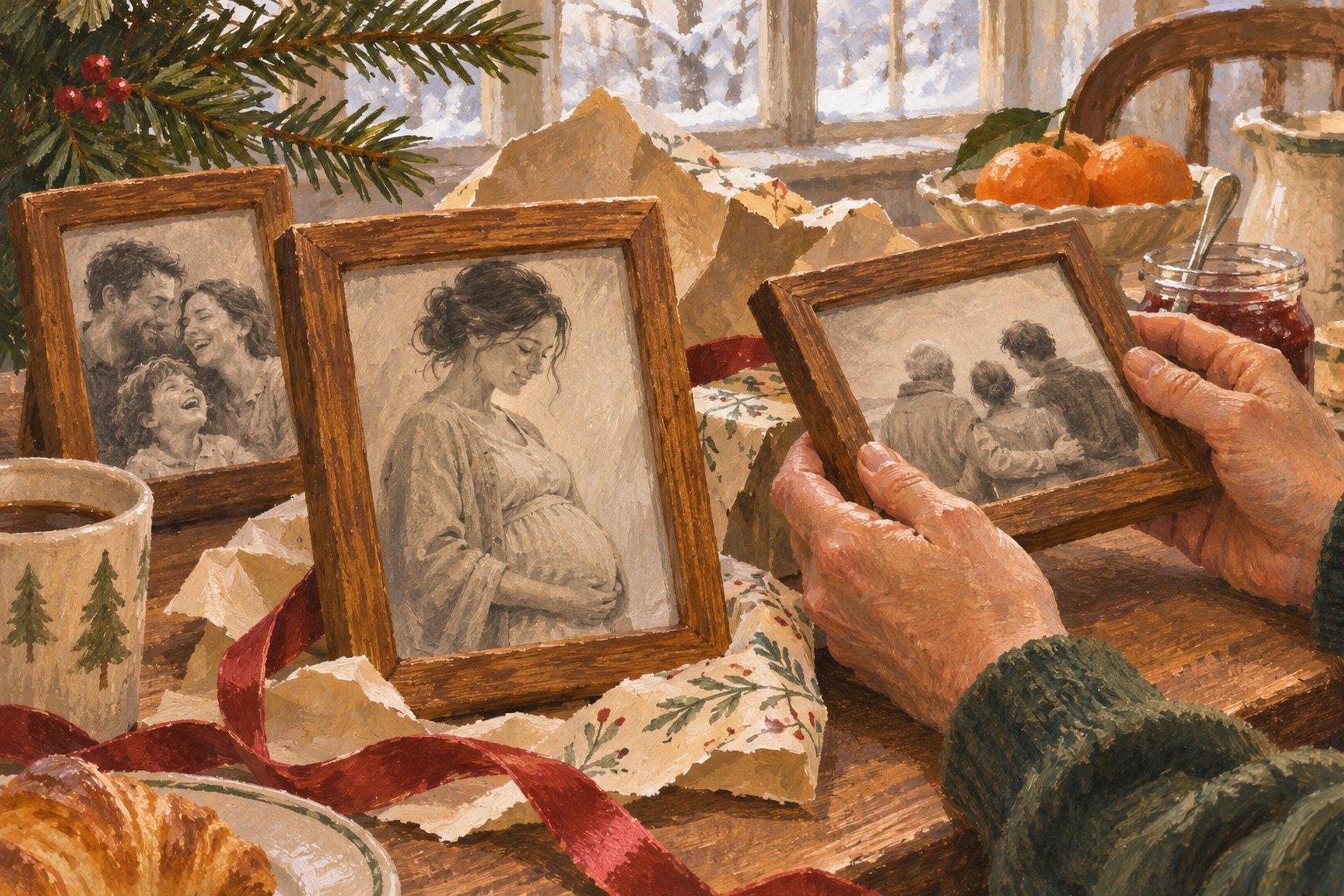
“That’s you and me, kid,” Sybil tells Amy. The sentence briefly takes them outside the arguments of the present. Mother and daughter encounter a version of their relationship that existed before either could imagine this Christmas.
Meredith’s gesture also disrupts the family’s easy judgment of her. The woman they have dismissed recognizes something beautiful in their history. Her gift does not settle the dinner argument or erase anyone’s misconduct. It reveals that their account of her has been incomplete.
Keaton makes the moment moving by letting Sybil receive it. The character who has spent so much time deciding what belongs in her household must accept an act of generosity from someone she resisted. As with performances that turn confidence into vulnerability, the emotional shift matters because authority has already been so firmly established.
What honoring Keaton’s memory could mean
The original film’s final Christmas gathering takes place after Sybil’s death. The household continues, but her absence changes the meaning of its familiar rituals. That ending already supplies a foundation for a continuation: people can remain connected to someone through habits, objects, disagreements, and the relationships that person helped shape.
Mulroney’s statement establishes an intention to honor Keaton. It does not, by itself, tell us which scenes or storytelling choices will express that intention. The artistic test will be whether remembrance affects how the surviving characters behave.
In my reading, The Family Stone is most compelling as a story about people mistaking familiarity for permanence. Its romantic machinery can feel forced, and its humor sometimes overreaches. Keaton gives its emotional center the resistance those neat arrangements need: Sybil cannot be reduced to a lesson, a saint, or the cause of everybody’s problems.
A sequel could honor that performance by allowing affection and unresolved frustration to coexist. Families inherit more than cherished photographs. They inherit ways of welcoming people, ways of hurting them, and opportunities to behave differently. Keeping Sybil present in those choices would give remembrance dramatic life.
Original content by this site's editorial team. Published: November 18, 2026 at 00:27:27 PST (Los Angeles time)