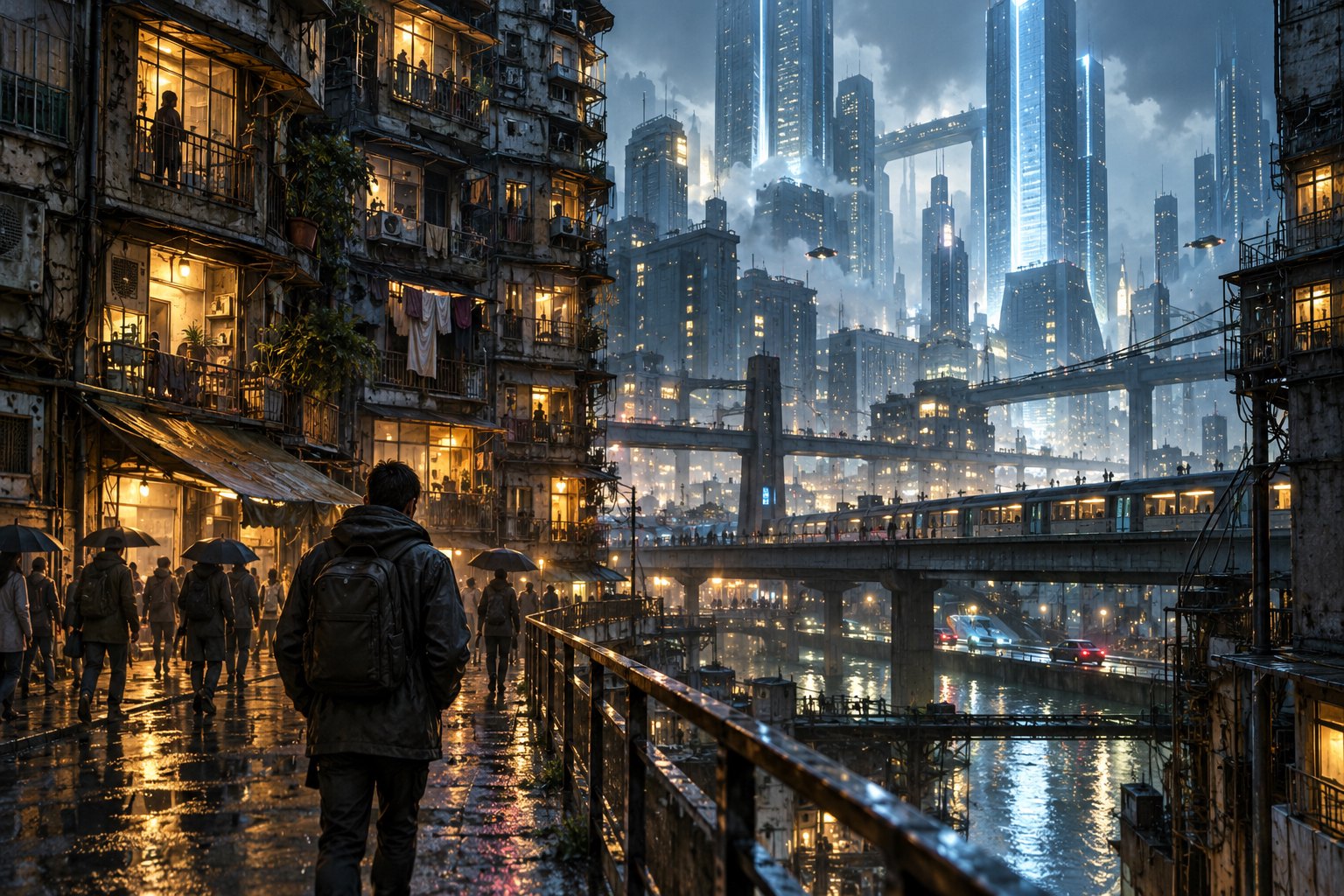
A Cyberpunk 2077 movie is in the works at Paramount, according to Variety. That development report gives audiences a project to watch, but it does not provide a finished film to judge. The most interesting creative question at this stage is how the adaptation might make its future feel inhabited: a place where people need shelter, maintain expensive equipment, earn money, and depend on others.
My view is that production design could be decisive. A futuristic city becomes dramatically meaningful when its buildings and objects tell us something about the person moving through them. Spectacular architecture can establish scale. A character’s relationship to that architecture establishes stakes.
This is spoiler-free development commentary, not a review of a completed movie. The discussion below proposes ways the film could work; it does not describe confirmed scenes, dialogue, casting, or story decisions.
What the Paramount report establishes
The central reported fact is straightforward: Paramount has a Cyberpunk 2077 movie in development. A development report should not be read as a release commitment or evidence that filming has begun. It also cannot tell audiences whether the eventual movie succeeds as drama.
That distinction matters particularly when a familiar title arrives with strong expectations. Recognition can encourage viewers to mentally assemble a film from remembered imagery and preferred characters. Those imagined versions may be exciting, but they remain separate from what has actually been reported.
Our earlier discussion of how a Cyberpunk 2077 movie could make choice cinematic considered the transition from participation to spectatorship. Here, the focus is physical space: how sets, costumes, props, and framing might communicate a character’s circumstances before anyone explains them.
Let the city reveal who gets access
A useful starting point would be access. Who can enter a building without being stopped? Who waits outside? Who has privacy, and who must conduct personal business within earshot of strangers? A film can make differences in power legible through movement and space.
Consider a hypothetical contrast between a crowded residential corridor and a quiet office reception area. The contrast becomes meaningful through behavior. One person might instinctively lower their voice in the office, unsure whether they belong there. Another might cross the same floor without acknowledging anyone. The design supplies the setting; performance reveals what occupying it costs.
This would give a Cyberpunk 2077 adaptation a concrete way to connect spectacle with character perspective. Instead of repeatedly pausing for impressive views, the camera could follow someone navigating obstacles that other people barely notice. A locked doorway might communicate more about the social order than another panoramic shot.
The visual storytelling should also preserve complexity. A modest apartment could be carefully maintained and full of affection. An expensive room could be impersonal or threatening. Equating poverty with dirt and wealth with beauty would flatten the people the film needs us to understand.
Technology becomes personal when it needs repair
Futuristic equipment often arrives on screen at its most impressive: newly revealed, flawlessly functioning, ready for action. Maintenance offers another dramatic possibility. Something that requires adjustment, replacement parts, or a trusted specialist can disclose a character’s habits and dependencies.
For this prospective adaptation, repair would be a productive visual language. A carefully preserved object might suggest pride, necessity, or an attachment its owner cannot easily explain. A cheap replacement could signal urgency. A polished exterior concealing unreliable components could connect appearance with insecurity. These are possible storytelling approaches, not details of the announced movie.

A repair scene could also create an unusually intimate exchange. Someone has to surrender control long enough to accept help. The person doing the work might be a professional, a friend, or someone whose reliability is uncertain. The interest would come from the relationship, with the equipment providing a reason for those people to share space.
The essential distinction is between showing a capability and showing a dependency. Both can generate suspense. A film that pays attention to dependency gains opportunities for vulnerability, bargaining, embarrassment, and care—emotions that can survive long after the novelty of a visual effect fades.
Give everyday spaces more than one emotional meaning
An adaptation can make a location memorable by allowing the audience to return to it under changed circumstances. A kitchen, workshop, or waiting area first introduced as routine might later feel reassuring, exposed, or lonely. The set does not need to transform dramatically. The people using it do.
This approach would help a futuristic world accumulate emotional history. Viewers could learn where someone feels comfortable, where they perform confidence, and where they stop performing altogether. Such distinctions give actors something specific to play and make relationships visible without explanatory speeches.
It would also create room for humor. People living under pressure still tease one another, develop habits, and get irritated by ordinary inconveniences. A consistently solemn future can become emotionally monotonous. Small moments of familiarity could make danger more consequential because the audience understands the everyday life being interrupted.
The same concern underlies our examination of why screen adaptations need a clear character perspective. Recognizable properties offer an entry point. Specific human relationships give viewers a reason to stay.
What meaningful first footage would show
When promotional material becomes available, scale alone will be a limited measure of promise. More revealing evidence would show whether the filmmaking connects environment to experience. A short exchange in a coherent space could demonstrate that more effectively than a montage of landmarks.
- Watch how characters occupy rooms. Confidence, hesitation, and familiarity can establish status without dialogue.
- Look for objects with a history. Wear, repair, and personalization can suggest a life beyond the immediate scene.
- Notice whose experience guides the camera. Framing should help us understand what a person wants, fears, or cannot access.
- Listen for differences between spaces. Noise, silence, and interrupted conversation can make privacy and security perceptible.
None of these features would guarantee a successful movie. They would, however, offer a stronger basis for discussing its dramatic intentions than the sheer amount of futuristic detail on screen. The question would be how those details contribute to a scene.
The deeper opportunity: make comfort visible
My strongest hope for Paramount’s Cyberpunk 2077 movie is that it makes comfort visible as something unevenly distributed. Privacy, reliable equipment, a safe place to rest, and access to competent help could become powerful dramatic resources. Once viewers understand who has them, they can better understand what other characters must risk to obtain them.
That perspective would allow the adaptation’s visual ambition to carry an argument. A beautiful skyline could remain beautiful while the film examines the conditions beneath it. A desirable piece of technology could remain desirable while its upkeep exposes an unequal relationship. Attraction and unease can occupy the same frame.
For now, the development news warrants interest rather than a verdict. The creative opportunity is substantial: to build a future whose surfaces reveal the lives underneath them. If the movie makes viewers notice who repairs that future, who feels at home in it, and who is kept waiting outside, its world could become far more memorable than its skyline.
Original content by this site's editorial team. Published: October 8, 2026 at 12:32:06 PDT (Los Angeles time)