David Fincher’s new movie is attracting attention over an allegation of extensive artificial intelligence use. Futurism’s headline frames that use as conspicuous, but the allegation alone cannot establish which images were altered, how they were produced, or whether those choices weaken the film. Those distinctions matter before a debate about technology becomes a verdict on a movie.
The most useful artistic question is what happens to the people on screen. Does an altered image help us understand a character’s experience? Does it preserve the expressive detail of a performance? Or does its construction become so distracting that we stop following the scene?
This is spoiler-free critical commentary, not a firsthand review. Without a verified basis for discussing the movie’s individual scenes, quoting dialogue or assigning motives to its characters would manufacture the very evidence a serious review needs. The AI allegation nevertheless presents a substantial issue: how should viewers judge a performance when the image carrying it may have been extensively manipulated?
What the AI allegation establishes—and what it leaves open
The narrow starting point is that a publication has characterized Fincher’s new film as heavily involving AI. That is an attributed claim, not a technical inventory. It does not, by itself, tell us whether the work concerns incidental details, entire environments, performers’ appearances, or something else.
Those possibilities have different artistic implications. Changing an unobtrusive background element and changing the expression through which a character communicates distress are not equivalent decisions. Treating them as a single category makes the discussion louder while making its subject less clear.
There are also two separate judgments to make: whether an image works and whether its production involved acceptable practices. A convincing image does not settle questions about permission or creative credit. An objectionable process cannot be diagnosed solely by spotting something that looks strange. Both conversations deserve evidence specific to their claims.
Our discussion of how to interpret objections to Madden’s portrayal of Al Davis approaches a related problem: a reaction can identify something worth investigating without becoming the final judgment on the work.
Character is where visual choices become dramatic choices
A character is more than dialogue and biography. Viewers read uncertainty in a delayed response, aggression in the occupation of space, and embarrassment in a glance that arrives a fraction too late. An apparently small visual adjustment can change the meaning of those details.
Consider a hypothetical exchange in which someone claims to be calm while their hands remain tense. The contradiction gives the audience information that the speaker is trying to suppress. If an intervention removes that tension, the words remain identical but the characterization changes. This is an illustration of the critical issue, not a description of a scene in Fincher’s movie.
From the character’s perspective, the essential question is whether we can still follow the relationship between intention and behavior. What does this person want? What are they hiding? What escapes their control? A technically polished image can be dramatically impoverished if it erases the clues that let us answer.
The opposite possibility deserves equal consideration. An alteration might clarify an environment, strengthen a point of view, or make a physical experience legible. The artistic standard should be specific: what understanding does this choice create, preserve, or remove?
A flawless surface is not necessarily an expressive one
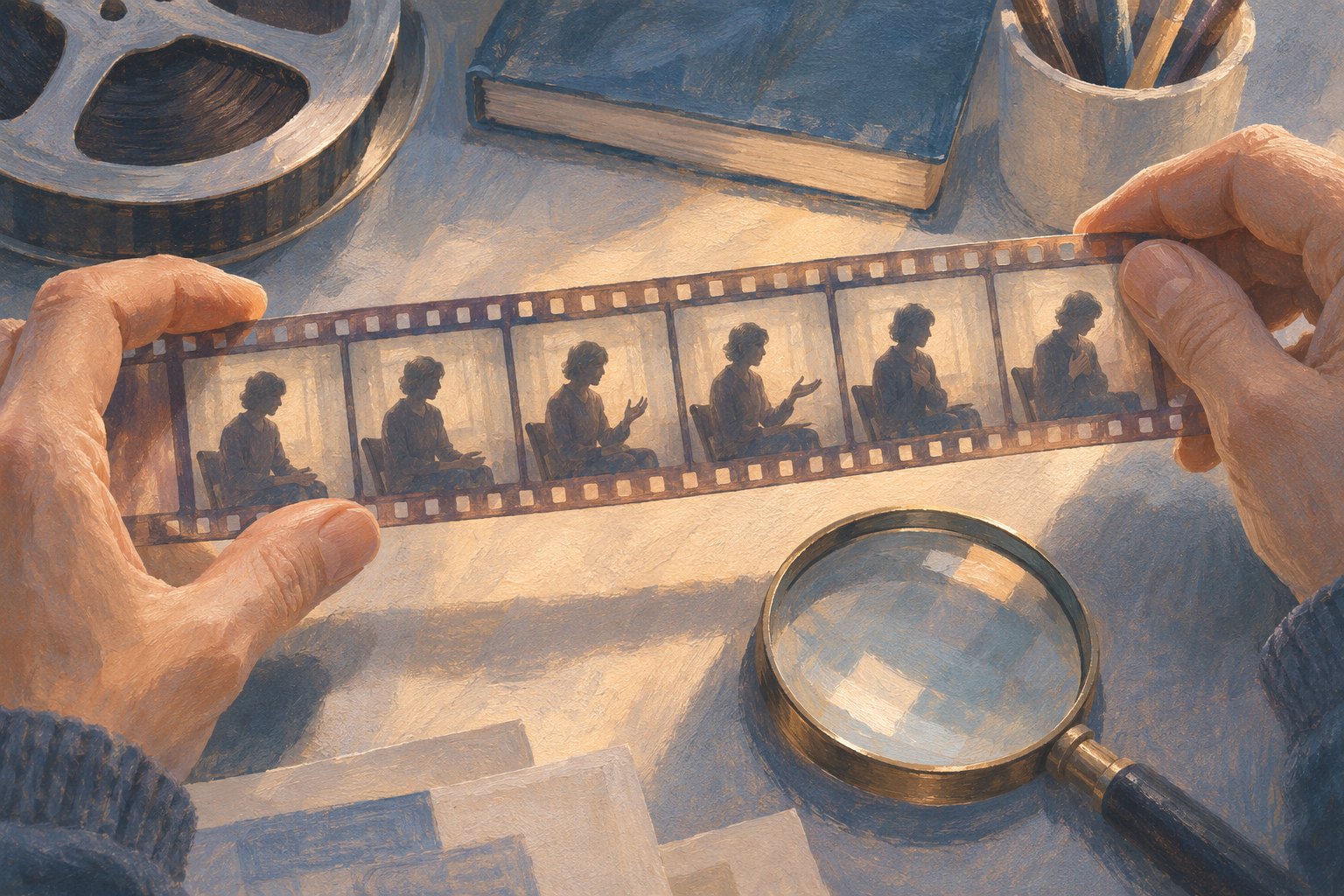
My critical preference is for images that preserve meaningful friction. A gesture can be awkward because the character is awkward. A face can resist easy interpretation because the scene depends on uncertainty. Making every element immediately readable may reduce the viewer’s involvement rather than improve it.
That does not mean imperfection is automatically truthful. Clumsy staging can obscure a strong performance, and distracting visual errors can interrupt an otherwise convincing scene. The distinction is between something that frustrates the drama and something that gives it texture.
For Fincher’s movie, an informed assessment would need to connect any disputed image to its dramatic function. Saying that a shot looks synthetic describes a response. Explaining that its appearance redirects attention away from a crucial exchange begins to establish a criticism. Identifying the actual production method requires further evidence.
This is why isolated screenshots can be insufficient grounds for judging a sequence. A film unfolds through duration, movement, sound, and cuts. An image that seems peculiar when frozen may serve a clear purpose in motion; an attractive frame may belong to a sequence whose timing never lets the characters breathe.
Four questions that would make the discussion more useful
Viewers do not need to become effects specialists to evaluate a film. They do need to separate what they notice from what they infer. A practical assessment can start with four questions:
- What specifically draws attention? Describe the visible issue or expressive choice before assigning it a technological cause.
- What happens to the character? Explain whether the image clarifies an emotion, obscures an intention, or interrupts belief in the person’s presence.
- Does the effect persist in context? Consider the full scene, including sound and editing, rather than relying only on a detached frame.
- What is documented about the method? Keep production evidence separate from aesthetic impressions, even when both point toward a concern.
These questions also allow disagreement to become productive. Two viewers may agree that a moment looks artificial while disagreeing about whether its artificiality belongs to the film’s expressive design. That is a richer argument than assuming that recognition of a tool automatically settles its value.
Creative responsibility cannot disappear behind the software
A director’s name often becomes shorthand for an entire film, but the finished work depends on many contributors. Any serious discussion of extensive image manipulation should leave room for the performers and craftspeople whose decisions shape what viewers see.
Permission, attribution, and responsibility are therefore relevant questions. Were contributors consulted about changes to their work? Who determined that an altered performance still communicated the intended emotion? These are questions to investigate, not accusations that the current allegation answers.
Our commentary on how accompaniment changes the way viewers read silent-film characters offers a useful parallel. Meaning does not reside in an image alone. The choices surrounding a performance can change whom we understand, whom we distrust, and whose experience receives our attention.
The deeper issue is how a movie earns belief
The AI debate surrounding Fincher’s new movie ultimately raises a question about audience trust. Viewers enter fiction knowing that images are constructed. What they seek is a coherent relationship between what they see and what the story asks them to feel.
That relationship can survive extraordinary visual invention. It can also collapse under a small intervention that makes a person’s response feel emotionally disconnected. Technical sophistication and dramatic conviction are different achievements.
The allegation deserves scrutiny, but a responsible artistic verdict requires the film itself and reliable evidence about the disputed work. The decisive test is whether the images sustain the characters as people with desires, contradictions, and consequences. If a visual choice makes those lives harder to perceive, criticism should explain exactly how. If it deepens our understanding, that achievement deserves an equally specific account.
Original content by this site's editorial team. Published: November 22, 2026 at 11:30:50 PST (Los Angeles time)