Crazy Taxi is the subject of a reported Netflix and Sega movie project, with Variety’s coverage also identifying Sonic and Stranger Than Heaven projects in development. The immediate attraction is easy to understand: a taxi puts movement, conflicting personalities, and a destination inside one compact storytelling machine. The harder question is what will make viewers care when the vehicle finally stops.
My view is that a compelling adaptation would begin with the relationship between the person driving and the person paying for the ride. Spectacle can introduce the movie’s personality. Those competing perspectives could give it staying power.
This is development-stage commentary, not a review of a completed film. The reporting discussed here establishes the project’s basic premise as news, but does not provide a basis for evaluating performances, recounting scenes, quoting screenplay dialogue, or identifying Easter eggs. The possibilities below are critical proposals, not descriptions of the movie’s actual story.
What the Crazy Taxi Development News Establishes
The central news is the reported association of Netflix and Sega with a Crazy Taxi movie. The accompanying mention of Sonic and Stranger Than Heaven places that project within a broader conversation about adapting Sega properties for the screen.
That grouping should not be mistaken for evidence of a shared fictional universe. Nor does the word “development” tell viewers when a finished project will arrive. It describes a stage of work, not a release commitment. This article makes no claim about a release date, cast, director, filming schedule, or completed screenplay.
For readers deciding whether the news is exciting, the useful distinction is between recognizing a property and understanding its proposed movie. Recognition gets attention. A clear dramatic premise explains how that attention might be sustained. Our examination of what early reactions need to reveal about character and visual storytelling offers a related principle: enthusiasm becomes useful when it identifies something specific on screen.
The Driver Needs an Objective Beyond Arriving
A taxi driver offers an unusually flexible point of view. The driver can know a city intimately while knowing almost nothing about the person sitting a few feet away. That imbalance creates room for confidence, misunderstanding, irritation, and unexpected sympathy.
For a hypothetical Crazy Taxi screenplay, I would look first at how driving expresses personality. Does a driver choose a difficult route out of pride? Does impatience expose insecurity? Can an apparently reckless decision turn out to reflect careful observation? These are possible writing choices, not established character traits.
The distinction matters because action becomes more engaging when it reveals a decision. A vehicle narrowly clearing an obstacle supplies a momentary thrill. Understanding why the driver attempted it gives the audience something to judge, anticipate, or laugh about afterward.
A character arc would not necessarily require a lengthy explanation of childhood trauma or an elaborate personal mythology. A modest, clearly defined conflict could work: someone excellent at navigating streets might struggle to listen to another person. If the film pursued that approach, changes in driving behavior could make emotional development visible without stopping the story for a speech.
Passengers Could Give the Action Its Meaning
From the passenger’s perspective, every journey involves surrendering some control. The driver chooses how to move through the city; the passenger has a reason to reach a particular place. Those priorities can overlap without being identical.
That makes the back seat valuable dramatic territory. A passenger should ideally contribute more than shouting at a dangerous maneuver. Their urgency, judgment, or unexpected knowledge could change what the driver does next. The trip would then become an exchange between people rather than a demonstration with a spectator attached.
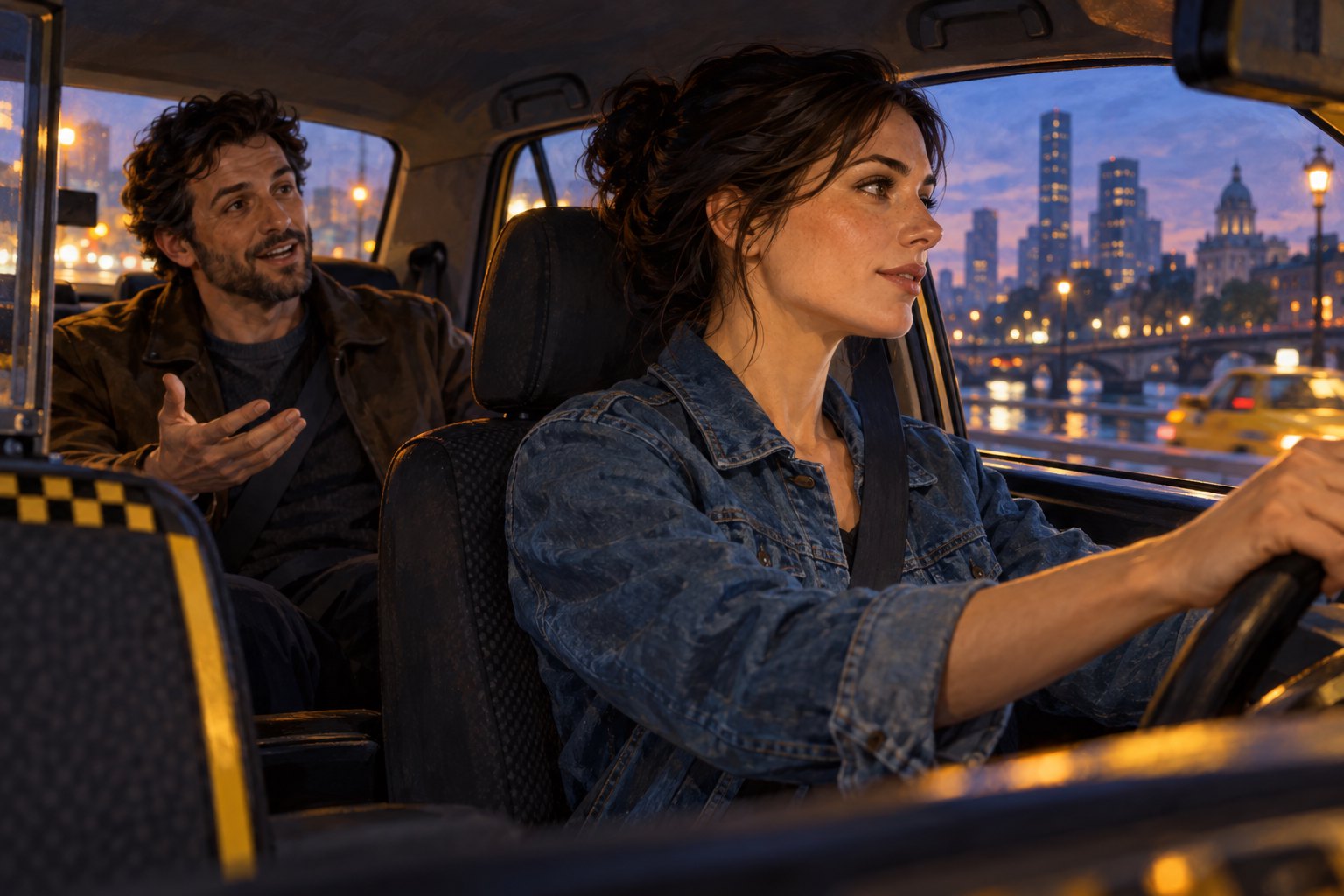
An ensemble approach could introduce different pressures through successive passengers. Its challenge would be accumulation: each encounter should alter something, even slightly, instead of resetting the protagonist for another interchangeable routine. A returning gesture, a changed assumption, or a decision carried into the next ride could provide continuity.
The stakes could remain small enough for comedy while still mattering to the people involved. Our discussion of responsibility behind the wheel in Runner considers a related storytelling question: how does the purpose of a journey shape our response to its action? A Crazy Taxi adaptation would need to find its own answer and tonal scale.
Fast Action Needs Clear Geography and Comic Timing
The visual test would be clarity. Viewers need enough information to understand where the taxi is heading, what blocks its path, and why a maneuver changes the situation. Speed becomes exciting when the audience can anticipate a problem and then enjoy the solution.
For that reason, I would favor sequences that establish a route before disrupting it. A visible destination or recognizable intersection can help an audience participate mentally. An uninterrupted stream of close-ups and impacts might communicate agitation, but it could also erase the spatial information that makes a clever escape satisfying.
Comedy adds another requirement: contrast in rhythm. A pause after an outrageous maneuver can let a reaction land. A calm response may be funnier than another scream. Sound could help distinguish confidence from panic, but volume alone would not establish either a joke or a character.
The city could also become legible through repetition. Returning to a location under different circumstances would reward attention and reveal how much the driver has learned. That is a cinematic opportunity available without assuming any particular setting or sequence has been selected.
Sonic and Stranger Than Heaven Raise a Question of Identity
The other properties named in the development coverage make distinctiveness especially relevant. Being associated with the same company does not supply a common emotional structure. Each adaptation needs a reason for its chosen perspective, pace, and format.
For Crazy Taxi, the most promising territory may be the temporary intimacy of a ride: strangers share a confined space, negotiate immediate needs, and then separate. That structure could support an energetic film with an emotional thread light enough to preserve its sense of fun.
The Deeper Opportunity Is a Story About Control
The interpretation I find most interesting is the tension between mastery and dependence. A driver may control the wheel while depending on customers for purpose. A passenger may name the destination while depending on someone else to get there. Neither person controls the whole experience.
That reciprocal vulnerability could give a Crazy Taxi movie more substance than its loudest set piece suggests. The eventual critical test would be whether its action changes the relationship inside the vehicle. If a final journey means something different from the first, the adaptation could turn a recognizable title into a satisfying movie. For now, that is a creative possibility worth watching, not a verdict on a film.
Original content by this site's editorial team. Published: September 14, 2026 at 10:32:22 PDT (Los Angeles time)