
Mike Macdonald’s love of game film offers an intriguing story about the relationship between watching and understanding. ESPN frames that interest through a journey connecting a camcorder with a Super Bowl mantra. For readers drawn to film analysis, the compelling question is what happens between those two ideas: how an image becomes something to examine, revisit, and put to use.
The subject here is recorded football, rather than a theatrical release. It calls for a different kind of criticism, concerned with perspective, duration, and the judgments we make about people on a screen. The discussion below considers those implications of Macdonald’s interest; it does not reconstruct his private viewing habits or assign him dialogue.
Why the camcorder is a meaningful starting point
A camcorder changes the status of an ordinary moment. Something that would otherwise disappear becomes available for another look. The person holding the camera decides where to stand, when to record, and which action deserves attention. Even a practical recording therefore begins with choices about what another person will be able to see.
As a framing device for Macdonald’s story, the camcorder is effective because it makes an abstract attachment to film tangible. Before footage can support an argument or become part of a larger philosophy, someone has to preserve an event. The machinery is modest; the possibility it creates is substantial.
There is also an important limit. A recording preserves a view, not an entire experience. Whatever lies outside the frame remains unavailable. That distinction matters whenever footage is treated as a final answer: the camera can give us evidence while leaving crucial context unresolved.
My reading of the camcorder-to-mantra connection is that its strongest theme is continuity of attention. The interesting progression is from having an image to developing a reason to return to it. That is an interpretation of the story’s framing, not a claim about particular episodes in Macdonald’s life.
A replay can change who appears responsible
On a first viewing, attention tends to follow the most obvious action. In football, that might mean following the ball. In a dramatic scene, it might mean watching the person who is speaking. Both instincts are useful, but both can obscure the contribution of someone elsewhere in the frame.
Consider a hypothetical football play in which one player creates space that another uses. A tight image of the eventual result might emphasize the second player. A wider view could make the first player’s contribution visible. The event has not changed; the viewer’s account of responsibility has.
The same distinction matters in character analysis. A scene can belong emotionally to the person listening, even when another character delivers every line. A hesitation, a retreat, or an unanswered gesture may explain more about the relationship than the most memorable speech. Watching again allows attention to move away from its initial target.
That makes Macdonald’s interest in game film a useful starting point for thinking about judgment. Recorded action can challenge our first impressions, provided we allow it to do so. Repetition becomes valuable when it changes the question we ask, rather than merely confirming the answer we already prefer.
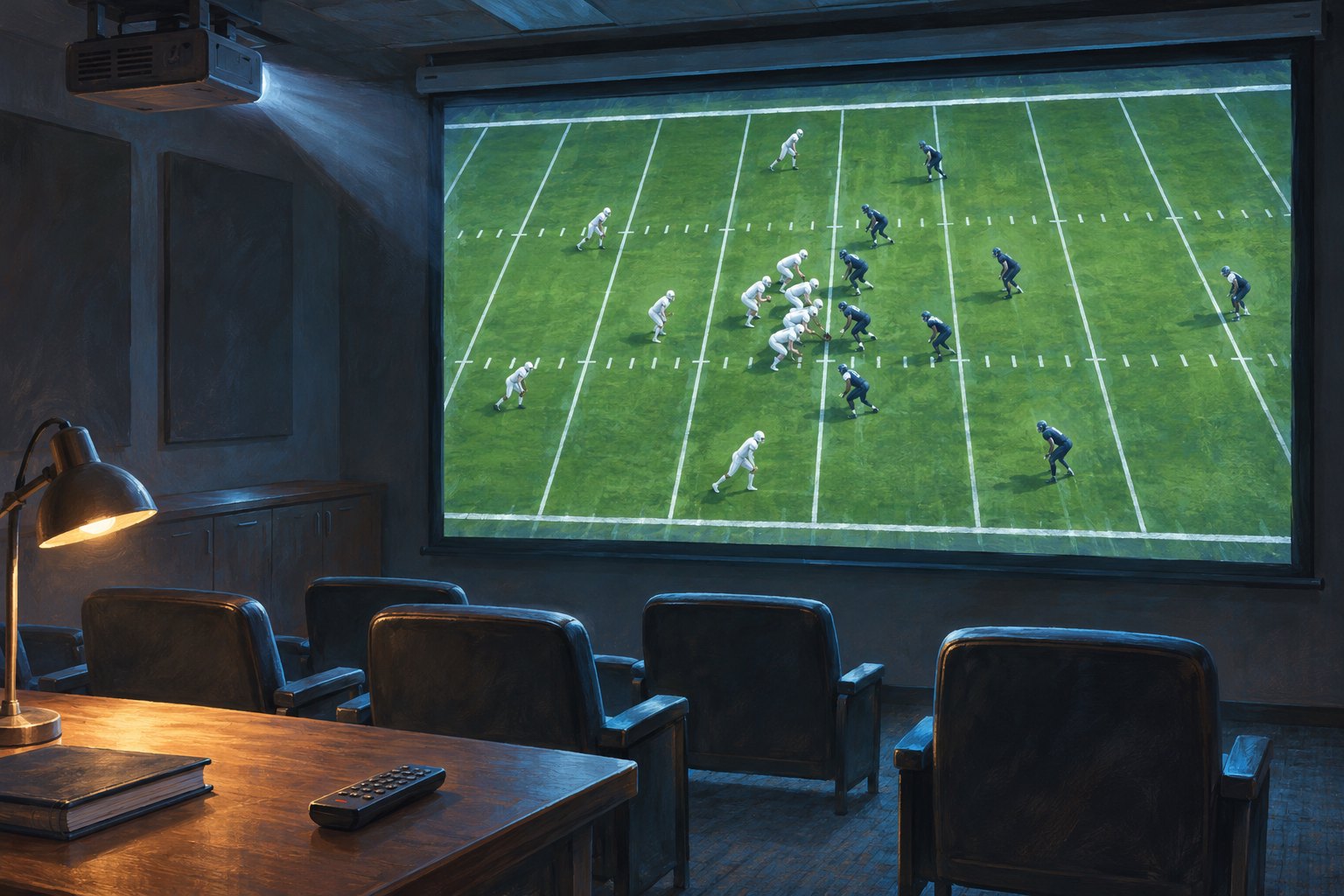
The difference between an exciting image and an explanatory one
Some images are exceptionally good at producing excitement. A close view makes physical effort immediate. A sudden cut can intensify a collision or a reversal. An expressive reaction can tell an audience where the emotional weight belongs.
An explanatory image may need different qualities. It might hold longer, include more space, or preserve activity that initially seems unimportant. Its value emerges through relationships: where people began, how they moved, and what became possible because of those movements.
This is where game footage and cinematic presentation can pursue different goals. An edited sequence can communicate the feeling of an event while withholding some of the information needed to understand its mechanics. Neither purpose automatically invalidates the other. Trouble begins when emotional clarity is mistaken for complete explanation.
Our discussion of what the Ravens at Panthers mini-movie format promises explores the storytelling side of that relationship. Macdonald’s subject invites attention to the viewing side: what a person might need from footage after the excitement of the event has passed.
What the Super Bowl framing establishes—and what it leaves open
The Super Bowl reference gives the story an immediate sense of scale. It connects an interest in recorded images with football’s largest stage. As an editorial structure, that contrast is compelling: a familiar piece of recording equipment at one end, a public expression of purpose at the other.
It would nevertheless be a mistake to turn the connection into a complete explanation of success. A headline cannot establish how much any single habit contributed to an outcome. Nor does its reference to a mantra provide the mantra’s exact wording. Inventing a motivational quotation would weaken the very attention to evidence that makes this subject interesting.
The more productive question is how an activity becomes a principle. Rewatching footage can remain a routine, or it can represent a commitment to examining what actually happened. The latter interpretation gives Macdonald’s story resonance beyond its sporting context without requiring a claim that film study explains everything.
It also preserves the human stakes. People recorded on a field are making decisions under conditions that a replay can slow down but cannot recreate. A viewer has the advantage of knowing what happened next. Fair analysis should remember that the person in the image did not.
How to make a second viewing useful
For a reader interested in applying this perspective, the method can be simple. These are general viewing practices, not a description of Macdonald’s personal process.
- Watch the full action first. Establish its rhythm before isolating details. A frozen image can make a temporary position seem more deliberate than it was.
- Follow someone away from the center. Notice how a supporting participant changes the options available to others.
- Separate observation from explanation. Seeing someone move establishes movement; it does not necessarily establish intention.
- Return to normal speed. Check whether an interpretation still feels persuasive when the action unfolds at its original pace.
Camera perspective also shapes performance viewing, a question explored in what the camera could reveal in Ariana Grande’s concert film. Across different subjects, the useful habit is to ask how the image directs attention—and what becomes visible when we redirect it ourselves.
The deeper appeal of watching again
What I find most compelling in Macdonald’s game-film subject is the possibility of revision. A first impression arrives quickly and often feels complete. Recorded images give us an opportunity to discover that it was partial: someone else mattered, a movement began earlier, or the apparent turning point was only the visible consequence of something quieter.
The camcorder and the mantra suggest two stages in that relationship with images: keeping a moment and deciding that returning to it matters. For film criticism, the lesson is precise. Looking closely should make our judgments more accountable to what is on the screen. The best second viewing leaves us with a clearer explanation—and sometimes a different one.
Original content by this site's editorial team. Published: November 24, 2026 at 10:04:57 PST (Los Angeles time)