Metropolis remains an extraordinary science-fiction film because its spectacle makes inequality physically visible. Comfort rises into the sunlight; exhaustion disappears underground. Fritz Lang’s 1927 silent epic, scripted by Thea von Harbou, imagines technological grandeur supported by people its beneficiaries barely acknowledge. Its vision feels prophetic less because it anticipates particular inventions than because it understands how easily progress can become an excuse for refusing to look down.
My verdict: visually overwhelming, dramatically uneven, and politically unresolved, it is essential viewing precisely because its contradictions remain alive. The film recognizes exploitation with frightening clarity, then asks a gesture of goodwill to carry more weight than it plausibly can.
Major spoilers follow, including the ending. English intertitle wording varies between editions. For a first viewing, seek the 2010 restoration incorporating footage recovered in Argentina; shortened versions can make an already elaborate narrative harder to follow.
Freder discovers what his comfort costs
Freder, the privileged son of city ruler Joh Fredersen, begins inside a world designed to prevent inconvenient encounters. Maria interrupts that insulation by bringing workers’ children into the pleasure gardens. Her declaration, rendered in one English version as “Look, these are your brothers,” turns a social division into a personal obligation.
Freder initially follows an attractive stranger, not a political conviction. That matters. His awakening begins in desire and becomes something more demanding when he encounters the machinery sustaining his lifestyle. After an industrial accident, he imagines a machine as a sacrificial monster. The intertitle “MOLOCH!” names what his protected upbringing has concealed: the city consumes people.
The sequence works because Lang lets architecture become Freder’s terrified interpretation. It is not a literal revelation that a demon operates the factory. It is a privileged observer finally finding an image adequate to suffering. The exaggeration tells an emotional truth that a tidy explanation of working conditions could not.
When Freder takes a worker’s place at a punishing dial-like machine, sympathy becomes bodily experience. His arms must serve an apparatus whose demands seem endless. The scene’s force comes from that reversal: the person supposedly operating the equipment becomes its moving component. Freder can leave this life eventually; the workers cannot. His temporary exposure is meaningful, but it does not make their positions equal.
Maria and her double turn trust into a weapon
Brigitte Helm’s dual performance gives the film its most compelling human contrast. As Maria, she conveys a calm that gathers frightened people into a community. As the artificial double, she makes familiar features feel aggressively unfamiliar. Gesture, posture, and expression become instruments of deception.
The real Maria offers workers a story about the Tower of Babel and the need for mediation. Her authority depends on recognition: she sees their suffering and gives it a shared language. Fredersen wants to undermine that authority. Rotwang, the inventor he approaches, supplies the means by giving his mechanical creation Maria’s appearance, while pursuing revenge of his own.
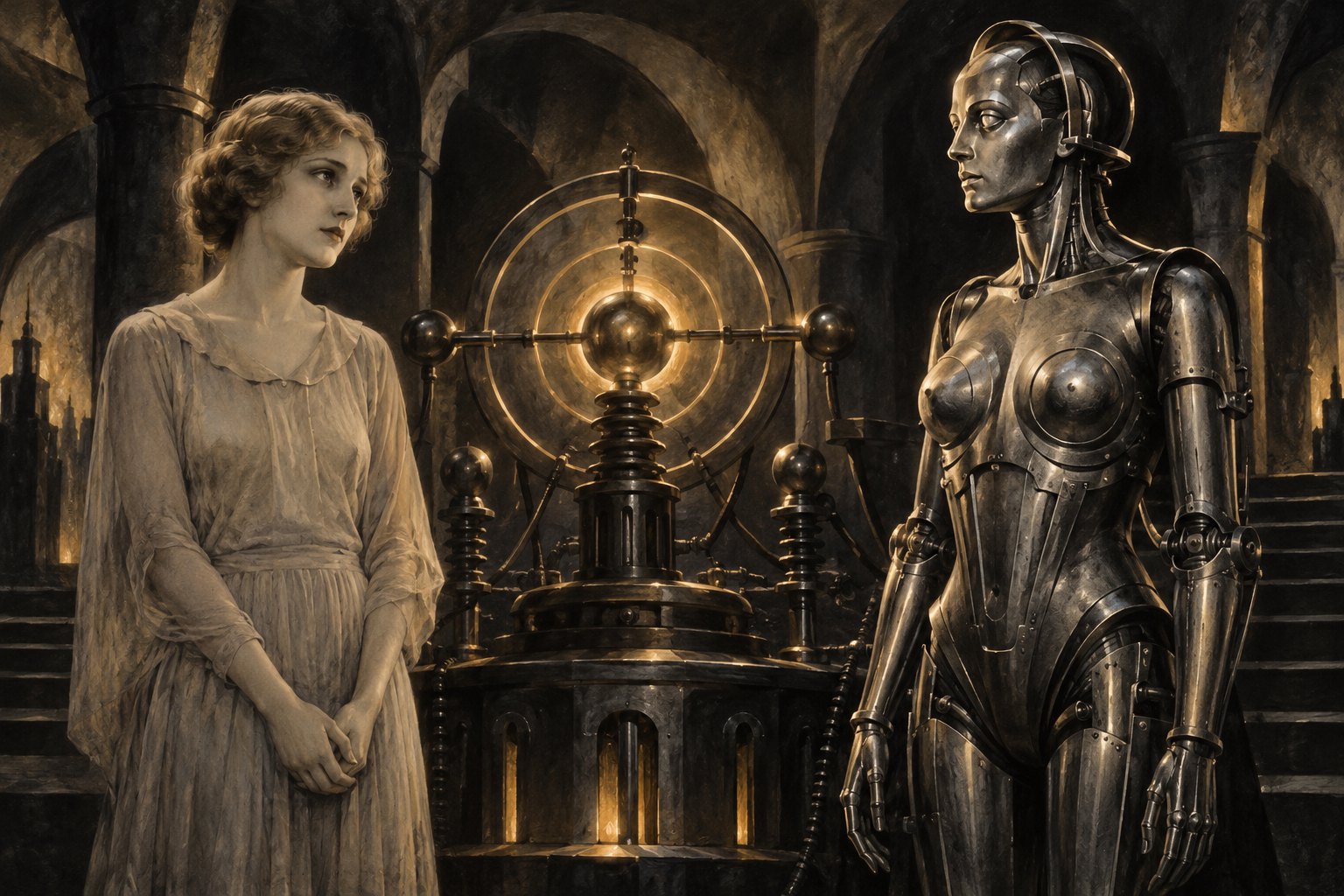
Here the film’s modern resonance is unusually precise. The counterfeit does not need to earn trust from nothing. It borrows an existing relationship and redirects it. Read through present-day concerns about synthetic impersonation, the robot is frightening because recognizable appearance can survive the disappearance of the person’s intentions. That is a contemporary interpretation, not evidence that Lang predicted a particular technology.
Yet the characterization carries an uncomfortable division. Good Maria nurtures, reassures, and saves; false Maria incites, performs, and attracts dangerous desire. Female virtue and female sexuality are pushed toward opposite moral poles. Helm makes both figures riveting, but the film’s imagination grants the disruptive woman a freedom it treats as monstrous.
That tension prevents the double from functioning as a simple warning about machines. Men manufacture and deploy her, yet the spectacle repeatedly concentrates fear on her body. The instrument becomes the visible villain while the ambitions behind it are harder to hold in view.
Fredersen and Rotwang mistake control for understanding
Fredersen’s defining weakness is not that he knows nothing about his city. He knows it as an arrangement to administer. The distance between his office and the machinery below becomes a distance between information and responsibility. Freder brings him suffering; Fredersen sees a problem of authority.
Rotwang introduces a different failure of perspective. His fixation on Hel, the woman he lost to Fredersen and Freder’s mother, turns invention into an attempt to master grief and defeat a rival. Their collaboration is unstable because each man assumes technology will extend his will, while neither fully understands the other’s purpose.
This helps explain the film’s sometimes exhausting plot. Romance, industrial conflict, religious allegory, surveillance, and private vengeance compete for attention. Some transitions feel driven more by symbolic necessity than psychological development. Freder’s emotional intensity can also become repetitive: astonishment is asked to do the work of several more specific feelings.
Nevertheless, the competing motives make the catastrophe more interesting than a machine simply going wrong. Human beings build a system of manipulation and then discover they cannot contain its consequences. The machinery amplifies their failures; it does not originate them.
The flood exposes the film’s political contradiction
Urged on by the false Maria, the workers destroy the Heart Machine, flooding their own underground city and endangering their children. Maria and Freder participate in the rescue while the crowd eventually turns against the impostor.
As suspense, the sequence is formidable. Industrial destruction becomes domestic danger, and the people least able to protect themselves inherit the consequences. Lang makes the connection between infrastructure and survival immediate. The same interest in vulnerability drives our comparison of fear in four horror classics: danger becomes more powerful when viewers understand whose options are disappearing.
As political argument, however, the revolt is troubling. The film first establishes compelling reasons for worker anger, then channels collective action into manipulated self-destruction. The workers become a crowd that must be redirected and rescued. Their suffering receives magnificent images; their capacity to govern their own future receives much less attention.
That imbalance should not erase the film’s sympathy. It should complicate it. Metropolis wants the oppressed to be recognized, but seems considerably less comfortable imagining their independent power.
Why the images outlast the proposed solution
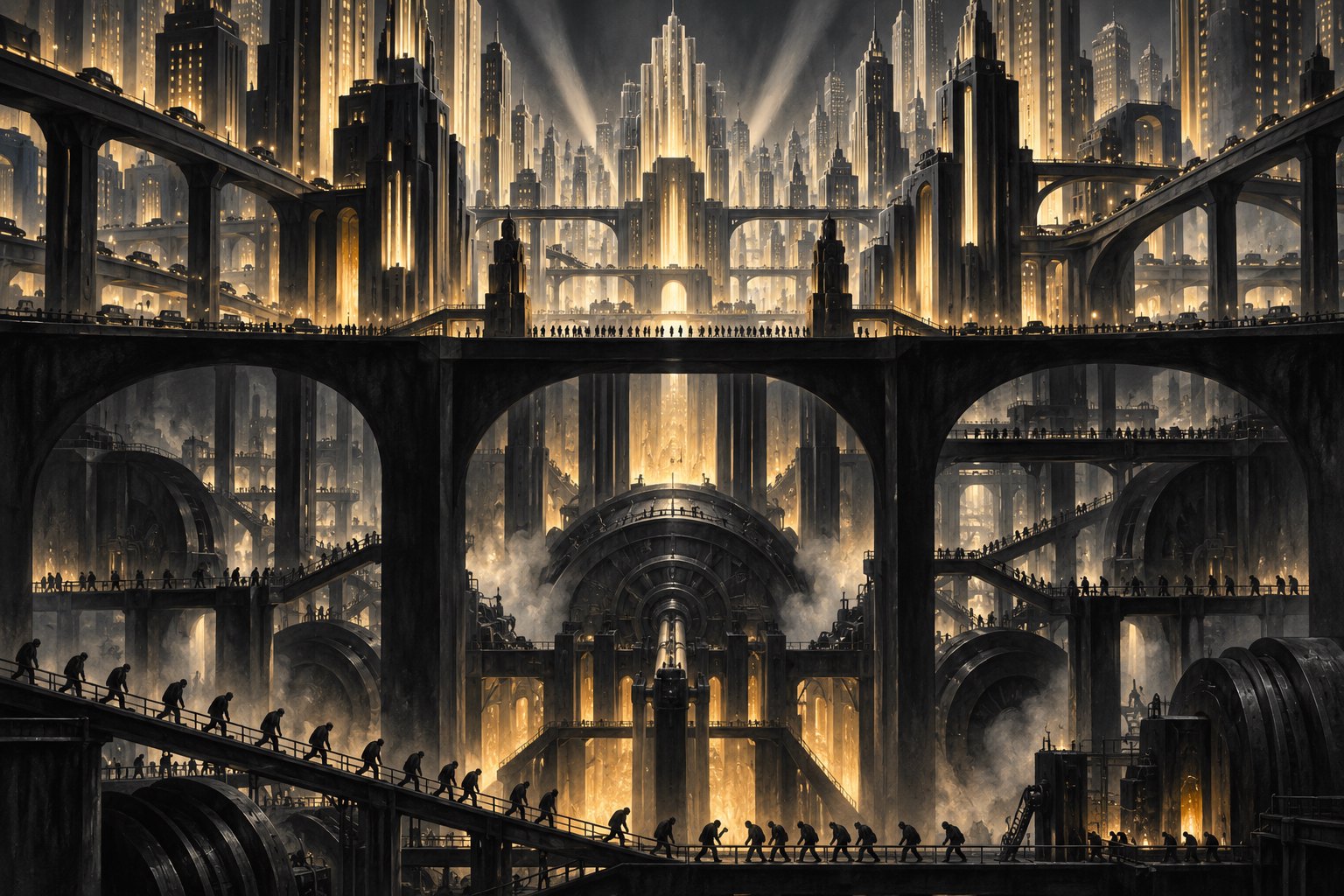
The city remains astonishing because its design performs dramatic work. Monumental spaces reduce people to patterns; machines impose rhythms on bodies; underground passages make social separation feel inescapable. The images do not merely decorate a futuristic setting. They organize our understanding of who has freedom and who is confined.
Such visual storytelling also connects with the questions in our discussion of how stylized worlds can carry adult themes. An obviously constructed environment can make an emotional or political relationship easier to see.
The crucial visual details are overt symbols rather than hidden Easter eggs. Watch the relationship between the Tower of Babel story, Fredersen’s elevated headquarters, and the Heart Machine. The film repeatedly translates society into architecture and anatomy, preparing us for its governing maxim: “the mediator between the head and hands must be the heart.”
The handshake is a beginning the film treats as an ending
At the conclusion, Freder mediates a handshake between his father and the foreman Grot. Emotionally, the gesture completes his journey from sheltered spectator to participant. Politically, it leaves the largest questions unanswered. Who controls the machinery tomorrow? What prevents another catastrophe? What power have the workers gained beyond a ruler’s willingness to acknowledge them?
The deeper problem sits inside the film’s metaphor. Calling rulers the head and workers the hands risks accepting that one class thinks while another merely acts. The heart can humanize that arrangement without changing it. Compassion matters, but the metaphor limits the equality it appears to promise.
That is why Metropolis remains so rewarding and unsettling. Its images demand a more profound transformation than its ending supplies. The film teaches us to see the people beneath the city, then leaves us to decide whether bringing them into view is enough.
Original content by this site's editorial team. Published: October 23, 2026 at 07:30:55 PDT (Los Angeles time)