
Yes, Melania already came out as a movie. Melania, The Series is a separate, two-part documentary companion that expands the timeline beyond the earlier film’s inauguration preparations. The similar names make the distinction easy to miss: this is another installment in the same portrait of Melania Trump, with a different format and a broader window onto her return to the White House.
The useful question is what that expansion offers. More time with a documentary subject can reveal competing loyalties, unexpected habits, or the gap between intentions and results. It can also reinforce an image the audience already understands. The difference depends on what the additional material allows viewers to discover.
Scope and spoilers: This is a reported critical companion, drawing on documented film content and the series’ published episode descriptions, rather than a firsthand review of both episodes. It discusses the film’s framing and closing statement.
The movie and series cover different stretches of the same return
USA Today reports that the feature arrived in January 2026 and followed the weeks before Donald Trump’s second inauguration. The series launched on Prime Video on November 20, 2026, extending into the couple’s return to the White House. Melania Trump is both its subject and an executive producer.
Prime Video lists two episodes: Family & Trust and Pride & Honor. Their descriptions emphasize protecting people close to Melania and putting her priorities as first lady into action. Those are the platform’s descriptions of the intended focus, not independent assessments of how revealing the episodes prove.
For viewers choosing between the titles, the practical distinction is straightforward:
- The movie: the earlier feature, organized around the approach to the inauguration.
- The series: a companion in two episodes that carries the portrait into the transition back to White House life.
- The viewing order: starting with the film provides the clearest chronological introduction, although that is an editorial recommendation rather than a viewing requirement.
Melania’s screen persona begins with attention to detail
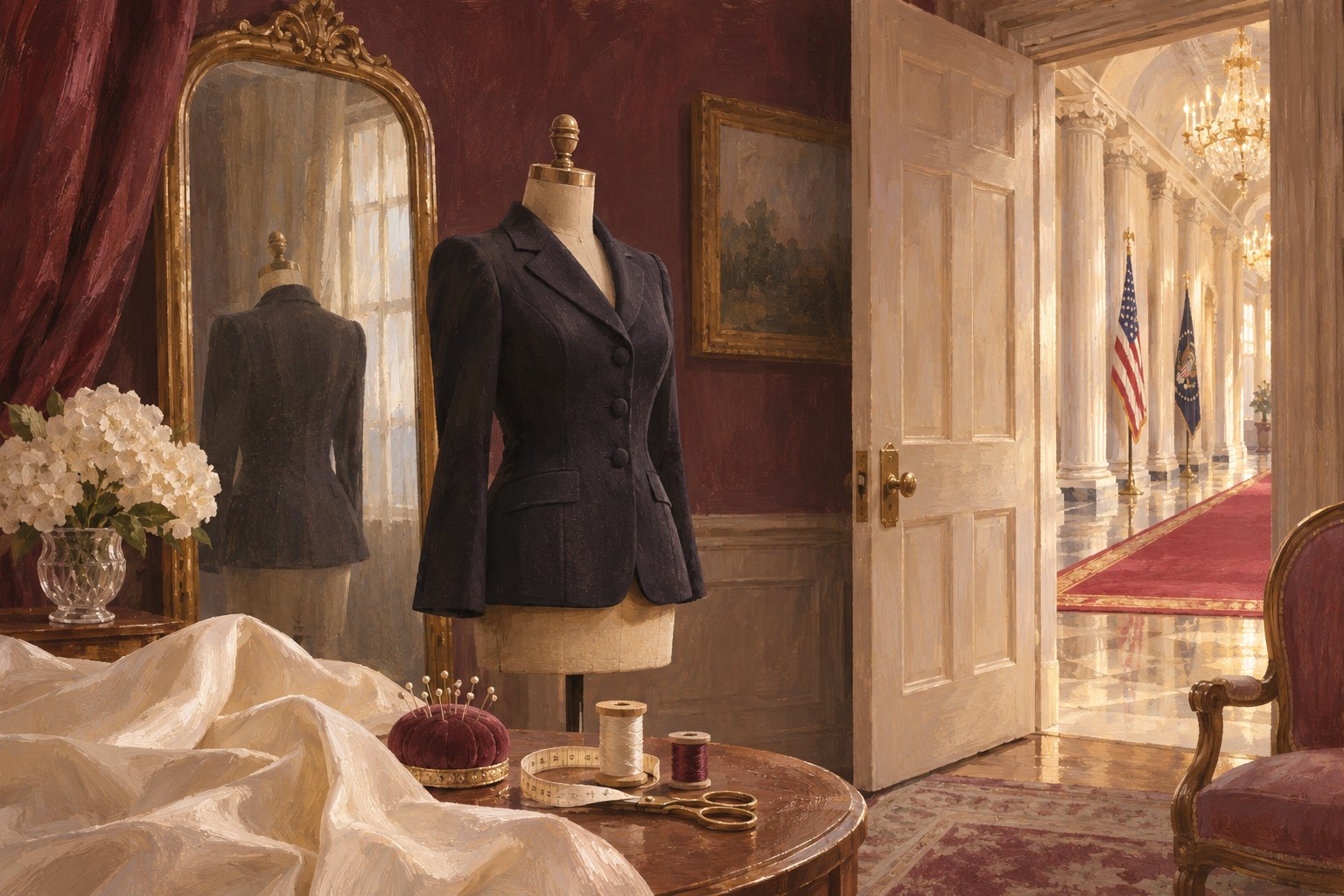
One revealing entry point into the film is clothing. TIME’s account describes Melania meeting designer Hervé Pierre and requesting precise adjustments to an inauguration jacket. Her voiceover declares, “I want to show the American people my life.”
That pairing establishes a particular invitation. The viewer is being shown a person making decisions about how she will appear in public. From her perspective, the small adjustment deserves attention because presentation belongs to the work. A camera can make that usually invisible preparation legible.
My reading is that this material has more potential than simply displaying expensive clothes. A fitting can reveal authority: who notices a problem, who proposes a solution, and whose judgment settles the matter. It can also reveal the limits of a portrait. Knowing what someone wants changed about a jacket does not necessarily tell us how she handles disagreement outside that controlled setting.
The critical question is whether the detail opens onto a larger understanding of the person. Does precision become a way to understand responsibility, self-protection, or anxiety? Or does the viewer merely learn that the finished appearance required work? The scene’s subject is fashion; its possible dramatic meaning is control over visibility.
Family and trust offer a different dramatic question
The first episode’s announced focus potentially shifts the emphasis from presentation to relationships. Preparing for a ceremony gives a film an obvious destination. Protecting family while living close to political power presents an ongoing problem with no comparably tidy finish.
The trailer articulates that concern. As quoted by USA Today, Melania says, “Everybody wants to be close to power, and sometimes could be very dangerous.” It is a statement about how she describes her surroundings, not evidence that any particular person poses a danger.
As characterization, the line suggests a useful tension. Someone who views access as a potential threat is also inviting an audience into a documentary. That does not make the invitation meaningless. It makes the terms of the invitation especially interesting: what is shared, what remains private, and how those boundaries shape the story.
A family-focused documentary becomes richer when other people retain perspectives of their own. Affection matters, but so do differences in temperament and priorities. Our discussion of giving real people lives beyond a familiar public story explores a related challenge. Recognition provides an introduction; relationships need room to develop beyond it.
Public duty requires more than a statement of purpose
The second episode’s announced emphasis on Melania’s mission as first lady raises another standard of judgment. A documentary about public work can show intention, preparation, execution, and consequences. Each stage answers a different question.
An intention establishes what someone hopes to accomplish. Preparation shows what the undertaking requires. Consequences allow an audience to assess whether the effort mattered to anyone beyond the person leading it. A convincing portrait connects those stages without assuming that a declared goal proves its own success.
This is where character analysis and documentary analysis meet. In fiction, a protagonist becomes clearer through choices made under pressure. In nonfiction, a subject can become clearer through the distance between a stated priority and the practical compromises involved in pursuing it. The episode description promises a subject worth examining; the description alone cannot establish the depth of that examination.
Access is valuable, but viewers still need perspective
Melania’s executive-producer role is relevant because it places her within the project’s production as well as at its center. That credit alone does not establish the extent of her editorial control. It does, however, make the relationship between self-presentation and observation a reasonable part of the critical discussion.
A subject’s participation can bring specificity that an outside account would miss. At the same time, viewers should consider whether the film gives them enough context to reach conclusions beyond the subject’s preferred explanation. Neither automatic suspicion nor automatic acceptance produces a particularly attentive viewing.
Useful questions are concrete: Does a scene disclose a decision? Does another participant contribute something unexpected? Does an interaction change our understanding of an earlier statement? These are also useful ways of judging what remains after a screening, once the novelty of access has faded.
The deeper connection is authorship of a public identity
TIME records the film’s closing promise: “I will move forward with purpose, and of course, style.” That short statement brings public ambition and personal presentation together. It offers a useful lens for understanding why the project can continue from a feature into a series: an inauguration ends, but the work of defining a public identity continues.
My interpretation is that the most interesting issue here is how a person accustomed to being watched chooses to become a narrator of her own visibility. The clothing, family emphasis, and stated public mission represent different routes into that question. They should not be mistaken for unrestricted access to her inner life.
The movie and series are therefore distinct releases with a shared critical challenge. Extending the chronology gives the portrait additional space. The meaningful test is whether that space helps viewers understand a choice, a relationship, or a consequence more fully than they did before.
Original content by this site's editorial team. Published: November 22, 2026 at 21:00:57 PST (Los Angeles time)