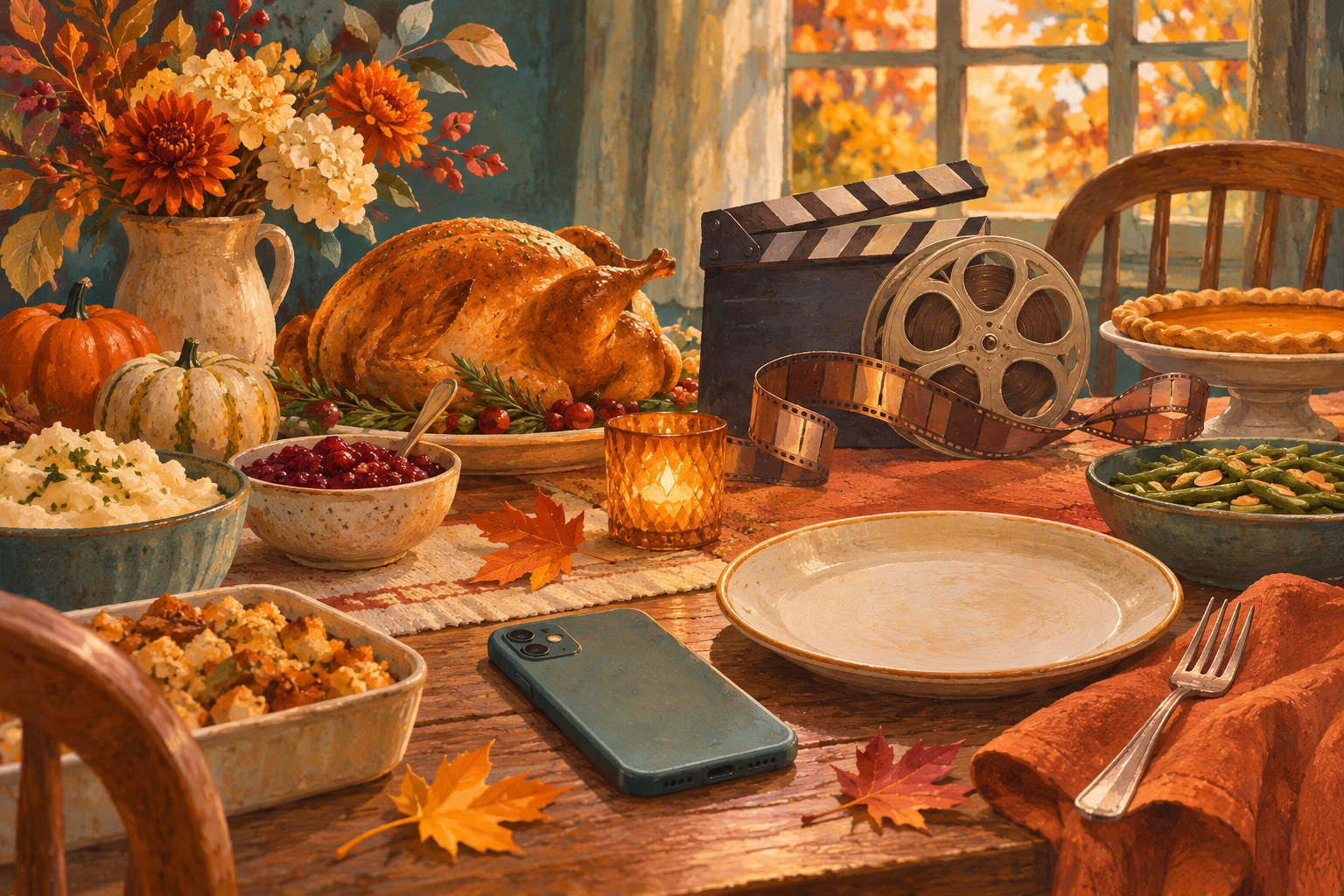
Wanda Dench and Jamal Hinton’s Thanksgiving friendship has the kind of beginning a screenwriter might struggle to make believable: an invitation sent to the wrong number, an unexpected reply, and a stranger welcomed to dinner. Their enduring connection is now the subject of a planned Lifetime movie. The attraction is obvious. The more interesting question is how a film can convey everything that happened emotionally after the misunderstanding stopped being a misunderstanding.
This is a preview and analysis of the adaptation’s real-life foundation, not a review of a completed film. The project remains in development, so judgments about performances, individual scenes, screenplay dialogue, or an ending would be premature. What can already be examined is the unusually strong relationship at its center—and the choices involved in bringing it to the screen.
What is known about the Thanksgiving movie?
In reporting for The Arizona Republic, Jose R. Gonzalez described a Lifetime adaptation with the working title The Thanksgiving Grandma. Dench said she and Hinton had signed over rights to their story. Filming was expected in early 2027, with producer Jack Leslie identifying November 2027 as the intended release window. Those are development plans, rather than a guaranteed premiere date. [The Arizona Republic’s reporting](https://www.aol.com/articles/arizona-thanksgiving-grandma-story-lifetime-141229000.html)
That distinction matters for anyone searching for the movie now. An announced adaptation does not establish which real events will appear, how much time the story will cover, or whether particular conversations will be recreated. The working title also should not be mistaken for an immutable final title.
For a prospective viewer, however, the essential appeal is already clear: this is a story about an accidental encounter becoming a relationship that people deliberately maintain. Its strongest material lies in that transition.
The invitation works because both people make a choice
The underlying incident began in 2016, when Dench intended to invite her grandson to Thanksgiving and reached Hinton instead. Their exchange exposed the mistake, but Hinton asked whether he could still come. Dench’s response included the now-famous words, “Of course you can,” followed by her explanation that grandmothers “feed everyone.” These are words from the real exchange, not verified dialogue from the forthcoming film. [TIME’s contemporary account](https://time.com/4582411/grandma-thanksgiving-invite/)
From a storytelling perspective, the crucial turn arrives after the error is corrected. Before that moment, the situation is an amusing misunderstanding. Afterward, both participants know they are dealing with someone outside their intended family conversation. Continuing requires a decision.
Hinton’s question gives the exchange its playful momentum. He does not merely receive generosity; he helps create the possibility of a new connection. Dench then makes that possibility practical. The invitation becomes meaningful because she allows it to stand after its original reason has disappeared.
My reading is that this mutual participation should be the adaptation’s organizing principle. A version that treats one person exclusively as the giver and the other exclusively as the grateful recipient would flatten the very exchange that makes the story engaging.
Wanda’s perspective: hospitality as an action
The phrase “Of course you can” is striking because it makes an unexpected decision sound ordinary. It contains no grand explanation. Its warmth comes from the ease with which Dench extends a familiar responsibility beyond its expected boundary.
For an actor portraying her, that presents a more interesting challenge than simply projecting kindness. Warmth becomes convincing through attention: listening, responding, making room, treating another person’s presence as welcome. A screenplay can announce that someone is generous, but a performance has to make that generosity feel lived.
There is also a risk in the grandmother label. It makes the premise immediately understandable, yet it can encourage a film to reduce a person to a comforting function. A fully developed Wanda would need individuality beyond what she represents to the audience.
That is a standard for the eventual adaptation, not a claim about scenes already written or filmed. The strongest treatment would let viewers encounter a person whose hospitality expresses her character, rather than a character assembled solely to express hospitality.
Jamal’s perspective: more than the unexpected guest
Hinton deserves equal dramatic space. His willingness to keep the conversation going is essential to the story’s beginning. A character-focused adaptation should preserve that initiative and avoid leaving him at the edge of someone else’s emotional journey.
The distinction is subtle but consequential. Being welcomed involves receiving something; sustaining a friendship involves contributing something. Humor, curiosity, attention, and companionship can all make a relationship reciprocal without requiring a manufactured crisis to prove its value.
Nothing in the mistaken invitation itself establishes that Hinton needed a replacement family. An adaptation should be careful about importing that assumption simply because it fits a familiar holiday formula. A new bond can enrich an existing life without rescuing someone from a life the film has invented for them.
Our discussion of character distinction in Double Booked for the Holidays raises a related concern: an appealing premise only becomes emotionally persuasive when its people remain specific. Here, both sides of the friendship need that specificity.
The decade matters more than the mix-up
A wrong-number invitation supplies an efficient opening. A decade-long tradition presents the harder dramatic task. Repetition can look uneventful on screen, even when it is exactly what makes a relationship valuable.
The adaptation’s opportunity is to make returning feel different from simply repeating. An annual meal can carry accumulated familiarity. What once required an introduction may eventually require no explanation at all. The meaning of the gathering changes as the participants acquire shared history.
These are possibilities for cinematic expression, not descriptions of the forthcoming movie. The distinction is especially important with a true-story adaptation: a plausible moment is not automatically a documented event.
Visually, the challenge also extends beyond attractive seasonal decoration. A beautifully arranged table can establish atmosphere, but it cannot establish intimacy on its own. As our commentary on how holiday settings acquire emotional meaning explores, a place becomes persuasive through what characters experience there.
What the friendship asks a film to understand
The deepest idea in this story is that an invitation can change meaning without being withdrawn. Dench originally meant to reach someone she already knew. Once the mistake became clear, she chose to make the welcome apply to someone new.
That is a small action with substantial emotional implications. It suggests that belonging can develop through conduct: asking, accepting, returning, remembering. The initial accident creates an opening; the people involved give that opening a future.
My strongest hope for Lifetime’s adaptation is that it trusts this modest scale. The friendship does not need to become a universal solution to loneliness or division to deserve a movie. Its specificity is its strength. Two people continued a conversation that could easily have ended.
The famous message explains why audiences first paid attention. The years afterward explain why the story is still worth telling. A successful film will make viewers care as much about the next ordinary visit as they do about the extraordinary first invitation.
Original content by this site's editorial team. Published: November 22, 2026 at 20:23:19 PST (Los Angeles time)