Macaulay Culkin has confirmed that he is returning for another Home Alone movie, according to KCRA. The prospect immediately brings Kevin McCallister’s resourcefulness to mind: the improvised defenses, the elaborate performances, the satisfaction of watching adults underestimate him. But revisiting the original reveals a more interesting reason to welcome Culkin back. His defining character is a child who discovers that being capable and needing other people can coexist.
The return is the reported news. What follows is a review of the original Home Alone and an argument about what a continuation could learn from it, not a description of the new film’s plot.
Spoiler warning: This article discusses the original movie’s major scenes and ending.
Kevin gets his wish—and misunderstands what it means
Directed by Chris Columbus and written by John Hughes, the 1990 film begins by making Kevin’s resentment understandable without making him entirely innocent. His crowded household is noisy, impatient, and quick to dismiss him. He contributes to the chaos, but the adults’ responses also teach him that being the youngest means struggling to get a fair hearing.
When his family accidentally leaves him behind while traveling to Paris, Kevin initially interprets the empty house through the logic of his own anger. “I made my family disappear,” he says. The line is funny because his conclusion is impossible. It is revealing because he assumes his feelings have enough power to change the world.
Culkin makes that fantasy pleasurable. Kevin enjoys access to things previously controlled by others, and his swagger resembles a child’s imitation of adulthood. He knows what freedom looks like in commercials and movies. He has less understanding of what sustained responsibility feels like.
That distinction gives the early comedy its bite. The house has stopped interrupting him, but it has also stopped answering him. The same space that seemed intolerably crowded now feels too large. In my reading, the film’s central achievement is making both complaints emotionally credible.
The house turns Kevin’s feelings into scenery
Home Alone understands how a familiar room can change when the people who make it familiar disappear. Stairs, doorways, and the basement acquire a different scale from Kevin’s perspective. The furnace becomes frightening because he experiences the house as something that might resist him.
His growing competence therefore matters before the burglars arrive. Shopping and handling household tasks give him opportunities to revise the family’s low opinion of him. These scenes let Culkin alternate between proud self-possession and the brief uncertainty that exposes the performance underneath.
The visual storytelling is unusually efficient. Kevin’s size against the rooms conveys something dialogue does not need to explain. As our analysis of why Back to the Future remains visually memorable explores, familiar screen objects become enduring images when they carry a character’s immediate desires. Here, a house becomes a shifting measure of freedom, fear, and belonging.
Harry and Marv make competence look like revenge
Harry and Marv, played by Joe Pesci and Daniel Stern, offer Kevin a concrete problem he can solve. Unlike family resentment, burglary has recognizable opponents and an immediate objective. His declaration, “This is my house. I have to defend it,” turns a place he wanted emptied into something he actively claims.
The traps are funny because they invert the household’s hierarchy. Adults who assume they understand the situation keep encountering evidence that the child understands it better. Pesci’s simmering irritation and Stern’s expansive physical reactions give the punishment different comic rhythms.
Still, the sequence is also where the movie asks the most indulgence. Injuries operate according to cartoon rules, and the escalating pain can feel excessive if that register does not work for you. My judgment is that the staging generally earns the laughter: anticipation, delayed recognition, and the burglars’ wounded pride matter as much as impact.
The limitation becomes clearer when imagining Culkin’s return. Adult Kevin would no longer occupy the same powerless position. A continuation would need to establish whose vulnerability gives its comedy meaning. Repeating the mechanics would not automatically reproduce the audience’s investment.
Marley understands the fear Kevin cannot trap
The church conversation with Kevin’s elderly neighbor Marley is the original’s most important interruption. Until then, Kevin has allowed a frightening story about the man to stand in for knowledge of him. Sitting together gives both characters permission to speak outside their assigned roles.
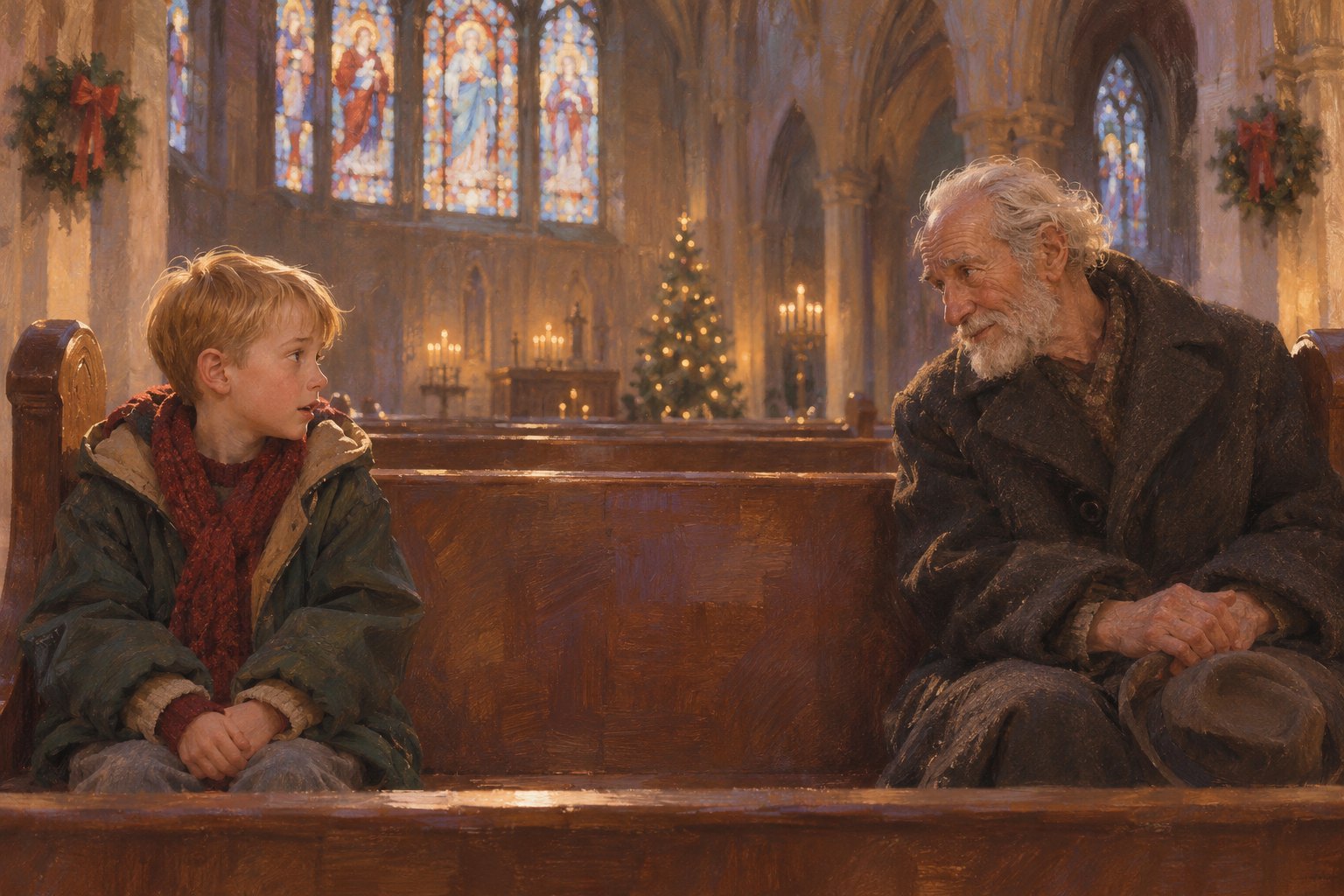
Marley’s estrangement from his son gives Kevin a version of family separation that cannot be fixed by waiting for a flight. The older man fears rejection. Kevin, who has spent much of the film feeling dismissed, recognizes the problem and encourages him to make contact.
The exchange works because wisdom travels in both directions. Kevin discovers that an intimidating adult can be lonely; Marley receives useful advice from a child. Neither has to become fearless before reaching toward someone else.
That conversation also changes the meaning of the climax. When the burglars catch Kevin, Marley intervenes and saves him. Kevin’s ingenuity is real, but it does not make him invulnerable. The person he feared becomes the person he needs.
This tension between courage and proving oneself also runs through our discussion of mentorship in Way of the Warrior Kid. Here, the decisive distinction is especially clear: Kevin’s achievement survives the admission that he cannot finish everything alone.
Kate gives the adventure its emotional consequences
Catherine O’Hara’s performance as Kevin’s mother, Kate, keeps the abandonment from becoming merely a convenient setup. While Kevin experiments with independence, her efforts to get home make the separation urgent from the other direction.
O’Hara allows Kate’s determination to look exhausting rather than graceful. Her character cannot reverse the mistake by explaining how it happened. She has to keep moving toward her child while living with the knowledge that he has been left behind.
The reunion works because the film has sustained both perspectives. Kevin has accomplished more than his family imagined he could, but that does not cancel his desire for his mother. Kate’s arrival restores a relationship, not simply adult supervision.
What Culkin’s return should carry forward
My verdict on the original remains strongly positive: its sentimental passages give the slapstick consequences, while its comedy prevents the lesson about family from becoming solemn instruction. Its exaggerations are obvious, but its shifts between irritation, exhilaration, and loneliness feel observant.
A new film could approach Kevin from many directions. The most promising question, to me, is whether someone remembered for extraordinary self-reliance has learned to recognize other people’s needs. That is a critical possibility, not a confirmed story detail.
The original’s deeper resolution arrives when Kevin sees Marley reunited with his family. Kevin is no longer occupied only with what he has lost or defended. He can take pleasure in another person’s happiness. Growing up means expanding his attention beyond himself.
A small detail worth watching again
During the opening dinner cleanup, Kevin’s airline ticket is accidentally discarded. This easily missed visual setup helps explain how his absence escapes notice amid the travel confusion. It also reinforces the film’s perspective: a household can contain plenty of adults and still fail to pay attention to one child.
That is the challenge a Culkin return inherits. The traps make Kevin unforgettable. The moments when he listens, misses someone, or accepts help make him worth returning to.
Original content by this site's editorial team. Published: November 28, 2026 at 04:07:29 PST (Los Angeles time)