The Transformers: The Movie and Optimus Prime: Awakening were announced for free YouTube streaming as part of the animated feature’s 40th-anniversary celebration. The November 27 announcement offers a timely reason to revisit the original, although viewers should check the official Transformers channel for current availability rather than assume the presentation remains accessible indefinitely.
The attraction extends beyond seeing familiar heroes again. Watch the 1986 movie from the Decepticons’ side, and its most unsettling story becomes clear: a ruler who treats everyone as expendable discovers how easily someone stronger can treat him the same way. Megatron survives his apparent defeat, but survival comes with terms he cannot dictate.
Spoilers follow for the original animated film, including its ending. This review concerns that feature; it does not assess the story or quality of Optimus Prime: Awakening.
Megatron establishes the rules that will destroy his independence
During the attack on the Autobot shuttle, Megatron dismisses Ironhide’s final resistance with “Such heroic nonsense.” It is a remarkably efficient statement of character. To him, courage without sufficient force is ridiculous. The possibility that loyalty might matter even when it cannot secure victory never enters the calculation.
That contempt makes the subsequent Decepticon retreat especially revealing. After his battle with Optimus Prime leaves him badly damaged, Megatron becomes one of the wounded passengers expelled from Astrotrain. Starscream sees an opportunity, but the betrayal also exposes the weakness of Megatron’s own order. His authority has depended on being formidable. Once he requires assistance, there is little mutual obligation to protect him.
From Megatron’s perspective, this is an outrageous personal betrayal. From outside his perspective, it looks like his governing principle applied consistently. The film never needs to stop and explain that irony. A commander who regarded vulnerability as contemptible is left drifting helplessly through space.
My favorite aspect of this sequence is its refusal to make suffering automatically ennobling. Megatron becomes vulnerable without becoming compassionate. The experience changes his circumstances more readily than his beliefs.
Unicron offers an upgrade with no freedom attached
“Nobody summons Megatron.” His response to Unicron is funny because the image has already disproved it. A damaged robot is addressing an intelligence whose physical scale makes the usual contest of military egos seem absurd. Megatron still speaks as though reputation can compensate for his position.
Unicron offers him a replacement body and forces to command in exchange for destroying the Matrix of Leadership. Megatron accepts under the pressure of threatened destruction. The resulting transformation into Galvatron is visually exhilarating, yet the transaction itself is ugly: he gains renewed physical power while surrendering control over how that power will be used.
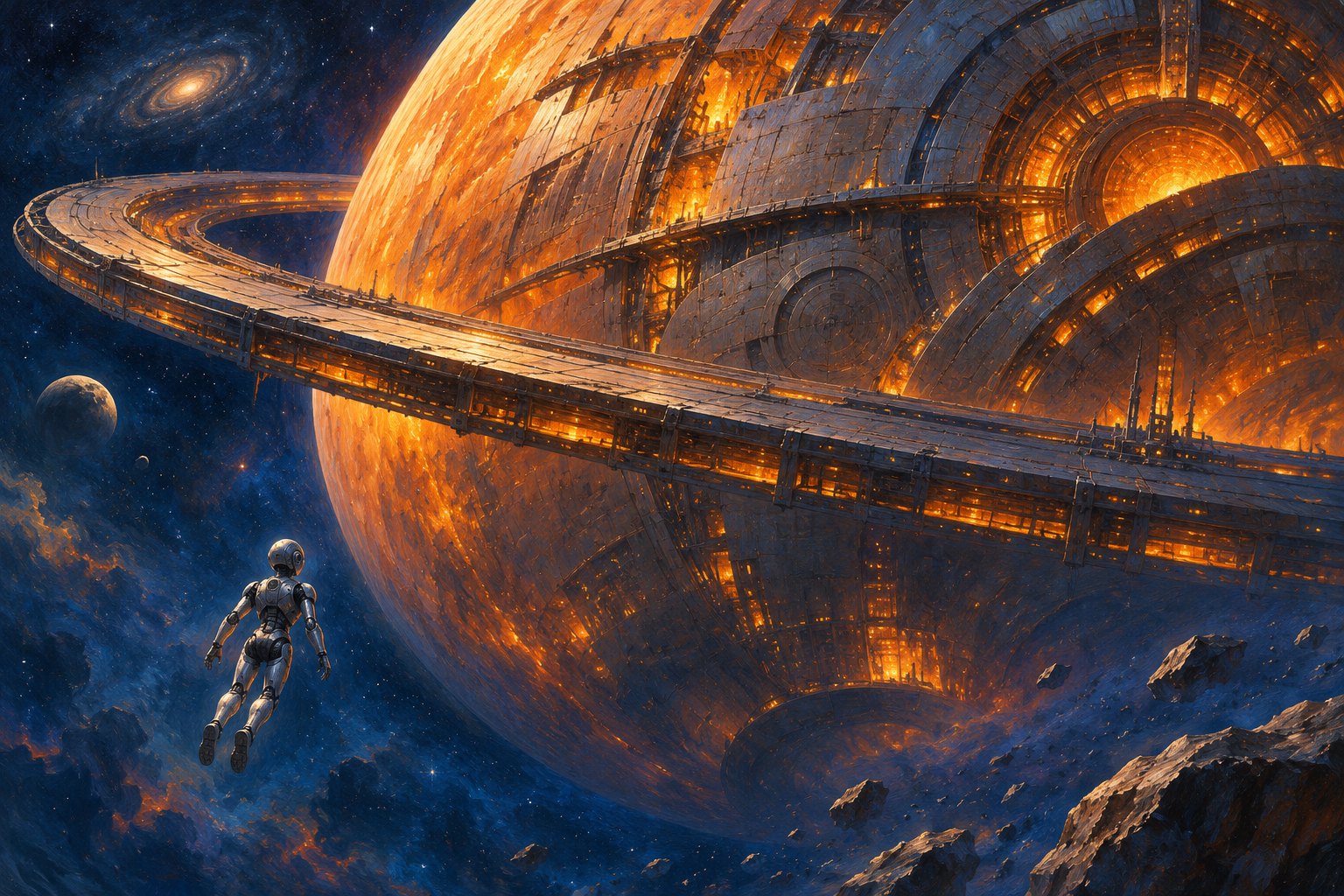
This is where the film’s mechanical imagery becomes unusually expressive. A new body would ordinarily promise liberation from an old limitation. Here, reconstruction also establishes ownership. Galvatron can threaten almost anyone he encounters, but Unicron can reach him through pain. His impressive exterior conceals a condition he cannot simply overpower.
The scene’s patience matters. Much of the movie hurtles between battles and unfamiliar locations; this encounter slows down enough to let humiliation register. Unicron does not need Megatron’s frantic insistence on status. The difference between their manners communicates the difference between their power.
Starscream mistakes a ceremony for security
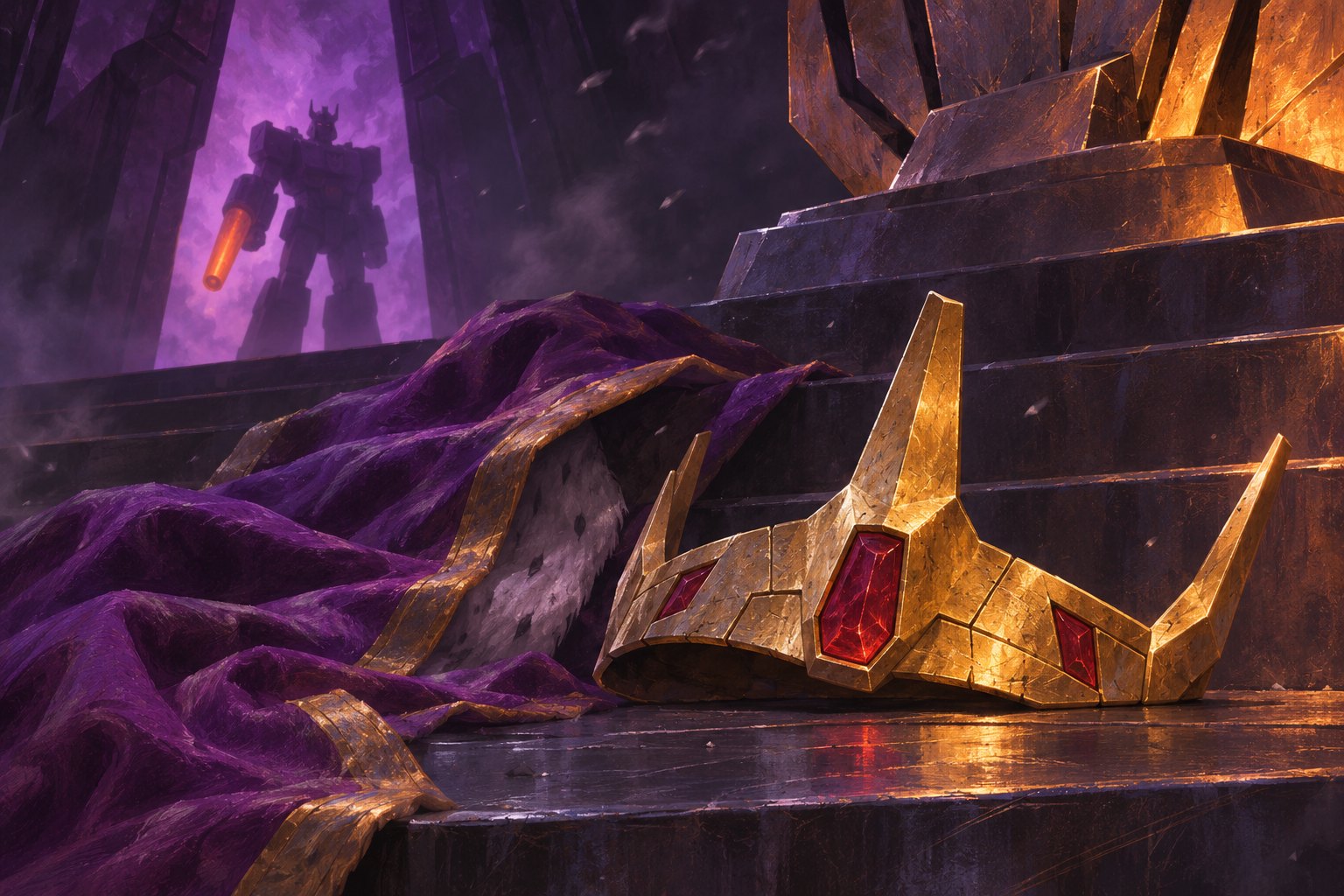
Starscream’s coronation offers the comic version of the same mistake. He has removed the incumbent and acquired the accessories of command. What he has not acquired is any reason to believe the position will remain his.
Galvatron interrupts with “Coronation, Starscream? This is bad comedy.” The line lands because the ceremony already feels precarious: Starscream is celebrating the appearance of permanence inside a faction built on opportunism. Galvatron then kills him and takes command.
For a moment, the returning villain seems to have achieved an uncomplicated triumph. He has punished his betrayer and restored his standing. But the audience knows what his followers do not: the new leader answers to someone else. His victory is real within the room and misleading outside it.
That double perspective gives the scene more bite than a straightforward revenge gag. Starscream cannot recognize how exposed he is; Galvatron cannot admit how constrained he remains. Both confuse the ability to dominate an immediate audience with genuine independence.
The Matrix exposes the limits of possession
After taking the Matrix from Ultra Magnus, Galvatron attempts to use it against Unicron. His reasoning has a practical basis: Unicron fears the object enough to demand its destruction. Keeping it should give Galvatron bargaining power.
His mistake is assuming that possession gives him access to its power. He can seize the Matrix, display it, and issue threats. He cannot make it work. The object interrupts the logic by which he has lived: acquiring a weapon is insufficient if its power cannot be compelled.
Unicron’s response turns the attempted rebellion into a further humiliation. His transformation and attack on Cybertron make Galvatron’s threat look desperately small. The film expands its physical spectacle while narrowing the villain’s options.
There is a useful connection here with Forbidden Planet’s portrait of intelligence without self-knowledge. Both films place extraordinary machinery around characters whose confidence exceeds their understanding. In Galvatron’s case, the missing knowledge concerns what power can accomplish when force stops being enough.
A possible alliance arrives too late
Inside Unicron, Galvatron briefly proposes joining Hot Rod against their common enemy. It is a fascinating opening: circumstances have finally made cooperation seem useful to someone accustomed to domination. But Unicron intervenes through pain and forces him back into combat.
The moment should not be mistaken for a completed redemption. Galvatron is seeking escape, and the film offers little evidence that he has developed a broader concern for others. Nevertheless, it reveals a possibility that his earlier behavior helped foreclose. When cooperation might save him, he no longer has the freedom to choose it.
For the corresponding Autobot story, our review of Hot Rod’s struggle with inherited responsibility examines the burden of succeeding Optimus. The villains supply a harsher counterpoint: command can increase a character’s reach while leaving him less able to direct his own life.
A thrilling movie with an uneven emotional rhythm
The film does not explore every implication with equal care. Its movement between catastrophic loss, broad comedy, and exuberant adventure can feel abrupt. Characters disappear before their absence has room to settle, and some encounters function more effectively as striking images than as developed drama.
Yet the Decepticon story benefits from that compression. Abandonment, reconstruction, coronation, rebellion, and punishment form a clean sequence beneath the surrounding chaos. Each apparent advancement carries a hidden reduction in security.
My reading is that Unicron represents the endpoint of the villains’ appetite for control. Megatron wants victory, Starscream wants the throne, and Galvatron wants freedom to command. Unicron reduces that ambition to consumption: everything outside him exists to be used or swallowed.
That makes the anniversary revisit rewarding beyond nostalgia. The most disturbing transformation is not Megatron receiving a different body. It is his discovery that being stronger does not necessarily mean being free—and that a world organized around treating others as disposable offers very little protection when your own usefulness runs out.
Original content by this site's editorial team. Published: November 28, 2026 at 02:22:11 PST (Los Angeles time)