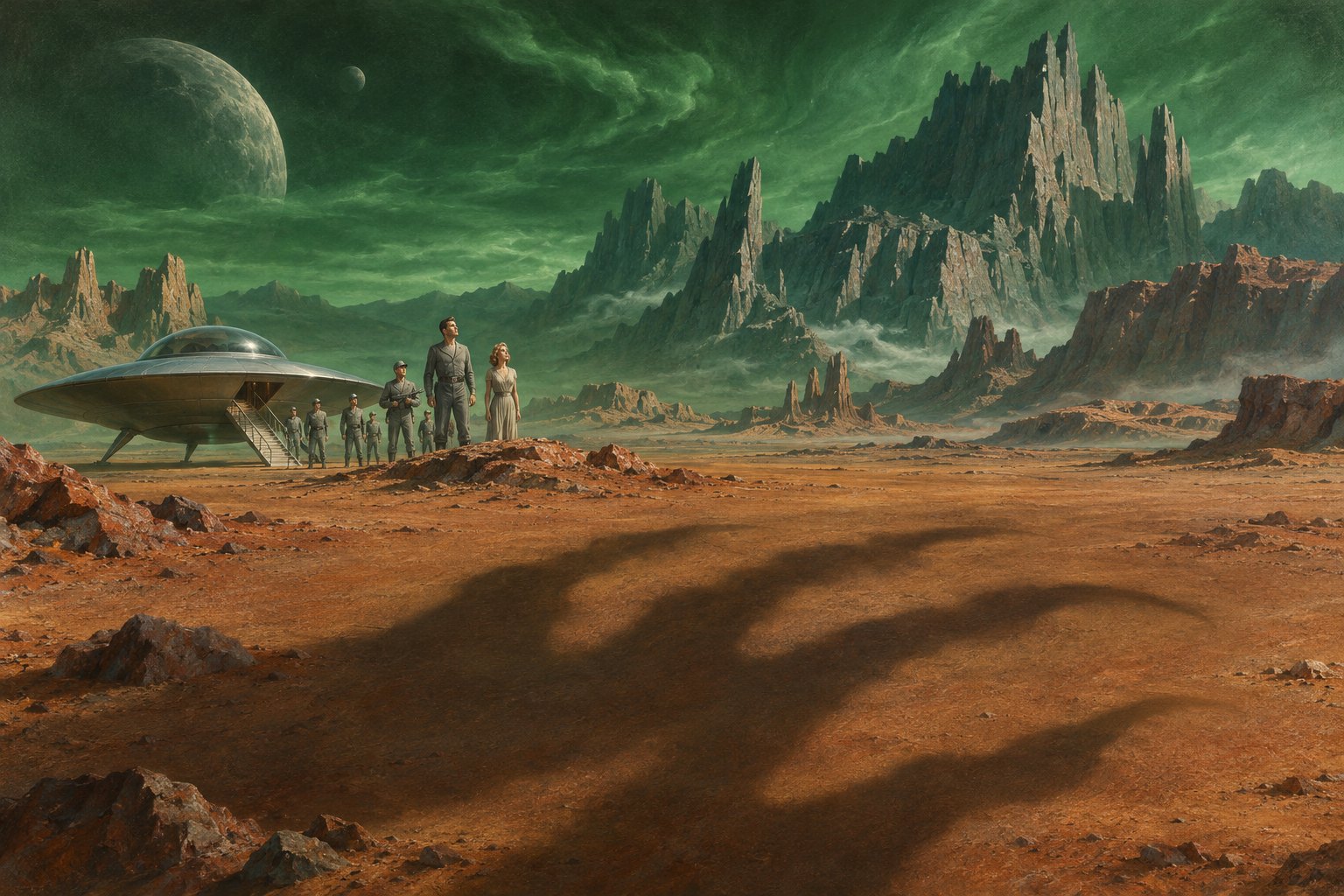
Forbidden Planet makes an excellent movie-night selection because its pleasures and its disturbing ideas arrive together. There is a flying saucer, an extraordinary robot, and an alien landscape worth getting lost in. Yet the most frightening thing on Altair IV is a familiar human conviction: that being the smartest person in the room makes you the safest person to put in charge.
Released in 1956, directed by Fred M. Wilcox, and written for the screen by Cyril Hume, the film gives Walter Pidgeon’s Dr. Edward Morbius a formidable opponent in Leslie Nielsen’s Commander Adams. Anne Francis plays Morbius’s daughter, Altaira. These credits are documented in the [AFI Catalog](https://catalog.afi.com/Film/51831-FORBIDDEN-PLANET). My verdict: the film remains absorbing because its spectacular machinery serves a deeply personal tragedy, although its treatment of Altaira sometimes limits the emotional freedom it seems to promise her.
Full spoilers follow, including the monster’s identity and the ending.
Morbius mistakes isolation for proof of innocence
Adams arrives to investigate the fate of an earlier expedition. Morbius warns him away, then receives the visitors with the confidence of a man who has organized an entire world around his preferences. His home is comfortable. Robby supplies practical necessities. His daughter has grown up beyond ordinary society. From Morbius’s perspective, the newcomers are interrupting an arrangement that already works.
That is the first unsettling feature of Pidgeon’s performance. Morbius does not behave like someone waiting to confess. His courtesy feels sincere, and so does his irritation. He can explain why other people should leave without seriously entertaining the possibility that their presence might expose something he needs to understand.
The vanished Krell civilization gives his intellectual pride a respectable purpose. Its surviving technology is an astonishing discovery, and studying it is meaningful work. The moral problem is the authority he builds around that work. Expertise becomes permission to decide who may enter, who may learn, and who may leave.
Pidgeon makes that progression persuasive through composure. Morbius rarely needs theatrical menace when an assured explanation can establish his superiority. The performance invites us to experience the attraction of his confidence before confronting its consequences. A less convincing scholar would make the movie much less frightening.
Adams can defend his crew, but he cannot shoot the explanation
Nielsen plays Adams with a directness that gives the investigation momentum. The commander wants answers he can use: who survived, what threatens his people, and how they can get home. His practical intelligence provides an effective counterweight to Morbius’s elaborate accounts of the planet.
The attack on the ship exposes the limits of that approach. The creature becomes visible against the crew’s energy defenses, giving the men something to fire at without giving them a durable solution. The sequence’s basic action is confirmed in Warner Bros. Classics’ [official attack clip](https://www.youtube.com/watch?v=fBxUGTQqYGo). The effect remains striking because visibility brings so little reassurance. Seeing the outline does not mean understanding the enemy.
For Adams, this is a crisis of command. Prepared defenses cannot compensate for a mistaken account of what is happening. His eventual achievement is interpretive: he must connect the violence to the person whose explanations have shaped the investigation.
The film is less convincing when his certainty extends to Altaira. His objections to her clothing and her effect on the crew make her responsible for managing male behavior. That does not invalidate his courage, but it complicates his position as the reasonable alternative to her father. Both men are comfortable telling her how the world works.
Altaira’s most important discovery is her father’s cruelty
Altaira’s isolation makes her curious about the visitors, especially their romantic attention. Some of these scenes depend on a dated joke: an educated woman supposedly becomes amusingly helpless when confronted with attraction. Francis gives the character enough openness and emotional responsiveness to suggest possibilities beyond that premise.
Her decisive moment comes when Morbius responds coldly to Doc Ostrow’s death. Suddenly, the father she admires appears unwilling to offer basic compassion to someone who crossed his intellectual boundaries. She chooses to leave with Adams. The plot and dialogue establish that sequence; the [film transcript](https://www.springfieldspringfield.co.uk/movie_script.php?movie=forbidden-planet) also preserves the confrontation that follows.
For me, this is the romance’s strongest justification. Altaira is judging behavior. Her departure becomes more substantial than the discovery of a handsome stranger: she has seen a failure of character that her sheltered upbringing could not prepare her to recognize.
That distinction also matters in our discussion of Lucia Sciarra’s limited agency in Spectre. A woman’s importance to a male character is different from the freedom a screenplay gives her. Altaira becomes most interesting when those two things pull apart.
The Krell machine gives denial physical force
Ostrow’s fatal experiment produces the explanation: “Monsters from the id.” The Krell machinery can make thought material, including destructive impulses its users do not consciously acknowledge. Morbius’s enhanced mind has activated a power he understands far less completely than he believes.
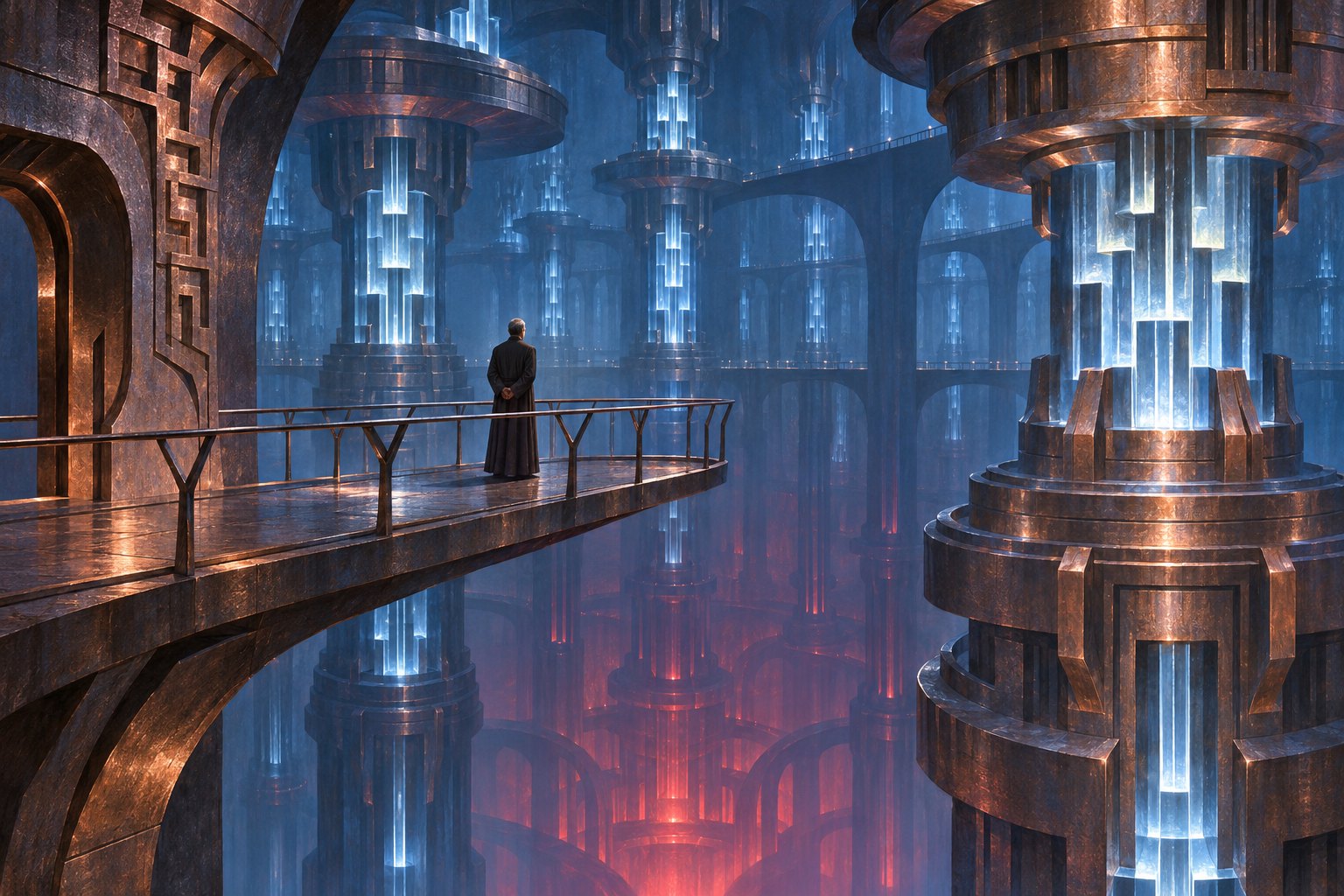
The immense underground spaces make his mistake visible. Standing before machinery of this scale, a person should feel uncertainty. Morbius instead draws confidence from his ability to explain parts of it. The gap between operating knowledge and self-knowledge becomes the film’s central danger.
The long scientific explanations can slow the middle section, but they also place us inside his preferred relationship with other people. He lectures; they listen. His account of the Krell sounds authoritative partly because their achievement is so impressive. The film asks how easily admiration for an accomplishment becomes trust in its interpreter.
Robby provides a revealing contrast. His prohibition against harming humans prevents him from killing the monster, which is inseparable from Morbius. The restriction is disastrous in the immediate emergency, yet morally clarifying: the robot has a limit its brilliant creator lacks. Morbius can rationalize his wishes; Robby cannot simply redefine an inconvenient human life.
What to notice on a second viewing
Watch the Krell laboratory demonstration in which Morbius projects an image of Altaira. It establishes the connection between thought and visible form before the final explanation. It also makes his daughter the chosen subject of a demonstration he controls. Read retrospectively, that combination gives the scene an uncomfortable intimacy.
The unusual Krell doorway offers another useful detail. Morbius treats its shape as evidence of bodies that no longer exist. The architecture lets absence become tangible. This is the kind of visual storytelling explored in our analysis of how Back to the Future makes its images memorable: objects become more rewarding when we understand the narrative work they perform.
The ending makes recognition more important than intelligence
Morbius finally admits, “My evil self is at that door.” His subsequent rejection—“I deny you, I give you up”—changes the meaning of denial. Throughout the film, he has refused responsibility. Now he refuses allegiance to the destructive part of himself. These brief lines, preserved in the transcript cited above, carry more emotional force than another technical explanation could.
His confrontation with the creature and the destruction of Altair IV save the others at a terrible cost. The connection between his unconscious impulses and the catastrophe is also examined in Ian Olney’s [National Film Registry essay](https://www.loc.gov/static/programs/national-film-preservation-board/documents/forbidden_planet.pdf).
My reading is that the ending indicts power without meaningful resistance. Everyone experiences feelings they would hesitate to defend aloud. The Krell machine removes the distance between having such a feeling and imposing it on someone else. Morbius’s tragedy is his inability to imagine that this danger applies to him.
That is why Forbidden Planet still earns its unsettling reputation. Its deepest fear is that a civilized person can sincerely love someone while treating her independence as an injury. Morbius becomes capable of saving his daughter only when he stops insisting that his love proves him innocent.
Original content by this site's editorial team. Published: November 28, 2026 at 01:03:47 PST (Los Angeles time)