Livingston’s city commission has temporarily suspended a film permit amid controversy, according to NBC Montana. The reported action concerns permission to film; it does not, by itself, establish that a movie has been canceled or explain how the dispute will end. For readers following the controversy, the immediate distinction is between a temporary decision and a final outcome.
There is also a question that deserves attention beyond the production’s next move: how should a town’s experience of hosting a film enter the conversation? Movie coverage naturally gravitates toward filmmakers, performers, and the work audiences might eventually see. Livingston’s permit suspension invites a different perspective, centered on the people for whom a filming location is home.
This is commentary on the reported permit decision, rather than a review of a completed film. The discussion below distinguishes that limited reported fact from broader editorial judgments.
What the Livingston decision establishes
The central fact is narrow: NBC Montana reports a temporary film-permit suspension by Livingston’s city commission in the context of controversy. That description does not establish the commission’s precise reasoning, the permit’s conditions, the scope of affected activity, or a timetable for resolution. Assigning any of those details without evidence would make the account sound more complete while making it less reliable.
The word temporary matters because it leaves the outcome open. It is not a promise that filming will resume, and it is not proof that the project is finished. Likewise, controversy describes a disagreement; it does not identify which complaints have been substantiated or whose explanation should prevail.
Our earlier discussion of the production questions raised by a Montana filming pause approaches the issue through filmmaking logistics. The useful next step here is to consider public accountability: what information would allow people outside the production to understand the decision and judge its fairness?
A filming location is also somebody’s everyday environment
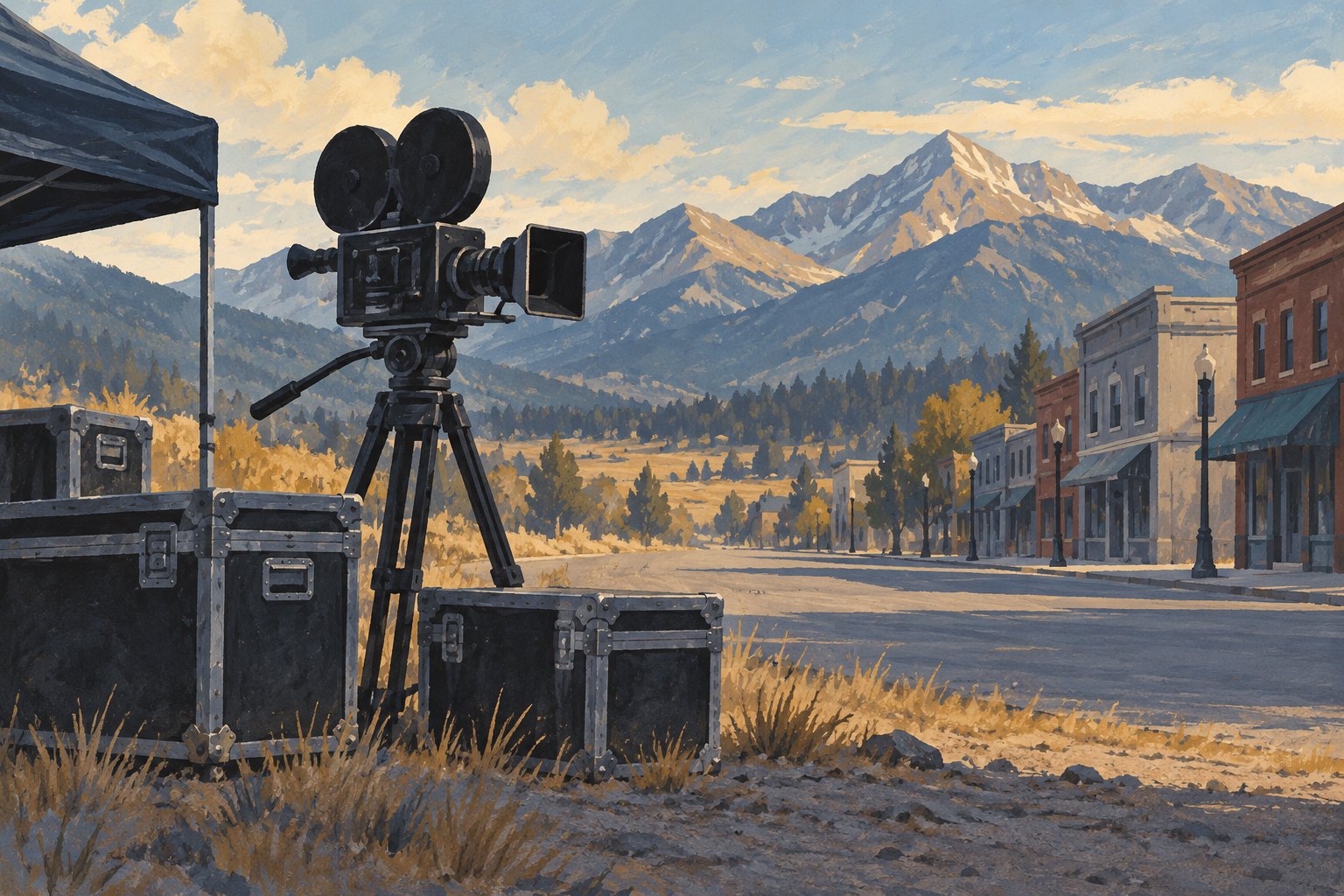
On screen, a street can become a shortcut to atmosphere. Its buildings suggest history; its proportions shape movement; its light gives a scene emotional texture. For a filmmaker, those qualities can make a location valuable before a character speaks. For someone who lives or works there, the same street has an entirely different set of meanings.
That difference is the most productive lens through which to consider Livingston’s dispute. A resident need not evaluate a production primarily as a future entertainment product. Someone can admire cinema while wanting clear information about activity nearby. Someone else can dislike a film’s apparent viewpoint while experiencing no practical inconvenience. Those positions should not be collapsed into a single category of support or opposition.
Consider a hypothetical example: a business owner asks whether customers can reach an entrance during a shoot. That question calls for an operational answer. A separate objection to the story being filmed calls for a different discussion. Neither example is an allegation about Livingston; they illustrate why specific questions produce more useful answers than broad declarations that a town is welcoming or hostile to movies.
My editorial view is that coverage becomes more revealing when it gives community members that specificity. Treating residents as an undifferentiated crowd makes their concerns harder to assess. It also encourages readers to assign motives before learning what anyone actually requested.
What a useful public explanation should answer
A persuasive account of the suspension would connect the action to identifiable reasons and explain what happens next. Readers should be able to distinguish the existence of complaints, the evidence supporting them, and the commission’s response. Those are separate stages, even when a headline compresses them into one event.
Four questions would make subsequent reporting particularly useful:
- What activity does the suspension cover? Its practical scope matters more than an assumption that every part of a project has stopped.
- What reasons did the commission give? An official explanation should be distinguished from comments made by supporters, opponents, or observers.
- What would resolve the issue? Any stated conditions, requested changes, or further review would help readers understand whether there is a defined path forward.
- How can affected people follow the outcome? A clear account of the next decision would make the temporary status easier to understand.
These are questions for evaluating the record, not claims that Livingston has failed to answer them. Without those answers, declaring either the commission or the production vindicated would be premature.
Community disagreement should not become a casting exercise
Film controversies can acquire the shape of a screenplay remarkably quickly. One side becomes the embattled creator, another the obstructive official, and residents become a chorus supplying outrage or applause. That structure is easy to follow because it provides protagonists and antagonists. It is also a poor method of understanding an unresolved civic dispute.
Real people can hold mixed positions. A person might welcome production work, object to one aspect of a shoot, and want the project to continue under clearer arrangements. An official might support filmmaking while finding a particular concern worth examining. These are possibilities, not descriptions of identified Livingston participants, but they show how much gets lost when coverage demands a simple allegiance.
Our commentary on separating reported events from assumptions about people at a movie theater raises a related reading discipline: visible conflict does not give an observer access to everyone’s motives. The same restraint is useful when interpreting a commission decision.
Why the eventual film cannot settle every question
A finished movie could be compelling, clumsy, provocative, or forgettable. None of those judgments would independently explain whether the permit suspension was justified. Conversely, the suspension cannot tell an audience whether a performance works, a character’s choices make sense, or a film earns its emotional conclusion.
That separation protects criticism from becoming publicity for either side. A controversial production history can encourage supporters to treat watching as solidarity and opponents to treat dismissal as accountability. Both approaches risk deciding the review before encountering the work.
There is nevertheless a meaningful connection between the two conversations: attention to perspective. Strong film analysis asks whose experience a story makes visible and whose experience it leaves outside the frame. Responsible production coverage can ask a parallel question about the community around a shoot, while recognizing that residents are people with their own interests rather than characters serving a filmmaker’s narrative.
The town deserves an explanation it can use
The deeper significance of Livingston’s reported suspension lies in that shift of perspective. A place can contribute enormously to a film’s atmosphere while the people who inhabit it remain peripheral to the public story of its making. Bringing their perspective into focus requires concrete information, careful attribution, and room for disagreement within the community itself.
The standard worth defending is straightforward: a temporary permit decision should be explained clearly enough for people to understand its reasons, its reach, and the conditions of its resolution. Until that picture is established, Livingston’s controversy deserves patient scrutiny. The town’s role in the story extends beyond providing a memorable backdrop.
Original content by this site's editorial team. Published: October 4, 2026 at 17:25:23 PDT (Los Angeles time)