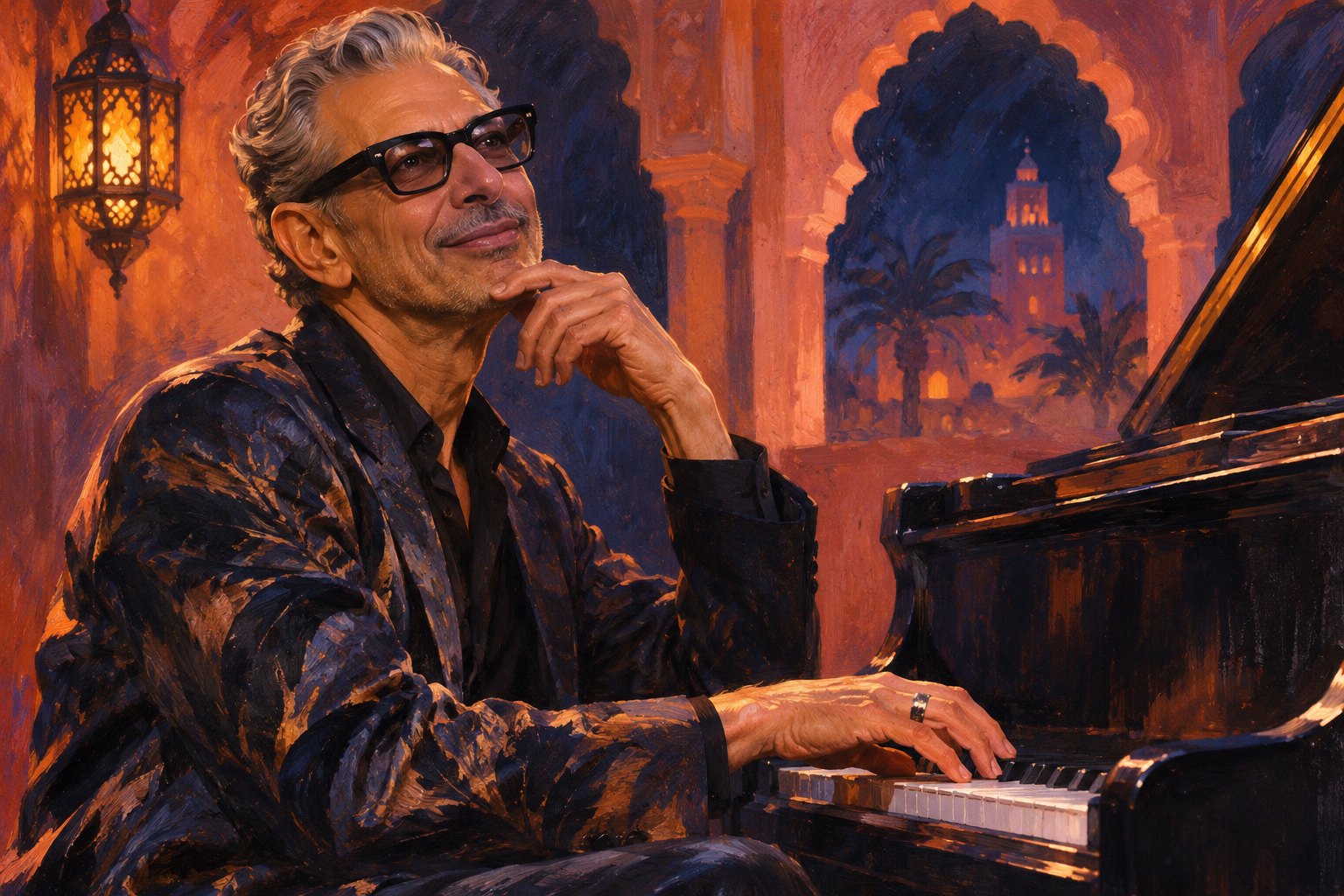
Jeff Goldblum brought music and reflection together at the Marrakech Film Festival, performing a piano medley and looking back on his career, according to Variety. His statement that “the stories that we tell matter” supplies the most interesting starting point for considering the appearance. It invites audiences to think beyond the pleasure of recognizing a familiar actor and toward the emotional work his performances actually do.
The combination is appealing: a performer at a piano, then a performer considering the stories he has helped tell. But the strongest response to a career reflection is to return to a performance in detail. David Cronenberg’s The Fly offers a particularly revealing example. Goldblum’s Seth Brundle is a man whose account of himself becomes increasingly difficult to reconcile with what other people can see.
Critical perspective: The connection between the Marrakech remarks and The Fly is an interpretation, not a claim that Goldblum discussed this film or its themes during the appearance. Major spoilers for The Fly follow, including its ending.
What the piano adds to a conversation about acting
A medley places different musical passages in relation to one another. That makes it an attractive metaphor for a career retrospective: individual moments acquire meaning through their arrangement. A change of pace can reveal a connection that a straight list of accomplishments would miss.
Without assessing the actual musical performance, that relationship between timing and meaning provides a useful way to watch Goldblum. In my reading of his screen work, the interest often lies in the movement between confidence and hesitation. A character can sound certain while the delivery leaves room for another possibility: perhaps he is thinking aloud, seeking approval, or trying to convince himself.
Music and acting both reward attention to these intervals. Our examination of how silent-film scores shape the experience of watching approaches a related question: sound can influence where we place our sympathy. In a spoken performance, a pause or a sudden change of tempo can perform comparable work.
The Fly: Seth Brundle wants someone to believe in him
In the 1986 film, directed by Cronenberg, Goldblum plays a scientist developing teleportation technology. Geena Davis plays Veronica Quaife, the journalist who becomes involved with both his discovery and his life. Their relationship gives the experiment its emotional stakes before the transformation takes over the story.
From Seth’s perspective, recognition seems almost as important as invention. He wants his work understood, but understanding requires another person to enter a world he has largely organized around himself. Goldblum makes that invitation awkward enough to feel personal. The scientific demonstration also functions as a bid for intimacy.
This is why the early scenes matter so much to the horror that follows. Seth cannot simply be an impressive mind attached to a vulnerable body. We need to understand the appeal of spending time with him. His eagerness makes the laboratory feel briefly like a place where an isolated person might build a shared life.
For me, the performance succeeds because charm remains unstable. Seth’s excitement is attractive, yet his desire to control the terms of discovery carries a warning. He welcomes an audience more easily than he welcomes disagreement. Goldblum lets those impulses coexist without announcing which one will win.
When improvement becomes a dangerous story
Seth’s experiment on himself goes wrong when a fly enters the telepod with him. Initially, however, the physical changes appear to him as improvements. Greater strength becomes evidence for a flattering explanation: the process has made him better.
The crucial character detail is the gap between sensation and judgment. Seth feels powerful, so he assumes he understands what has happened. His intellect becomes a means of defending an interpretation he wants to believe. The tragedy develops through that mistaken confidence as much as through the scientific accident.
Goldblum’s increasing physical assertiveness makes this persuasive. Confidence changes the way Seth occupies space and addresses others. What initially felt like an invitation begins to feel like a demand. Veronica’s caution threatens him because accepting it would require surrendering the exhilarating story of his own advancement.
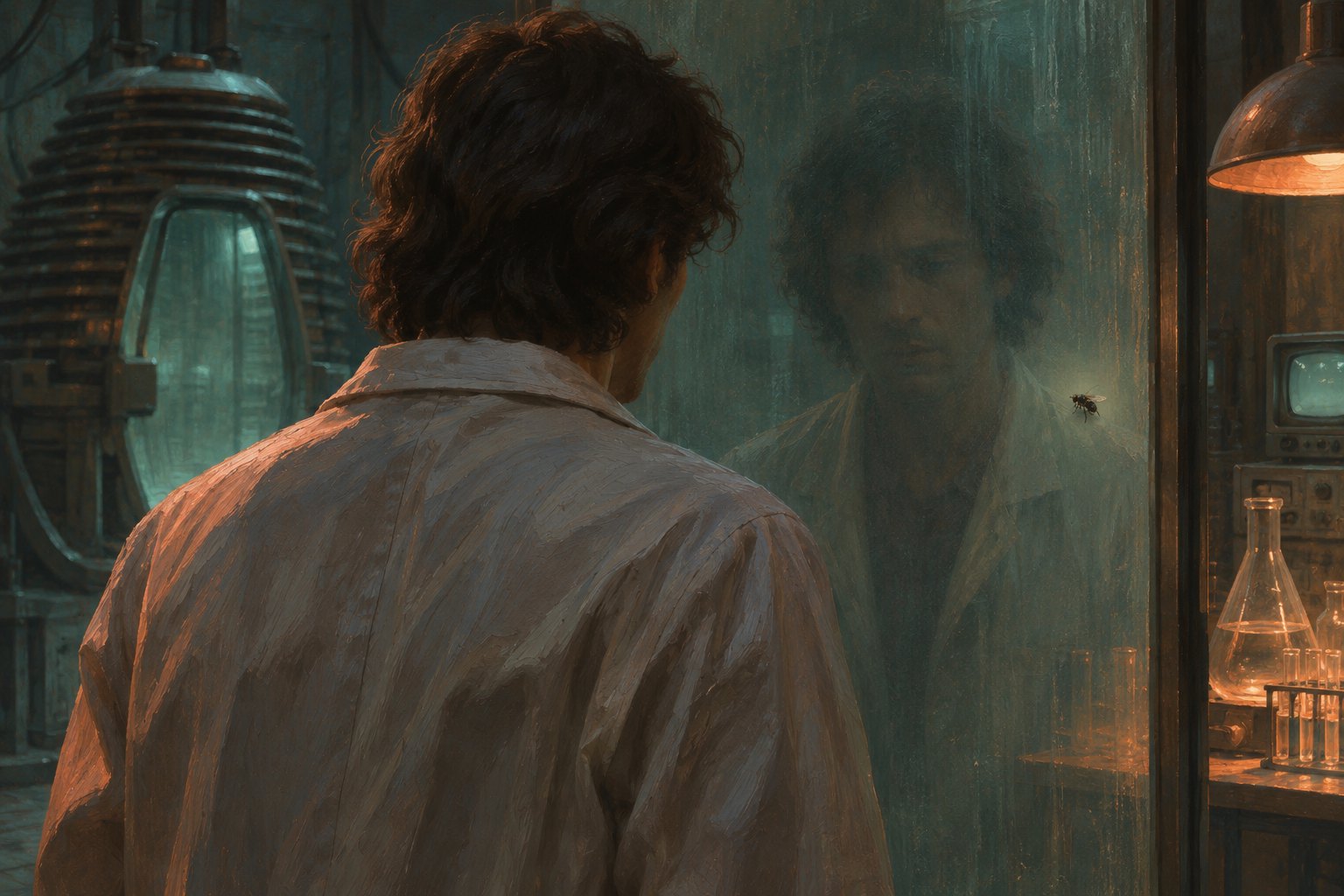
That makes The Fly an especially sharp companion to Goldblum’s Marrakech observation. Stories matter partly because they direct behavior. Seth’s explanation of his condition determines whom he trusts, which warnings he dismisses, and what he believes he can ask of another person.
Veronica sees what Seth cannot admit
“Be afraid. Be very afraid.” Veronica’s famous warning has the snap of a perfect horror quotation. Within the relationship, though, it represents a refusal to let Seth’s confidence settle the question of whether he is safe.
Davis is essential to the film’s emotional balance. Veronica’s concern gives viewers a perspective outside Seth’s self-description. Her attachment does not disappear when she recognizes danger, and that makes her position more difficult. She must respond to someone she loves while taking seriously the harm he can cause.
My strongest reservation about watching the film purely as a showcase for Goldblum is that it diminishes this shared achievement. His changes register through her responses. She gives the audience a measure of what has been lost and a reason to resist his increasingly coercive demands.
The distinction also matters when discussing the makeup and bodily deterioration. Altered appearance does not, by itself, establish cruelty. Seth’s treatment of other people does. That question connects with our discussion of appearance, vulnerability, and moral judgment in horror: the most useful criticism watches behavior as closely as surfaces.
The ending brings the performance down to a gesture
“Please help me” expresses the need beneath Seth’s increasingly elaborate explanations. Help is also the film’s most troubling idea, because his desire for rescue eventually becomes a threat to Veronica’s independence.
At the end, after a further catastrophic fusion, the creature guides the shotgun toward its own head. The gesture makes a final request legible when conversation is no longer possible. The scene is devastating because the audience must recognize a remnant of Seth without being offered a comforting restoration.
My judgment is that The Fly earns its emotional force through this narrowing of expression. The expansive talker becomes a figure whose smallest action carries enormous weight. The film’s grotesque spectacle is effective, but the remembered person inside it gives that spectacle its consequence.
Why the Marrakech remark reaches beyond celebration
Returning to Goldblum at Marrakech, the piano medley and career reflection suggest two ways of holding an audience: the immediate pleasure of performance and the longer experience of considering what a performance means. Neither needs to cancel the other.
The Fly offers a darker interpretation of the claim that stories matter. The stories we tell about ourselves can invite connection, conceal fear, or justify control. A good performance makes those possibilities visible without resolving them into a simple lesson. Goldblum’s Seth remains compelling because we can understand his longing while recognizing the damage it causes.
A small detail rewards a rewatch: Cronenberg himself appears as the gynecologist. More consequential than that cameo, however, is the film’s shifting distribution of understanding. Watch when Veronica recognizes something Seth still refuses to name. The distance between them is where this performance becomes tragedy—and where a festival statement about storytelling acquires its fullest weight.
Original content by this site's editorial team. Published: November 22, 2026 at 14:27:48 PST (Los Angeles time)