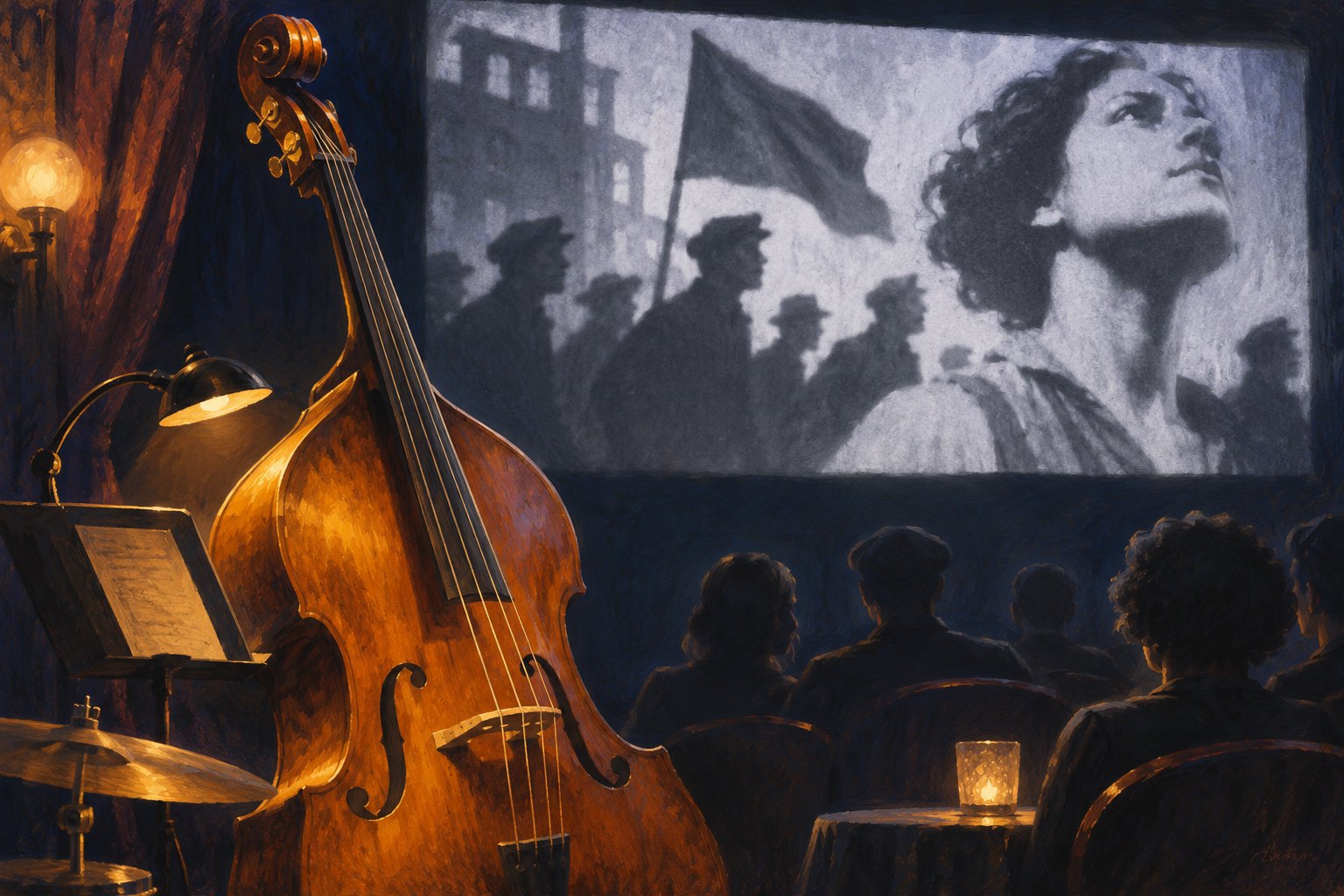
Alexis Cuadrado’s silent-film scoring project at The Jazz Gallery puts an unusually consequential question before movie lovers: how much of our sympathy comes from what we see, and how much comes from what we hear? JazzTimes identifies the bassist-composer and his group’s performance as a presentation of silent-film scores connected to social justice. That combination makes the event relevant beyond the concert audience. It concerns the way music directs our attention toward people on a screen.
This is a critical examination of the project’s premise, rather than a firsthand concert review. Its specific musical execution cannot be judged here, and no particular film lineup, scene, quotation, or audience response is assumed. The premise itself, however, deserves serious consideration: a new score can become an argument about whose experience matters.
Accompaniment Is Also Interpretation
A film score does more than establish whether a scene feels happy or sad. It can suggest where the scene’s emotional center lies. Imagine, as a general example, a confrontation filmed from a distance. An insistent pulse might make us anticipate an attack. A restrained, hesitant phrase might instead draw attention to someone’s uncertainty. The visible action could remain identical while the viewer’s understanding shifts.
That possibility gives Cuadrado’s project its critical interest. Connecting silent-film scores with social justice invites listeners to consider accompaniment as a choice about perspective. The useful question becomes whether music helps us recognize an individual’s circumstances, vulnerability, or capacity to act.
In my view, the strongest version of this approach would make the images more complicated. A score that merely announces the correct emotion risks flattening a film into an illustrated position statement. Music that allows conflicting feelings to coexist can make a character harder to dismiss and harder to reduce to a symbol.
Start With the Person Inside the Frame
Character-focused criticism begins with specific questions. What does someone want? What can they realistically do? What do they understand about their situation, and what remains outside their knowledge? Those questions offer a productive way to approach the social-justice ambitions associated with Cuadrado’s program, even without assigning unverified stories to its repertoire.
For any film depicting unequal power, there is a difference between presenting a person as helpless and revealing the restrictions on their choices. Music can influence that distinction. A continuously mournful accompaniment may encourage pity while obscuring resourcefulness, irritation, humor, or desire. A more varied response could preserve the fullness of a person whose circumstances are difficult.
This is a standard worth bringing to the project, rather than a claim about what its musicians played. Does the accompaniment notice a character making a decision? Does it respond to a change in confidence? Does it leave space for a gesture that resists an easy emotional label?
The same attention to inner experience informs our discussion of how a child’s perspective shapes the meaning of fear in Josephine. The relevant connection is a critical method: understand the person’s experience before turning that person into evidence for a larger argument.
The Risk of Making Suffering Beautiful
There is a difficult artistic tension in pairing expressive music with images of hardship. Beauty can hold our attention long enough for us to look closely. It can also become the thing we remember most, allowing the circumstances on screen to recede behind admiration for the performance.
Cuadrado’s social-justice framing makes that tension especially pertinent. The musical achievement and the ethical ambition need separate consideration. A passage might be compelling as music yet simplify the scene it accompanies. Conversely, an awkward pause or unresolved phrase might serve the film more effectively than an emotionally satisfying climax.
My preference would be for a score that leaves some discomfort intact. If a film presents an unequal relationship, the accompaniment need not make that relationship feel resolved simply because a musical phrase reaches its destination. Emotional release can be pleasurable, but pleasure should not automatically become the measure of successful interpretation.

What the Group Adds to the Question
The presence of a group introduces another useful dimension: several musical voices can share responsibility for a single screen image. Without a verified account of the arrangements, it would be inappropriate to describe specific instrumental exchanges or improvisational moments. Still, ensemble scoring creates the possibility of contrast, interruption, and competing emphasis.
That matters because characters rarely experience a situation in precisely the same way. One may feel secure while another feels exposed. One may treat an encounter as routine while another understands it as decisive. An accompaniment capable of holding different emotional pressures can help a viewer notice that imbalance.
Cuadrado’s combined identification as bassist and composer also points toward two distinct responsibilities: shaping a musical interpretation and participating in its performance. Neither role automatically guarantees insight into a film. Together, however, they make the relationship between the written conception and its realization a central criterion for evaluating the event.
How to Listen Without Losing the Movie
For viewers approaching this kind of performance, the most useful habit is to follow the image and the music as related but distinguishable experiences. Notice when an emotion appears to originate in an actor’s gesture, when the accompaniment intensifies it, and when the two seem to pull in different directions.
- Watch the shift in attention. Ask which person becomes emotionally prominent when the music changes.
- Distinguish movement from motivation. Following a visible action is different from suggesting why a character performs it.
- Notice restraint. A quieter passage may leave room for uncertainty, although restraint alone is no guarantee of insight.
- Question the emotional ending. Consider whether the music offers closure that the character’s circumstances have not earned.
These questions also protect a performance from being evaluated solely through its stated intentions. Social justice is an ambitious frame, but the artistic judgment still depends on what happens between sound, image, and viewer. Our consideration of how a special screening shapes expectations around I Play Rocky raises a related issue: the occasion matters, while the work still requires its own assessment.
The Deeper Stakes of Cuadrado’s Premise
The most persuasive interpretation of this project’s premise is that looking again requires listening differently. Familiar ways of accompanying an image can make a response feel inevitable. A new musical approach can expose that response as a choice, inviting viewers to reconsider whom they trust, whom they fear, and whose discomfort they overlook.
There is a responsibility attached to that freedom. New music cannot establish facts missing from a film, repair every limitation in its representation, or speak conclusively for its characters. It can offer a reading, and that reading should remain open to disagreement.
That is why Cuadrado and his group’s social-justice focus is worth discussing as film commentary. Its strongest potential lies in making attention more exact: encouraging viewers to recognize a character’s desires and contradictions before settling into pity, admiration, or judgment. Whether the particular performance achieved that requires direct engagement with it. The ambition is compelling because it asks audiences to hear their own assumptions—and then look at the screen again.
Original content by this site's editorial team. Published: November 22, 2026 at 07:50:27 PST (Los Angeles time)