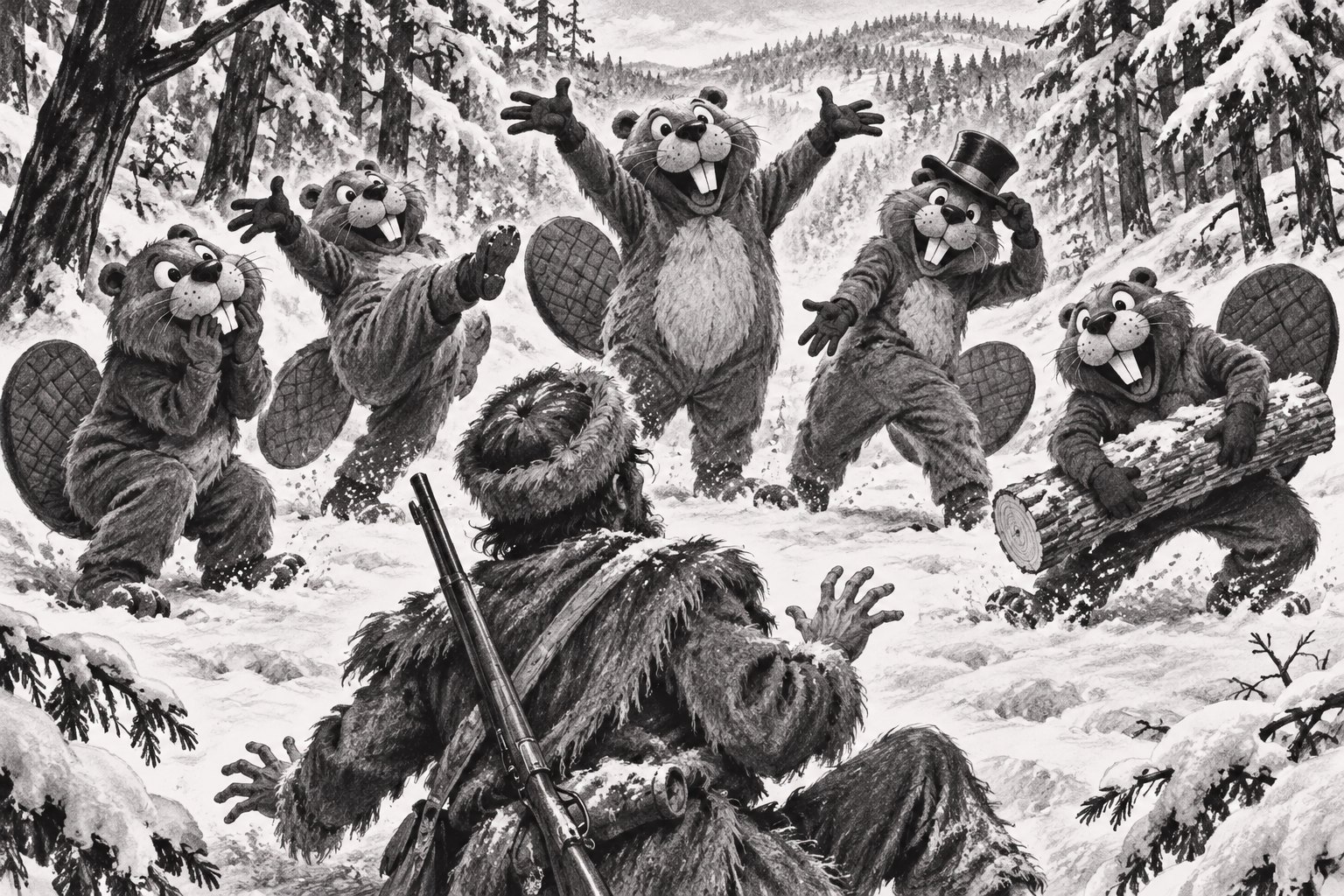
Hundreds of Beavers is returning to Milwaukee’s Oriental Theatre on film, as reported by [Milwaukee Magazine](https://www.milwaukeemag.com/hundreds-of-beavers-returns-to-the-oriental-theatre-on-film/). The occasion suits a comedy whose pleasures depend on watching small mistakes grow into enormous consequences. A failed attempt to catch dinner becomes an education; an education becomes a business; a business becomes a war with exceptionally organized rodents.
My verdict: this is an unusually rewarding physical comedy, both gleefully ridiculous and carefully constructed. Its relentless repetition can test your patience before its larger patterns emerge, but that patience pays off. The central attraction is watching a man acquire enough knowledge to become dangerous—and discovering that his opponents have been thinking, too.
Spoilers follow for the character arcs, major comic developments, and parts of the ending.
Jean Kayak Learns to Read the Wilderness
Directed by Mike Cheslik and written by Cheslik and Ryland Brickson Cole Tews, the film stars Tews as Jean Kayak, an applejack salesman stranded in a fantastical nineteenth-century winter. Its animals are performers wearing full-sized mascot costumes, an essential part of the premise described in the [official synopsis and credits](https://www.hundredsofbeavers.com/synopsis/).
Jean’s initial problem is less a shortage of courage than a shortage of understanding. He wants food, sees something potentially edible, and acts. The wilderness refuses to reward such a straightforward approach. His body reaches a conclusion before his brain has considered the consequences.
Tews makes that gap funny. Jean’s eagerness is always slightly ahead of his competence. Even when he begins to improve, his physical uncertainty preserves the memory of the fool who could barely get started. We root for him because learning remains visible in his behavior.
The film’s most satisfying character development happens through practical decisions. Catching animals requires observation, adjustment, and remembering what went wrong. These are modest achievements in an adventure supposedly about conquering the wilderness. Their modesty makes them persuasive: Jean earns progress one embarrassing correction at a time.
Repeated Gags Become a Form of Character Development
A repeating joke needs more than another impact. It needs a changed expectation. Here, the viewer gradually learns to inspect a setup alongside Jean: where something is positioned, what an animal might do, which detail could upset the plan.
That shared attention turns the landscape into an accumulating store of knowledge. The film invites us to become better viewers while Jean becomes a better trapper. A familiar situation arrives with new possibilities because both parties remember its previous version.
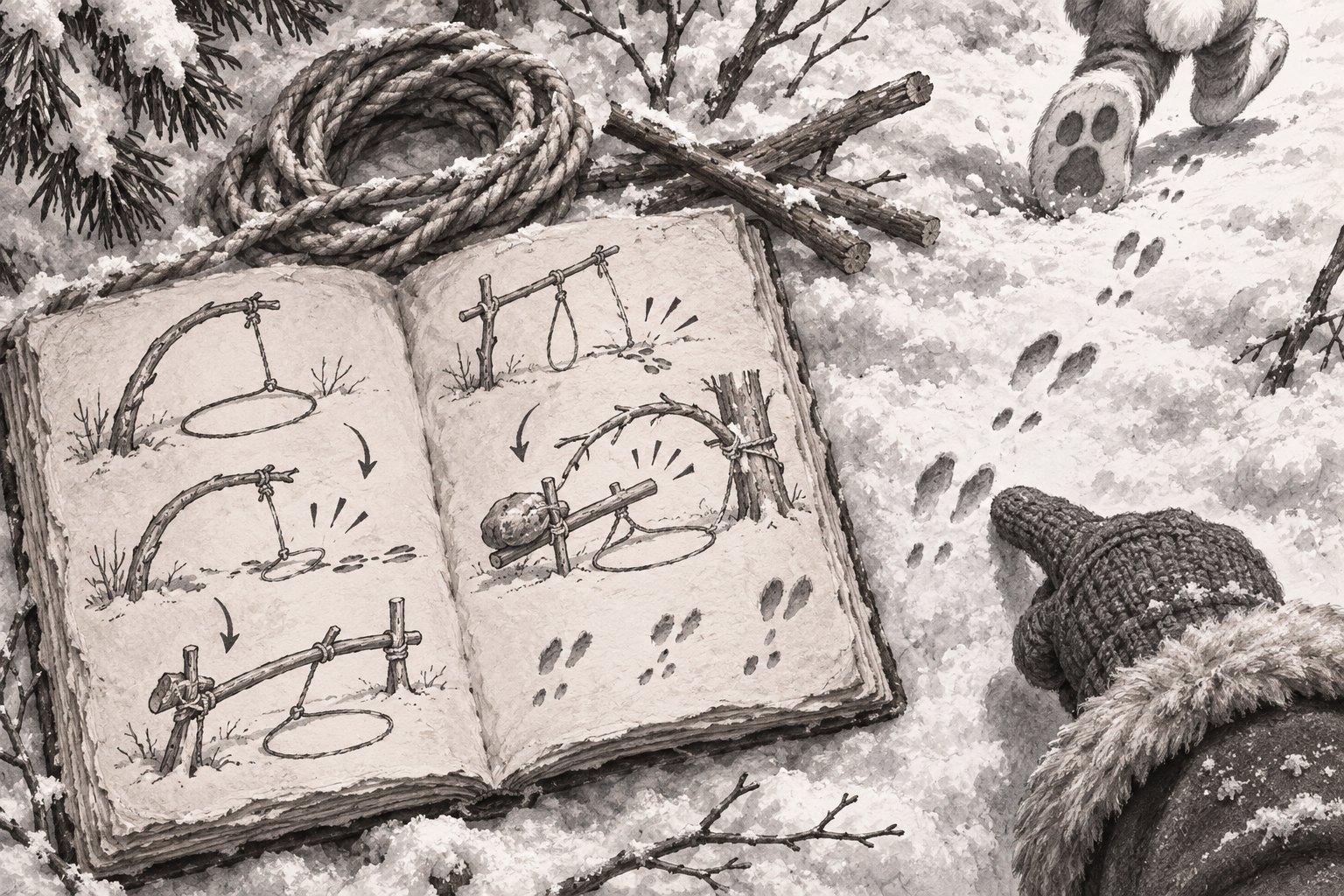
This is also where the film risks losing some viewers. If its early rhythm feels stalled, the eventual escalation may take too long to arrive. I find that delay productive, though occasionally overextended: helplessness needs enough time to become a condition before competence can feel like a breakthrough.
The distinction matters when judging cinematic invention. As our discussion of what innovation means on screen argues, unfamiliar presentation becomes valuable when it changes how we watch. Here, the oddness gives the audience an active job.
The Furrier Gives Jean a Reason to Want More
Jean’s relationship with the Furrier, played by Olivia Graves, adds desire to survival. Her father, the Merchant, played by Doug Mancheski, demands an enormous haul of beavers before permitting their marriage. Jean’s hunting and trading therefore acquire an additional destination. These relationships and the marriage condition are outlined in [Common Sense Media’s plot account](https://www.commonsensemedia.org/movie-reviews/hundreds-of-beavers).
From Jean’s perspective, this makes success measurable. Affection might be difficult to interpret, but a quantity of pelts offers something he can pursue. The joke is that an intimate ambition becomes another logistical problem.
The Furrier’s practical ability also makes her more interesting than a distant reward. Her work belongs to the same material world Jean is struggling to understand. His admiration meets someone who already possesses useful competence.
Still, the romance has limits. The story gives Jean substantially more room to develop, and the marriage bargain reduces the woman’s future to a transaction between men. Graves supplies personality within that arrangement, but she cannot make the dramatic structure equally generous to her character. The romance provides momentum more effectively than emotional depth.
The Beavers Have Their Own Version of the Story
The mascot costumes do more than soften the violence. They make the animals immediately legible as performers with intentions. Their obvious artificiality allows them to belong simultaneously to a woodland adventure and a theatrical comedy.
As the beavers investigate Jean and eventually put him on trial, the perspective changes. His resourcefulness looks rather different to the community losing its members. The film even threatens him with the same transformation into clothing that underpins his livelihood. These developments, along with the detective pair modeled on Sherlock Holmes and Dr. Watson, appear in the film’s [documented plot and character listing](https://en.wikipedia.org/wiki/Hundreds_of_Beavers).
I read that reversal as the movie’s sharpest complication. We have been encouraged to treat successful trapping as progress. Suddenly the targets possess institutions, colleagues, and an understandable grievance.
The film never needs to become a solemn moral lesson for this to work. It simply lets its antagonists organize. Jean is still our protagonist, but the wilderness no longer resembles a collection of objects awaiting his ingenuity. Other minds are at work, and some are assembling a case against him.
A Nearly Wordless Film with Visual Punch Lines
There is no substantial collection of memorable spoken lines to quote throughout this review: Hundreds of Beavers communicates primarily through movement, images, and sound. Its memorable units are gestures and consequences.
That choice suits Jean particularly well. A speech about determination would summarize what the film can demonstrate through another attempt. His thinking becomes something we watch happening rather than something he reports afterward.
The black-and-white presentation helps organize this activity. Dark figures against snow create readable relationships between bodies and space. The costumes may be ungainly, but the compositions need clarity for a complicated joke to register.
This makes the Oriental return appealing beyond the attraction of the format itself. In a theater, anticipation and recognition become shared experiences. Someone catches the setup; someone else laughs at the delayed result. A room can make the distance between those moments feel wonderfully alive. That communal pleasure also informs our consideration of why familiar films remain rewarding theatrical events.
What Jean’s Success Finally Means
Beneath its escalating absurdity, the film offers a persuasive account of learning. Jean improves when he stops assuming that wanting something is enough. Attention becomes more useful than indignation. Experience matters only when he changes his next attempt.
Yet his growing efficiency also expands the conflict around him. Getting better at a task does not automatically make that task admirable from every perspective. The beavers’ resistance keeps that uncomfortable possibility inside the comedy.
The Holmes-and-Watson detective reference crystallizes the idea. Jean has learned to study the animals, but the animals can study him back. The joke rewards recognition while giving his adversaries intellectual dignity.
That is why Hundreds of Beavers sustains more than its initial novelty. Its world keeps answering its hero. Every apparent solution creates another response, and every hard-won advantage can become tomorrow’s humiliation. On the Oriental’s screen, that restless exchange has a fitting place to become everybody’s problem—and everybody’s laugh.
Original content by this site's editorial team. Published: November 27, 2026 at 17:07:23 PST (Los Angeles time)