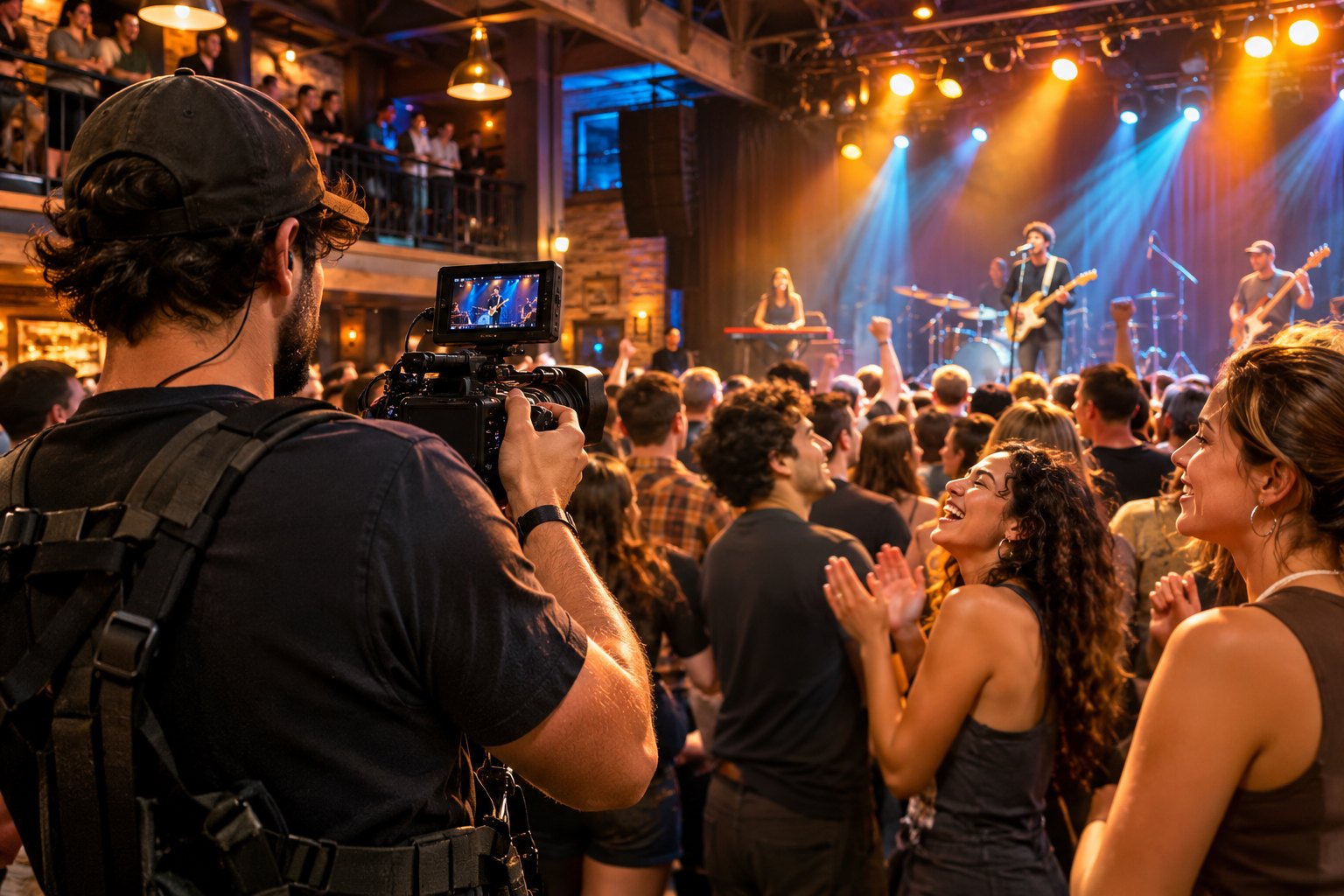
To film and edit a high-energy event sizzle reel, capture clear actions, genuine reactions, and enough surrounding detail to connect them. Then build an edit that changes pace, uses live sound, and moves toward a payoff. Fast cutting can add excitement, but it cannot explain why a moment matters.
The most compelling reels borrow a basic strength from narrative filmmaking: they give us someone to watch and something to anticipate. A performer waiting to enter, an attendee discovering an installation, or a crew member preparing a reveal can provide that thread. My editorial preference is for energy that grows out of people doing things, rather than transitions competing for attention.
Decide What the Viewer Should Experience
Before making a shot list, finish this sentence: the viewer should come away feeling that this event was ____. Intimate, exhilarating, welcoming, and inventive suggest different filming choices. A reel that promises all four without establishing any of them can feel like interchangeable promotional footage.
Also define the intended use, approximate running time, and delivery format. A short social edit needs a premise that registers quickly; a longer recap can accommodate more context. If multiple crops are required, plan your framing before the event so important faces and actions survive those versions.
Choose a simple progression: arrival, anticipation, participation, release. This is a proposed editorial structure, not a requirement to rearrange events misleadingly. The objective is to give the audience a developing experience rather than a succession of equally emphatic highlights.
Build a Shot List Around Actions and Reactions
Coverage becomes useful when its pieces relate to one another. A wide shot establishes the room, a medium shot identifies an action, and a close-up reveals a detail or response. Together, they give the editor options for changing scale without losing the viewer.
For each important activity, try to collect a compact sequence:
- Orientation: Where is the action happening, and how are people arranged?
- Preparation: What gesture signals that something is about to begin?
- Action: What actually happens?
- Reaction: How do the people involved respond?
- Aftermath: What changes once the moment has passed?
At a hypothetical performance, that might mean the stage, a musician taking position, the opening gesture, an audience response, and a shared glance afterward. These shots offer a miniature story. Five unrelated camera moves offer movement, but much less meaning.
Record a little time before and after each action. Cutting immediately after the apparent highlight can eliminate the smile, breath, or release that makes the sequence satisfying. When working alone, prioritize an unobstructed view of an unrepeatable moment over collecting another decorative angle.
Give the Event a Human Perspective
An attendee is not a fictional character, and a reel should not invent an emotional journey for them. Still, following an identifiable participant through several observable moments can help viewers understand the event from inside it.
Look for visible behavior rather than presumed feelings. Someone pauses, leans forward, joins an activity, or applauds. Those actions are available to the camera. Claims that they were overwhelmed, transformed, or inspired require more evidence than an attractive close-up.
This is also why reactions should retain an honest relationship to the actions they accompany. Moving applause from an unrelated moment can imply a response that never occurred. The distinction between showing a result and explaining its context also matters in reading the action before a football highlight: the surrounding sequence changes what the image means.
Move the Camera With a Purpose
A moving camera can introduce a space, follow a participant, or reveal something previously hidden. Before each move, identify its destination. If the shot ends without revealing new information, a steady composition may serve the sequence better.
Vary your approach. Capture stable frames alongside tracking shots and handheld observations. A locked-off view can make movement within the frame more legible, while giving the edit a resting point between more kinetic passages.
Check focus, exposure, and how venue lighting behaves in recorded footage. Review a short test clip before the essential moments begin. Avoid assuming that an appealing camera display guarantees usable highlights, clean motion, or consistent color across the room.
Use slow motion selectively. If you plan to slow footage down, choose an appropriate recording frame rate and test the result in advance. Reserve the effect for gestures worth examining; extended slow motion can flatten the urgency of an otherwise lively sequence.
Record the Sound That Makes the Room Specific
Music can organize an edit, but location sound gives it physical presence. Applause, footsteps, a burst of laughter, or the brief hush before a performance can make the viewer feel the difference between anticipation and release.
Monitor recordings with headphones when possible, and leave headroom for sudden loud moments. Gather a few stretches of room ambience as well as distinct sounds. These recordings can help connect cuts without forcing the music to do all the emotional work.
If a spoken line earns its place, preserve its meaning and make it intelligible. Do not combine fragments into a statement the speaker did not make. Choose music you have permission to use for the intended publication, and settle that choice before building an elaborate edit around its structure.
Edit for Progression Before Adding Effects

Start by organizing footage into actions, reactions, setting details, and usable sound. Mark the strongest moments, but also identify the connective shots that explain them. A technically beautiful clip does not automatically deserve a place in the final sequence.
Build a rough assembly with straightforward cuts. Introduce the event, establish participation, increase intensity, and find an ending that feels earned. Judge whether that progression works before adding transitions, speed changes, or extensive graphics.
For a hypothetical minute-long reel, a useful starting structure is:
- Opening: Present an intriguing action or sound, then orient the viewer.
- Development: Show people engaging with the event through connected sequences.
- Escalation: Increase the density of meaningful moments as the music develops.
- Payoff: Let one memorable action and its response complete the experience.
Cutting on musical beats can create coherence, but hitting every beat predictably can become monotonous. Sometimes hold through a beat so an action finishes. Elsewhere, let the next scene's sound arrive before its image. That small overlap can pull the viewer forward without a conspicuous visual effect.
A brief quieter passage can make the next peak feel larger. Contrast creates room for intensity; constant intensity gives the viewer little basis for comparison.
Check Clarity, Honesty, and the Final Payoff
Watch the first cut without sound. Can you understand where you are and what people are doing? Then listen without watching. Does the soundtrack develop, or does it remain at one continuous level? These checks expose different weaknesses.
Review the intended delivery crop, match distracting differences in color and brightness, and check that speech remains clear beneath music. Remove repeated shots that communicate the same information. If a transition draws attention away from the event, simplify it.
Our discussion of what viewers should look for in film-event coverage offers a related viewing lens: presentation should give audiences something meaningful to notice. A sizzle reel benefits from that same specificity.
Ultimately, an event reel is an interpretation of shared attention. It shows what people gathered around, what they did, and how moments passed between them. The strongest ending leaves us with one of those exchanges—a completed gesture, a response, a release. That is what turns an energetic montage into an experience worth remembering.
Original content by this site's editorial team. Published: November 16, 2026 at 13:51:52 PST (Los Angeles time)