FKA twigs is taking on Josephine Baker in Maïmouna Doucouré’s biopic, according to Variety. That pairing gives the project an immediately compelling center: a performer portraying another performer, with the difficult task of making a familiar public figure feel like a person discovering her next move. The interesting question reaches beyond resemblance. What will Baker want in a particular moment, and how will the film let us experience that desire?
This is a critical preview, not a review of the completed film. The casting and filmmaker provide a starting point for analysis, but they cannot establish the quality of the performances, the shape of the screenplay, or the effectiveness of individual scenes. No unverified dialogue or plot developments are treated here as material from the movie.
What the FKA twigs casting puts at stake
The phrase “becoming Josephine Baker” promises transformation. In movie publicity, transformation often means the visible work: hair, wardrobe, posture, a face made familiar through photographs. Those elements can help an audience accept a portrayal, but recognition is only the beginning of characterization. A convincing likeness can still leave the central figure emotionally remote.
For twigs, the more demanding task will be establishing a coherent relationship between Baker’s outward presence and her inward attention. Where does she look when someone else speaks? Does her expression change before she answers? Can the audience distinguish a response she means from one she has chosen for its effect? These are questions about the eventual performance, not claims about how twigs has played it.
My view is that this casting will be most rewarding if the film allows moments that resist immediate interpretation. A person performing for an audience may be readable by design. A person deciding whether to trust someone can be harder to read. Giving Baker both kinds of presence would create dramatic range without requiring the screenplay to explain every feeling.
Baker needs a point of view, not just a spotlight
A biopic has a built-in imbalance: viewers may arrive knowing that its subject matters, while the character must live through events without that retrospective certainty. If every scene announces historical importance, ordinary decisions lose their tension. The audience watches a reputation accumulate instead of encountering a person making choices.
Doucouré’s central storytelling challenge, as I see it, is therefore one of perspective. A scene organized around Baker’s experience would establish what she notices, what she misunderstands, and what she is trying to accomplish. A scene organized only around her significance might instead prioritize the reactions of people impressed by her. Both approaches can produce striking images, but they invite very different relationships with the protagonist.
This is related to the question explored in our discussion of how filmmaking gives characters a point of view. Screen time alone does not guarantee subjectivity. A character can dominate the frame while the movie remains more interested in how everyone else sees her.
For this biopic, the strongest version of that distinction would let viewers understand Baker’s immediate priorities before asking them to assess her legacy. Admiration can follow understanding. It does not need to replace it.
The acting test between movement and stillness
In a film built around a performer, physical expression can carry narrative information that dialogue cannot. A repeated gesture might acquire a different meaning as circumstances change. An entrance could communicate confidence, calculation, or the effort required to appear composed. Such possibilities make the body part of the storytelling rather than merely something the camera records.
Yet movement gains meaning through contrast. Stillness can expose hesitation; an unfinished gesture can suggest a decision being revised. The question for twigs’s portrayal will be whether public and private behavior belong to the same character, even when their surfaces differ. An abrupt switch from dazzling performance to generic sadness would simplify that relationship.

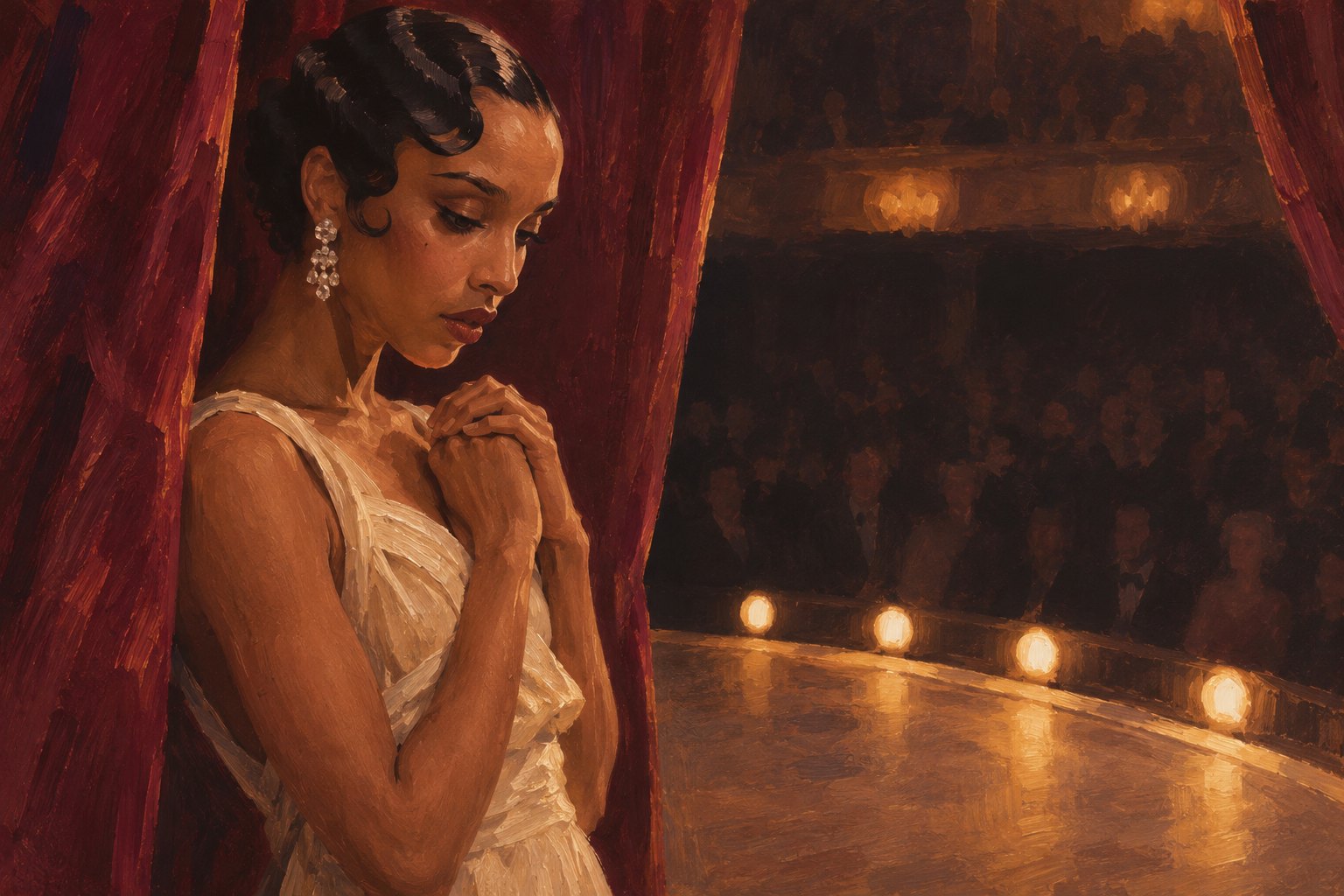
The illustration above imagines that contrast symbolically; it does not depict a verified scene. A backstage setting is not automatically more truthful than a stage. People perform versions of themselves in private relationships, too. The richer dramatic possibility is a Baker whose different ways of presenting herself remain purposeful, sometimes protective, and not always fully understood by the people around her.
How the camera could make spectacle meaningful
Performance sequences earn their place in a drama when they change our understanding of the performer. That does not require every musical or physical flourish to symbolize something. Pleasure, skill, and command can matter on their own. But a sequence becomes especially revealing when its formal choices connect what the audience sees with what the character experiences.
Framing would be crucial. A distant view can show the relationship between a body and a stage; a close-up can redirect attention toward effort or concentration. Editing can preserve the continuity of an action or break it into impressions. Neither approach is inherently superior. The useful critical question is what each choice enables us to perceive about Baker.
Sound offers another route into character. Applause can register as affirmation, pressure, or simply the environment in which someone works, depending on how a scene prepares us to hear it. Our analysis of music’s relationship to character considers a related principle: sound becomes dramatically useful when it shapes perspective, rather than merely telling viewers what emotion to supply.
What a finished-film review will need to establish
A fair assessment of Doucouré’s biopic will need to examine its actual narrative scope. Which period does it dramatize? How does it handle the passage of time? Which relationships receive enough space to develop reciprocal motives? These choices determine whether the protagonist encounters other people or merely a succession of obstacles and admirers.
Dialogue will require the same attention. A memorable line matters because of who says it, to whom, and under what pressure. Without verified scenes or a screenplay, quoting supposed dialogue would manufacture evidence. The eventual test is whether Baker’s speech expresses specific intentions—persuading, withholding, deflecting, connecting—rather than functioning chiefly as a collection of statements about her importance.
Release timing, supporting roles, and the movie’s final structure should likewise be established through confirmed information before informing a verdict. For now, the casting invites interest; it does not justify a star rating or a claim that the film has successfully captured Baker.
The deeper possibility: a person who exceeds her image
The most promising interpretation of this project is that portraying an icon can become an inquiry into the limits of public recognition. Being recognizable is not the same as being understood. A biopic can explore that distance by allowing its central character desires, contradictions, and judgments that do not exist solely to complete a familiar portrait.
That is the standard I would bring to FKA twigs’s Baker and Doucouré’s direction: whether the finished film makes individual choices matter as much as the image they eventually create. If it does, the transformation will reach beyond appearance. Viewers will have something more substantial than the satisfaction of recognition—a sense of a person thinking and acting within the moment.
Original content by this site's editorial team. Published: November 12, 2026 at 00:44:10 PST (Los Angeles time)