Oklou has scored a new animated film, according to Pitchfork. For moviegoers, the announcement raises an appealing question: what can music reveal about an animated character that the drawing, movement, and dialogue leave unspoken?
A scoring credit establishes an artist’s involvement; it does not establish how successfully the music works inside the finished movie. This is a spoiler-free critical commentary on that distinction, rather than a review of the film’s scenes or performances. The interesting prospect is hearing how Oklou’s contribution serves a dramatic perspective—and whether the score gives viewers something more specific than a pleasing atmosphere.
A Score Can Decide Whose Experience We Share
Film music does more than identify the emotional temperature of a scene. It can determine whose experience seems to matter. A wide shot may contain several people, but a musical cue can pull our attention toward the uncertainty of one person within it. The image presents a shared space; the score can make that space feel intensely private.
Consider a hypothetical animated character entering a crowded room. A buoyant rhythm could make the entrance feel exciting. A persistent, unresolved tone could make the same movement feel difficult. Neither choice changes the visible action, but each proposes a different relationship between the character and the room. These are illustrative possibilities, not descriptions of Oklou’s film.
The useful question for her scoring work is therefore precise: does the music tell us something about the person experiencing the moment? Calling a cue beautiful or melancholy only gets criticism so far. A stronger assessment connects its sound to a desire, a hesitation, or a change in understanding.
Animation Makes Timing Especially Expressive
Animation offers composers an unusually visible relationship between movement and duration. A turn of the head, a held pose, or a sudden change in scale can become the organizing event of a musical phrase. That relationship can be playful, but it can also convey thought. A character may appear to arrive at a realization because a movement and a harmonic change meet at exactly the right instant.
Perfect synchronization is only one possibility. Music can begin before a gesture, making the gesture feel anticipated. It can arrive afterward, giving an action the weight of an afterthought. It can continue steadily while the picture becomes frantic, suggesting that the character’s attention lies somewhere beyond the immediate commotion.
That makes timing a more revealing standard than sheer musical richness. A spare cue placed well may explain more than an elaborate passage that leaves no room for the animation to breathe. Our discussion of sound and creative purpose in I Made a Film in Excel approaches a related issue: the value of an audiovisual idea depends on what its elements accomplish together.
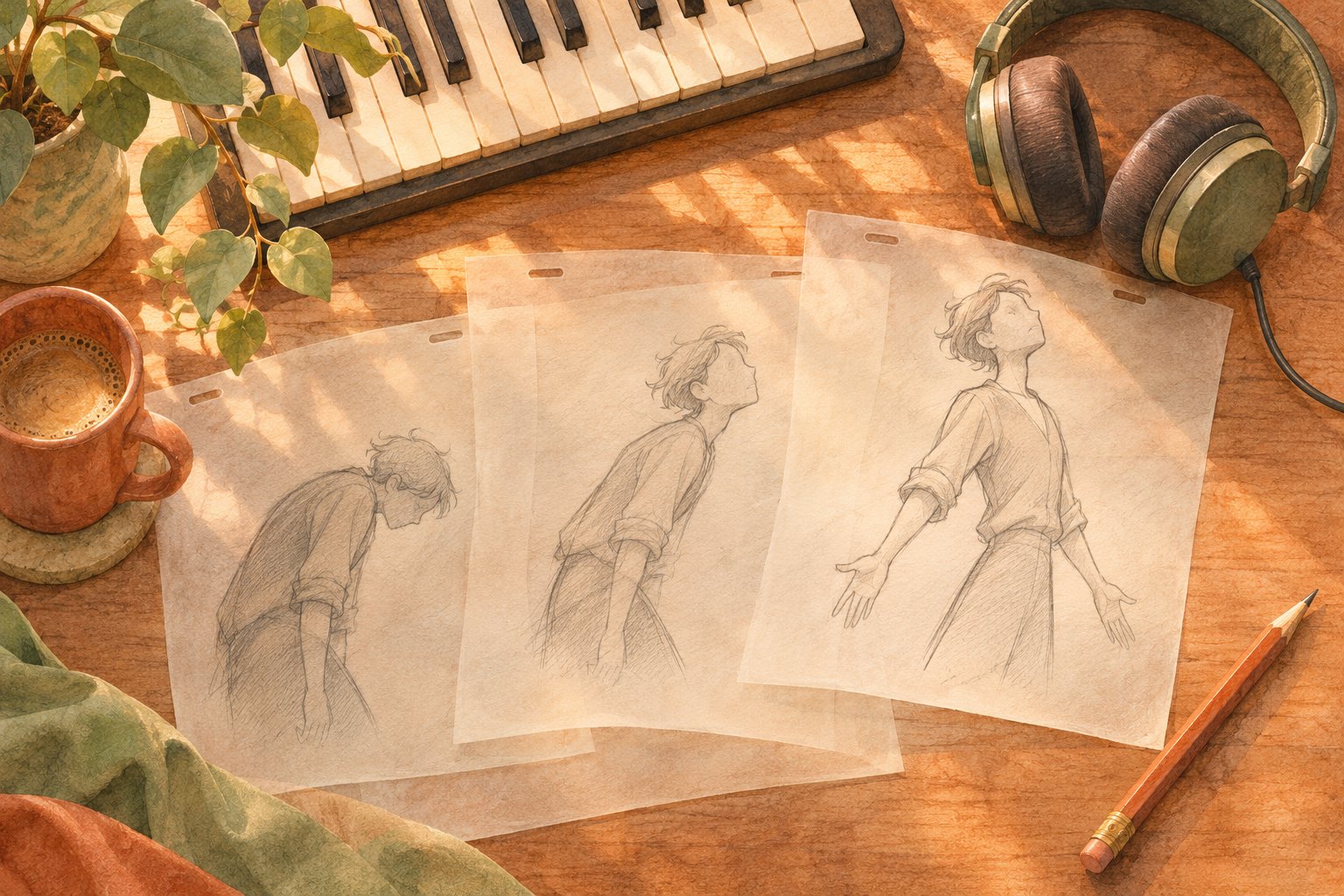
Characters Need Room to Contradict the Music
One of the most interesting things a score can do is introduce uncertainty. A smiling face accompanied by unsettled music may suggest an emotion the character is concealing. Yet that combination can also become an easy shortcut, instructing viewers to distrust a person before the performance or story has earned the suspicion.
My preference is for scoring that leaves some interpretive space. If every expression receives an unmistakable emotional label, the audience has little left to discover. A character becomes more compelling when we can register competing possibilities: confidence alongside fear, affection alongside resentment, relief that has not quite become happiness.
For Oklou’s score, the critical test would be whether musical ambiguity deepens those possibilities or merely makes the film feel hazy. Ambiguity has dramatic value when it belongs to a particular conflict. Without that connection, an evocative texture can remain attractive while telling us very little.
Dialogue also needs that space. A memorable line can gain force from what happens immediately before or after it, including the absence of music. No film dialogue is quoted here because there is no verified scene-level basis for selecting it. Inventing a line would obscure the very relationship between sound and character that deserves careful attention.
A Returning Melody Should Carry New Meaning
Repetition gives a film score a way to remember. Once a musical phrase becomes associated with a person or encounter, its return can bring the earlier moment into the present. The audience hears both at once, even when the image shows only what is happening now.
But recurrence alone does not establish development. A recognizable theme can function as a convenient label, announcing the same feeling whenever a familiar character appears. More revealing uses allow the story to alter what the listener hears in it. An unchanged melody might feel different because the character’s circumstances have changed; a transformed arrangement might make that change audible.
This is a useful distinction to carry into any eventual assessment of Oklou’s contribution. The question is not simply whether a tune returns, but what has happened between its appearances. Does the recurrence preserve a memory, expose a misunderstanding, or make an earlier moment newly painful? Those judgments require the film’s actual dramatic context.
How to Listen Without Turning the Movie Into Homework
There is no need to identify instruments or recognize compositional techniques to assess a score. Start with your own attention. Notice when the music brings you closer to a character and when it seems to stand outside the scene, explaining everyone from a distance.
- Notice entrances: What changes when the music begins—your expectations, your sense of pace, or your sympathy?
- Notice exits: Does the score’s withdrawal make a voice, gesture, or environmental sound newly important?
- Notice returns: Does familiar music mean something different after the story has moved forward?
- Notice the aftermath: Do you remember a character’s experience, or mainly the sensation of hearing an appealing piece of music?
That last distinction also informs our examination of what a concert film should reveal beyond familiar songs. Music’s appeal is a starting point for film criticism. The interaction between sound, image, and human presence is where the assessment becomes more revealing.
The Deeper Promise of Oklou’s Scoring News
The strongest reason to follow Oklou’s animated-film work is the possibility of discovering how her music participates in someone else’s story. A score can make an invented figure feel like a person with an inner life: someone whose experience continues beyond the expression we can see.
That is the standard I would bring to the film. Does the music help us understand what a moment costs the character, what remains unresolved, or why an apparently ordinary action matters? The announcement invites curiosity. The finished relationship between music and character must earn the emotional response.
Original content by this site's editorial team. Published: November 11, 2026 at 17:31:20 PST (Los Angeles time)