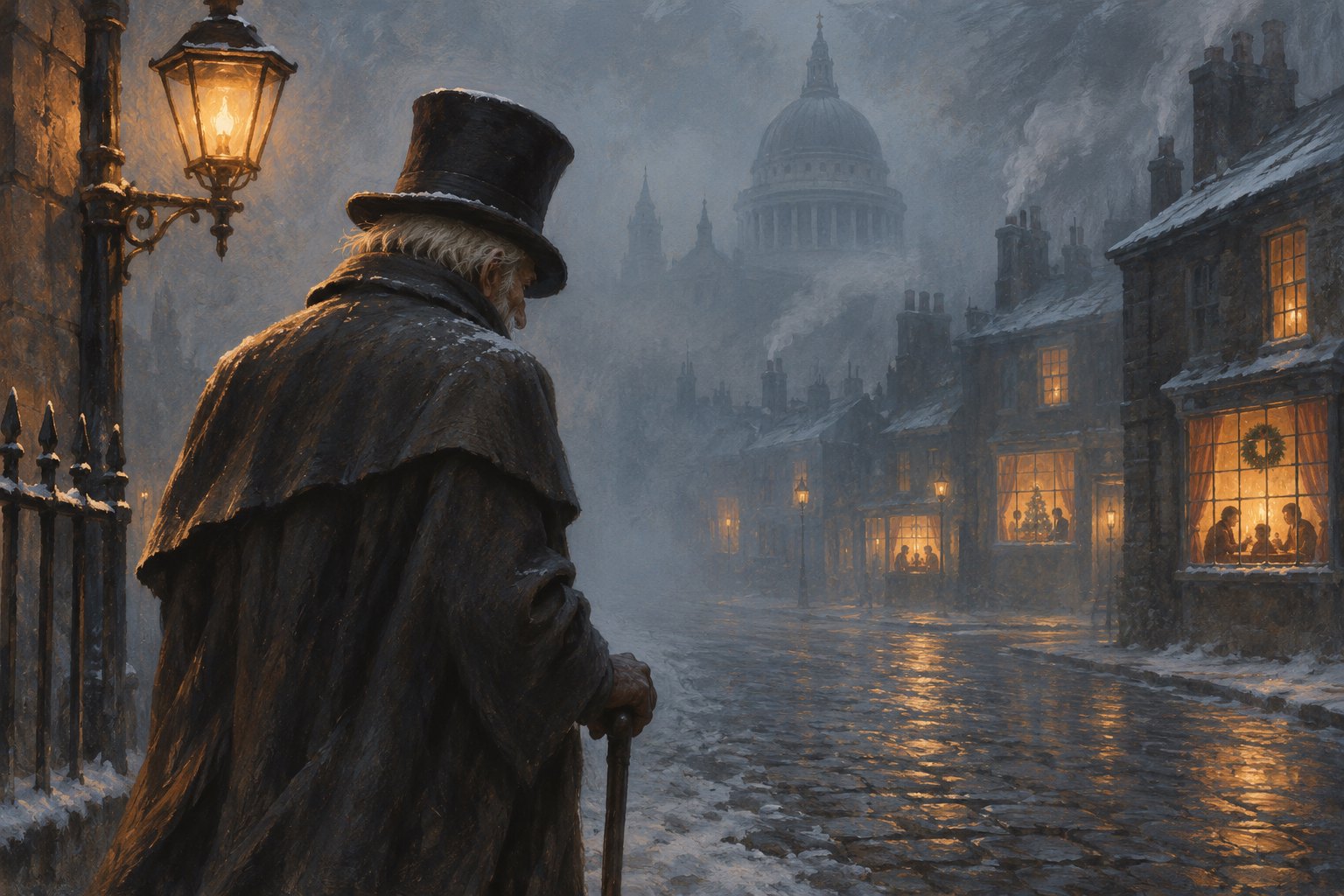
Ebenezer makes its most interesting argument when Scrooge’s supernatural ordeal becomes a problem of ordinary human relationships. Frightening a miser is relatively straightforward. Getting him to acknowledge an employee’s needs, accept an invitation, and surrender something he owns demands a more consequential transformation. That distinction gives Ti West’s interpretation of A Christmas Carol its strongest avenue for character analysis: the ghosts can interrupt Scrooge’s life, but the living must experience the difference afterward.
Johnny Depp plays Scrooge in the film directed by West and written by Nathaniel Halpern. Paramount identifies it as a Victorian London ghost story about confronting the past, present, and future, with Rupert Grint as Bob Cratchit and Sam Claflin as Fred. The theatrical release was November 13, 2026. [Paramount’s film guide](https://www.paramountplus.com/sneak-peak/ebenezer-everything-you-need-to-know/)
Spoiler warning: This review discusses the character arcs and ending. The accompanying illustrations are thematic artwork, not film stills.
Scrooge’s Self-Protection Becomes Everyone Else’s Problem
“Bah! Humbug!” is more than a seasonal catchphrase. It allows Scrooge to dismiss an emotional demand before considering it. An invitation, a celebration, or another person’s vulnerability can all be reduced to foolishness. Once he has declared the occasion meaningless, he owes nobody his participation.
Depp’s stated approach to the character emphasizes someone who retreats from caring because it has become painful. That provides a useful interpretive starting point, although it cannot serve as a moral defense. Scrooge’s suffering explains why isolation might appeal to him; it does not explain why other people should bear its costs. Paramount’s cast feature also describes Fred’s connection to his late mother and Bob’s struggle to provide for his family. Those competing needs keep the story from belonging exclusively to its wealthy protagonist. [Paramount’s cast feature](https://cms-corp.paramount.com/news/inside-ebenezer-with-its-all-star-cast)
My reading is that Scrooge’s central mistake lies in confusing control with safety. Money can be counted, stored, and withheld. Relationships resist that kind of management. They introduce obligations and the possibility of loss. His retreat therefore has a terrible internal consistency: he protects himself from grief by refusing the connections that make grief possible.
The danger for any sympathetic interpretation is allowing explanation to become acquittal. A lonely employer still exercises power over an employee. A wounded uncle can still wound his nephew. The film’s redemption story becomes meaningful only when those facts survive our growing understanding of Scrooge.
Fred Wants a Relationship, Not a Conversion Trophy
Fred’s persistence deserves attention because his Christmas invitations have a history behind them. As Claflin explains in an interview about the ending, his character’s desire to remain close to Scrooge is bound to their shared connection with Fred’s mother, Scrooge’s sister. He is trying to preserve a family relationship that still matters to him. [Claflin’s discussion of Fred](https://www.cinemablend.com/movies/ebenezer-ending-sam-claflin-meant-johnny-depp-ebenezer-merry-christmas)
From Fred’s perspective, another refusal cannot simply be dismissed as an amusing display of an old man’s temperament. It is a rejection of something he values. His optimism consequently carries a cost: maintaining the invitation means leaving himself open to disappointment.
That makes him an important counterweight to Scrooge. Both men have a relationship to the same absence, but they respond differently. One protects himself by withdrawing; the other seeks continuity through connection. Neither can restore the person they have lost. Fred nevertheless recognizes that loss need not dictate the shape of every surviving relationship.
This is also where Christmas storytelling can become more complicated than its reputation suggests. As in our analysis of grief and family attachment in The Family Stone, the holiday matters because it concentrates unresolved feelings into a shared occasion. An invitation asks who still belongs.
Bob Cratchit Makes Redemption a Material Question
Bob supplies a different test. Fred wants his uncle’s presence; Bob’s household is affected by Scrooge’s decisions as an employer. Grint’s character therefore prevents the story from reducing goodness to an improved mood.
Bob’s warmth is easy to misread as evidence that deprivation has left him essentially untouched. The more useful interpretation is that generosity requires effort under pressure. His commitment to family gives his work a purpose beyond the counting house, while Scrooge treats financial accumulation as though it could provide its own sufficient purpose.
There is an uncomfortable imbalance here. Bob has to remain considerate while carrying practical burdens; Scrooge receives an elaborate supernatural intervention before reconsidering his conduct. Recognizing that imbalance strengthens the story. It reminds us that the miser’s awakening is overdue, however moving it may become.
Bob also establishes the standard by which the ending should be judged. A benevolent expression cannot improve a household’s circumstances. A change in the employment relationship can. Repentance needs consequences outside the repentant person’s feelings.
The Ghosts Break Scrooge’s Control Over His Own Story
The familiar sequence of past, present, and future remains crucial. Each stage attacks a different defense. Memory challenges Scrooge’s account of how he became this way. The present exposes lives continuing beyond his attention. The future makes his preferred way of living impossible to separate from its eventual consequences.
West’s adaptation retains that basic progression while giving the apparitions threatening physical designs. Andrea Riseborough plays Christmas Past, Tramell Tillman plays Christmas Present, and Ian McKellen plays Jacob Marley. Contemporary accounts describe the film’s spectral imagery as deliberately unsettling rather than reassuring. [The MacGuffin’s account of the film](https://macguff.in/film-reviews/ebenezer/)
Horror fits this structure because Scrooge loses his usual power to end an encounter. He cannot dismiss these visitors as easily as he dismisses a relative or employee. The supernatural forces him into sustained attention.
Still, fear and moral understanding are different achievements. Being terrified of one’s fate may produce self-preservation without compassion. The deeper test arrives when Scrooge must recognize that other people matter independently of what their suffering predicts for him.
Why the Ending Needs More Than “Merry Christmas”
The ending gives Scrooge concrete actions: he promotes Bob, gives a beggar his pocket watch, and visits Fred to apologize and offer a Christmas greeting. These developments are described in Claflin’s interview about the reconciliation. [The ending and its family significance](https://www.cinemablend.com/movies/ebenezer-ending-sam-claflin-meant-johnny-depp-ebenezer-merry-christmas)
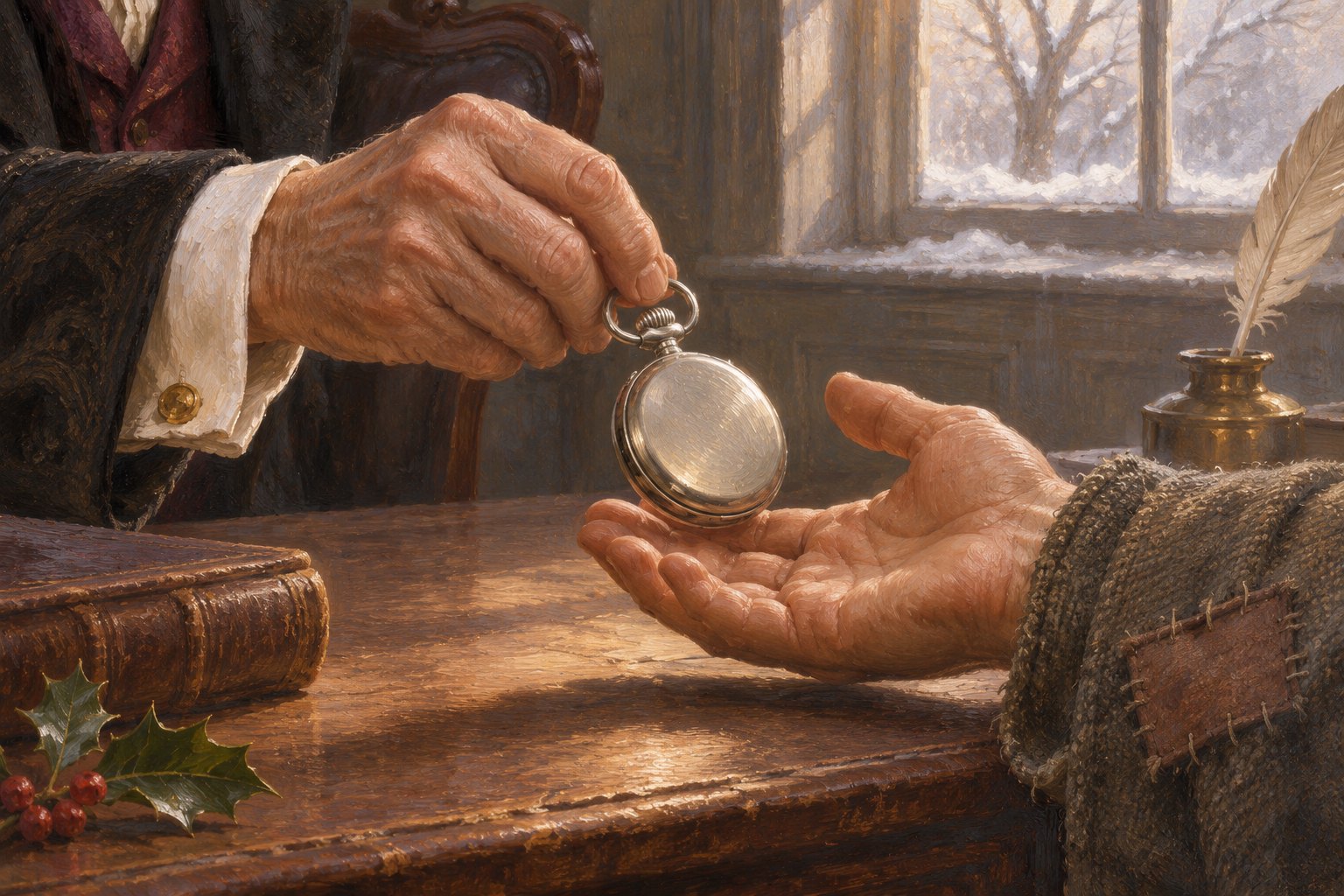
The pocket watch invites an especially productive interpretation. In a story organized around time, giving it away suggests a changed relationship to possession. An object that measures passing hours becomes something another person can use. Its value finally moves beyond its owner.
“Merry Christmas” likewise acquires meaning from the relationship in which it is spoken. The words are ordinary; Scrooge’s willingness to address Fred with warmth is the development. He accepts an encounter he previously refused.
Our review of confession and control in Oh, Canada considers how acknowledgment can remain centered on the speaker. Ebenezer offers a useful companion question: who benefits when a man announces that he has changed?
A Second Chance Is an Obligation
For me, the strongest interpretation of Ebenezer places its emotional center in the relationships Scrooge must repair. Fred makes belonging possible; Bob makes responsibility unavoidable. Together, they give redemption a social meaning that a frightening night alone cannot supply.
The ending offers a beginning rather than proof of lifelong virtue. Scrooge has discovered that he can act differently. What matters next is whether generosity survives the disappearance of the ghosts and the passing of Christmas. The story’s enduring challenge is that a second chance creates work: attention, restitution, and the repeated decision to let other people matter.
Original content by this site's editorial team. Published: November 18, 2026 at 03:08:00 PST (Los Angeles time)