Oh, Canada makes a final confession feel less like relief than a fresh demand on everyone listening. Paul Schrader’s 2024 adaptation of Russell Banks’s Foregone follows Leonard Fife, an acclaimed documentary filmmaker whose terminal illness gives him an urgent reason to challenge his own reputation. Richard Gere plays the older Leonard; Jacob Elordi embodies his younger self. Between them stands a question the film refuses to settle comfortably: does admitting selfishness mean that you have stopped being selfish?
My judgment is that the film works best as a difficult marital drama concealed inside an artist’s retrospective. Its fractured memories can hold viewers at a distance, but Leonard’s need to be heard—and his wife Emma’s need to survive the hearing—gives that fragmentation an emotional purpose.
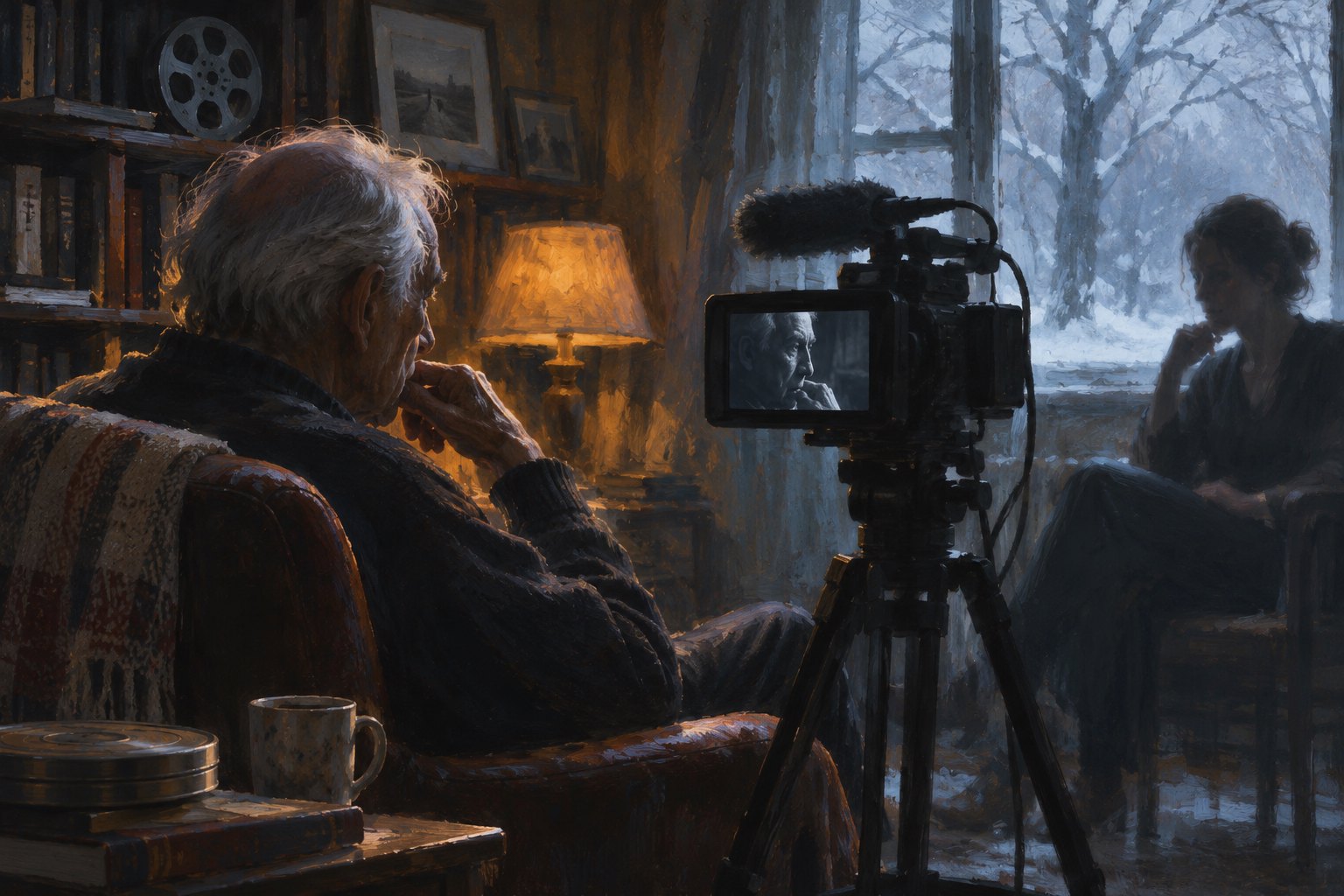
Spoiler warning: This review discusses Leonard’s family history, the interview’s ethical conflicts, and the film’s treatment of unreliable memory. The accompanying images are conceptual illustrations.
Leonard Wants a Confession; His Interviewers Want a Legacy
The situation initially promises an orderly tribute. Malcolm, played by Michael Imperioli, is Leonard’s former student. He comes to record a respected filmmaker reflecting on his accomplishments. Leonard instead redirects the interview toward the private history beneath his public identity. He insists that Emma, his wife and artistic partner, remain present.
That condition changes the meaning of every answer. Malcolm may be asking the questions, but Emma is the person Leonard needs to address. The interview becomes a marital encounter with witnesses, lighting, and recording equipment. What might ordinarily remain an intimate exchange now produces material that other people can preserve and interpret.
Leonard announces his intention with a compact reversal: “I made a career out of getting people to tell me the truth.” Then comes the challenge: “Now it’s my turn.” The symmetry sounds fair. Yet the film makes that fairness questionable. Leonard still decides when the disclosure begins, what it concerns, and who must hear it.
Gere’s performance is compelling because physical dependence does not erase Leonard’s authority. His failing strength and impatience coexist. He needs care while continuing to direct the room. The resulting discomfort is more interesting than a simple portrait of either a humbled artist or an unreformed tyrant.
Emma Has to Live With What Leonard Says
Uma Thurman’s Emma supplies the film’s essential resistance. She is more than an audience for Leonard’s remorse. As his partner, she has her own experience of their life together, and his declarations threaten to overwrite that experience with a final, supposedly definitive account.
Her objections also have an immediate practical basis. Leonard is exhausted, ill, and taking medication. She questions the accuracy of his recollections and the wisdom of continuing to record them. These concerns complicate the familiar dramatic assumption that stopping a confession must mean suppressing the truth.
“This is hard on me, Leo,” she says. The plainness matters. Leonard’s desire to unburden himself carries an emotional cost for someone else. Emma has to absorb the disclosures while also worrying about the condition of the person making them. Her care does not disappear because she is wounded, and her distress does not automatically make her interpretation unreliable.
I find Emma the strongest reason to resist treating the interview as a cleansing ritual. Leonard may gain something from speaking, but she has not agreed to the meaning he gives that experience. The film’s richest question is whether intimacy can be declared by one person while the other is asking for a pause.
The Younger Leonard and the Appeal of Leaving
The memories take us into Leonard’s earlier relationships and the circumstances surrounding his move to Canada. In Virginia, he has a wife, Alicia, and a family life that demands decisions. A trip toward Vermont opens the possibility of departure. His later reputation connects his migration with opposition to the Vietnam War, while his recollections bring private motives into uncomfortable proximity with that political story.
Elordi gives this younger Leonard the appearance of possibility. That is important to the character’s appeal: another place, another relationship, another version of himself can seem available just beyond his present commitments. From Leonard’s perspective, departure offers freedom. From the perspective of those left behind, the same action creates an absence they must organize their lives around.
The film does not need to discredit resistance to war to examine Leonard’s conduct. Political conviction and personal evasion can occupy the same life. Its more difficult proposition is that a publicly admirable decision cannot explain every private consequence attached to it.

Why the Flashbacks Refuse to Behave Like Evidence
Schrader complicates the division between the two Leonards. Gere sometimes occupies scenes belonging to the younger man’s past. Changes in color and framing further interrupt any expectation of a transparent chronological account. We are watching remembered experience take shape under pressure.
That choice gives the film an unsettling emotional logic. When people revisit an old mistake, they do so with the knowledge and shame of their present selves. Allowing the older Leonard into the younger man’s world makes that intrusion visible. The man remembering cannot stay outside the memory.
It also limits what a viewer can confidently conclude. A flashback usually carries an implied assurance that an event happened as shown. Here, recollection, confusion, and self-interpretation keep rubbing against one another. Leonard’s certainty about his guilt does not guarantee precision about every circumstance.
This is where the film may frustrate viewers who want its revelations to assemble into a clean explanation. I think the uncertainty is productive when it exposes competing perspectives; it is less immediately satisfying when another temporal shift delays an already tense exchange. The structure asks for patience without always supplying equal emotional force in return.
Readers interested in how cinema separates memory from identity may also find a useful companion in our analysis of Motoko Kusanagi’s uncertain sense of self. Leonard’s crisis is different, but he too discovers how fragile a person becomes when the account holding that identity together starts to fail.
Malcolm’s Camera Makes Listening an Ethical Choice
Malcolm has a responsibility that admiration alone cannot satisfy. Recording a mentor’s testimony may preserve something valuable. Continuing while that mentor deteriorates may also turn vulnerability into an opportunity. Leonard’s willingness to speak does not make every decision about filming him straightforward.
The camera therefore becomes an active presence in the drama. Leonard believes recording can give his disclosure weight. Emma sees reasons to stop. Malcolm must navigate material that resists the tribute he expected. Everyone has a different investment in what the interview becomes.
A related distinction between testimony and its interpretation appears in our discussion of memory and historical witness in A Strike and an Uprising. Here, the concern turns inward: who gets to shape a life once its subject has spoken?
The Deeper Meaning: Confession Cannot Repair a Relationship by Itself
Leonard’s estranged son Cornel prevents the film from becoming exclusively a story about an artist’s feelings toward himself. The account of their encounter at a screening brings the consequences of paternal rejection into focus. Regret belongs to Leonard, but the injury does not.
That distinction is the film’s deepest achievement. A person can recognize wrongdoing without restoring what was lost. Leonard can revise his self-description; he cannot give another person back the years that description concealed. His final interview may produce knowledge, but knowledge and repair remain different things.
The title also carries a revealing literary connection. Schrader explains in the film’s production notes that Banks had wanted to call his novel Oh, Canada and asked him to use that title for the adaptation. The interview apparatus offers another deliberate reference: its Interrotron setup acknowledges documentary filmmaker Errol Morris. Both details suit a film preoccupied with how stories acquire their final form.
For me, Oh, Canada is most moving when Emma’s presence interrupts Leonard’s attempt to finish explaining himself. She represents a life that exceeds his account of it. He wants to leave behind a true version of himself. The film asks whether any final version can be adequate when other people still carry the consequences.
Original content by this site's editorial team. Published: November 18, 2026 at 02:13:22 PST (Los Angeles time)