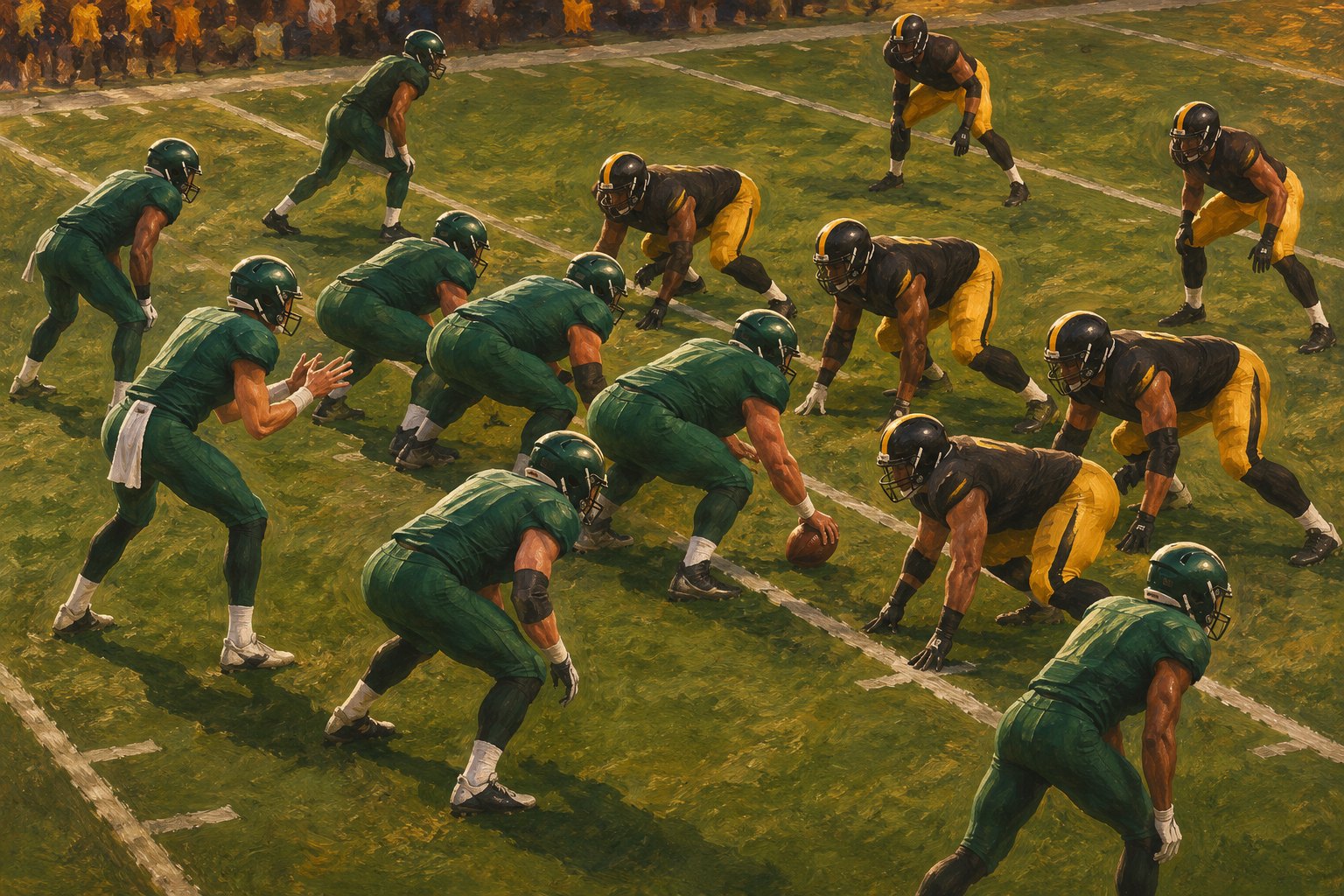
The central question in the Eagles–Steelers film-review discussion is whether Philadelphia’s offensive changes made the players’ jobs easier. Bleeding Green Nation’s headline offers a favorable judgment of the changes compared with the older offense. That is an intriguing assessment because it concerns the quality of the approach, rather than simply whether a play ended well.
My view is that an offensive adjustment deserves enthusiasm when it creates clearer decisions, workable blocking assignments, and opportunities that arrive on time. Novelty alone earns little credit. The useful distinction is between an offense asking its players to execute a coherent plan and one repeatedly asking them to rescue a difficult situation.
This is commentary on that distinction, not a possession-by-possession reconstruction. Here, film means football game footage. The people at its center are athletes making decisions under pressure, and understanding their responsibilities is more useful than imposing a scripted story on them.
What does it mean for the new offense to look better?
A favorable visual impression can contain several different judgments. An offense might appear less crowded. Its movements might fit together more smoothly. A quarterback might have an identifiable answer when a defender attacks. Those qualities deserve separate examination because they do not necessarily improve together.
Consider a hypothetical pass that falls incomplete despite a receiver reaching an open area at the intended moment. The result is a failure, but the design may still have accomplished its purpose. Conversely, a difficult catch through tight coverage can produce a successful result without demonstrating that the call consistently creates good opportunities.
That distinction gives the Eagles–Steelers discussion its substance. Accepting that a change looks promising does not require declaring every unsuccessful play acceptable. It requires locating the failure accurately. Was the opportunity missing, or did the offense fail to use it?
A useful offensive change should improve the conditions for execution. Execution then remains a separate responsibility. Treating those as separate questions allows criticism to be demanding without becoming indiscriminate.
The quarterback’s perspective: an answer must arrive in time
From the quarterback’s position, an offensive concept is a sequence of decisions with a deadline. The defense presents an initial picture, that picture changes after the snap, and the ball must leave before the available opportunity disappears. An attractive route on a diagram is only the beginning.
For Philadelphia, the relevant analytical question is whether the revised approach offers decisions that fit the time available. A receiver becoming open after the protection has broken down is different from a receiver becoming available while the quarterback can still deliver normally. Both might look open in a paused image; only one may represent a practical answer.
Watch the relationship between the quarterback’s setup and the receivers’ movements. Does the intended opening appear as the passer becomes ready? Is another option available if the first is covered? These are criteria for assessing the claim of improvement, not assertions about particular snaps.
Body language offers much weaker evidence. A player who appears composed might have made the wrong read; a hurried movement might be the correct response to immediate pressure. The decision and its context matter more than how reassuring the player looks.
The receiver’s perspective: useful space has a purpose
Receivers need more than room to run. They need routes that create a usable relationship with the quarterback and the coverage. Two players can occupy different areas yet still make the defense’s job relatively straightforward if their routes never force a difficult choice.
One way to evaluate an offensive revision is to follow the defender between two potential threats. Does that defender have to commit? If so, does the commitment create an opportunity elsewhere? This shifts attention from the eventual target to the work that made the target available.
It also changes how individual contributions are judged. A receiver who never touches the ball may still influence the coverage. That possibility should be demonstrated through movement and defensive response, however, rather than assumed merely because a teammate got open.
The visual principle has a counterpart in our discussion of how screen space can reveal relationships in The Heart in Winter: distance becomes meaningful through what it allows people to do. On a football field, useful spacing creates choices and consequences.
The blockers’ perspective: every opportunity has a cost
Offensive analysis often follows the ball and leaves the people creating time outside the story. Yet any argument that Philadelphia’s changes are better should include the demands placed on its blockers. A concept cannot be evaluated fairly without considering what must happen before the ball reaches its destination.
A longer-developing pass asks for protection that lasts long enough. A running play asks blockers and the ball carrier to reach the relevant spaces in a coordinated sequence. An adjustment that improves one relationship while making another unrealistic may simply move the problem.
This is why assigning blame from the final collision can be misleading. A blocker losing contact is observable. Whether that player faced a reasonable assignment, expected assistance, or a timing problem requires a wider view. The footage can reveal physical events more readily than it reveals every instruction.

Pittsburgh’s perspective belongs in the comparison
The Steelers are essential to evaluating Philadelphia’s offensive choices. A design works against a particular defensive response, not against empty space. If the defense changes its alignment or responsibilities, a previously attractive opportunity may become harder to produce.
That makes comparisons between old and new approaches more demanding than placing two clips beside each other. Distance to gain, field position, defensive personnel, and the pressure presented can all affect what the offense is being asked to solve.
Our examination of what game film must explain about Virginia Tech and Miami explores the related problem of separating a compelling game narrative from its underlying causes. Here, the challenge is more specific: distinguishing the benefit of a revised approach from the circumstances surrounding its use.
A convincing comparison would include unsuccessful examples of the newer ideas and successful examples of familiar ones. Otherwise, the selection itself can manufacture the conclusion. The strongest criticism survives the clips that complicate it.
The deeper issue is how Philadelphia defines progress
The favorable assessment of the Eagles’ changes raises a worthwhile editorial argument: improvement should be judged partly by the opportunities an offense creates for its players. That standard recognizes promising work without confusing promise with completion.
It also avoids making offensive identity an end in itself. Familiar calls should earn their place through what they enable. New calls should face the same scrutiny once the initial interest wears off. Neither age nor novelty tells us whether the players have a workable answer.
For me, the most persuasive version of a better Eagles offense is one in which individual responsibilities support one another: the protection gives a route time, the route gives the quarterback a decision, and that decision gives the ball carrier a useful opportunity. That is the deeper significance of the comparison with the old approach. Change matters when the team’s talent has a clearer way to become collective execution.
Original content by this site's editorial team. Published: November 23, 2026 at 14:58:09 PST (Los Angeles time)