
Drake Maye and New England’s defense are the central subjects of the Patriots’ After Further Review coverage following their Week 2 win over the Pittsburgh Steelers. For anyone trying to understand that victory, the useful distinction is between the result and the decisions that produced it. Winning answers who finished ahead. Evaluating the quarterback and defense requires a closer look at how individual plays developed.
Here, film means football footage. This is a commentary on how to approach that review, rather than an independently charted assessment of Maye’s performance. Specific throws, defensive assignments, and player grades require evidence from the relevant snaps. The questions below help organize that evidence without turning assumptions into observations.
Start With Maye’s Choices Before Judging the Ending
A quarterback attracts attention because so many plays pass through his hands. That visibility can also distort the story: viewers remember the throw and assign responsibility backward from where it landed. A completion feels like proof of sound judgment; an incompletion looks like a mistake. Neither conclusion necessarily follows.
When watching Maye against Pittsburgh, separate three questions. What options were available? When did an option become available? How well was the chosen action executed? Those questions distinguish a decision from its mechanics and its outcome. A sensible throw can be inaccurate. An accurate throw can still expose the offense to unnecessary risk.
Pause at the Release
A useful first exercise is to stop the replay when the ball leaves Maye’s hand. Consider the receiver’s position, the nearest defender, and the space toward which the pass is traveling. Then resume playback. This prevents the eventual catch or breakup from completely determining your judgment of the original choice.
Even that exercise has limits. A broadcast angle may hide a safety or an entire route. A receiver who looks open later might have been covered when the quarterback needed to decide. Helmet direction can suggest where a player is looking, but it does not reveal his complete thought process. Describe what the footage shows before explaining what you think it means.
Watch the Pocket as a Shared Space
Next, replay the same snap while watching the protection. Does the space in front of the quarterback remain usable? Does movement preserve a throwing lane or narrow it? Where does pressure first become visible? These are questions for the footage, not claims about what happened on a particular Maye dropback.
The distinction matters because pocket movement belongs to a chain of actions. Blocking, route timing, defensive movement, and the quarterback’s response interact. Assigning every disrupted play to one person can make a complicated sequence feel satisfyingly simple while explaining very little.
Give the Defense Its Own Viewing Pass
The inclusion of a defense review alongside Maye’s breakdown invites a broader reading of the Steelers win. Watch New England’s defensive snaps without treating the ball as the only center of interest. A defender can influence a play without making the tackle or appearing in the final close-up.
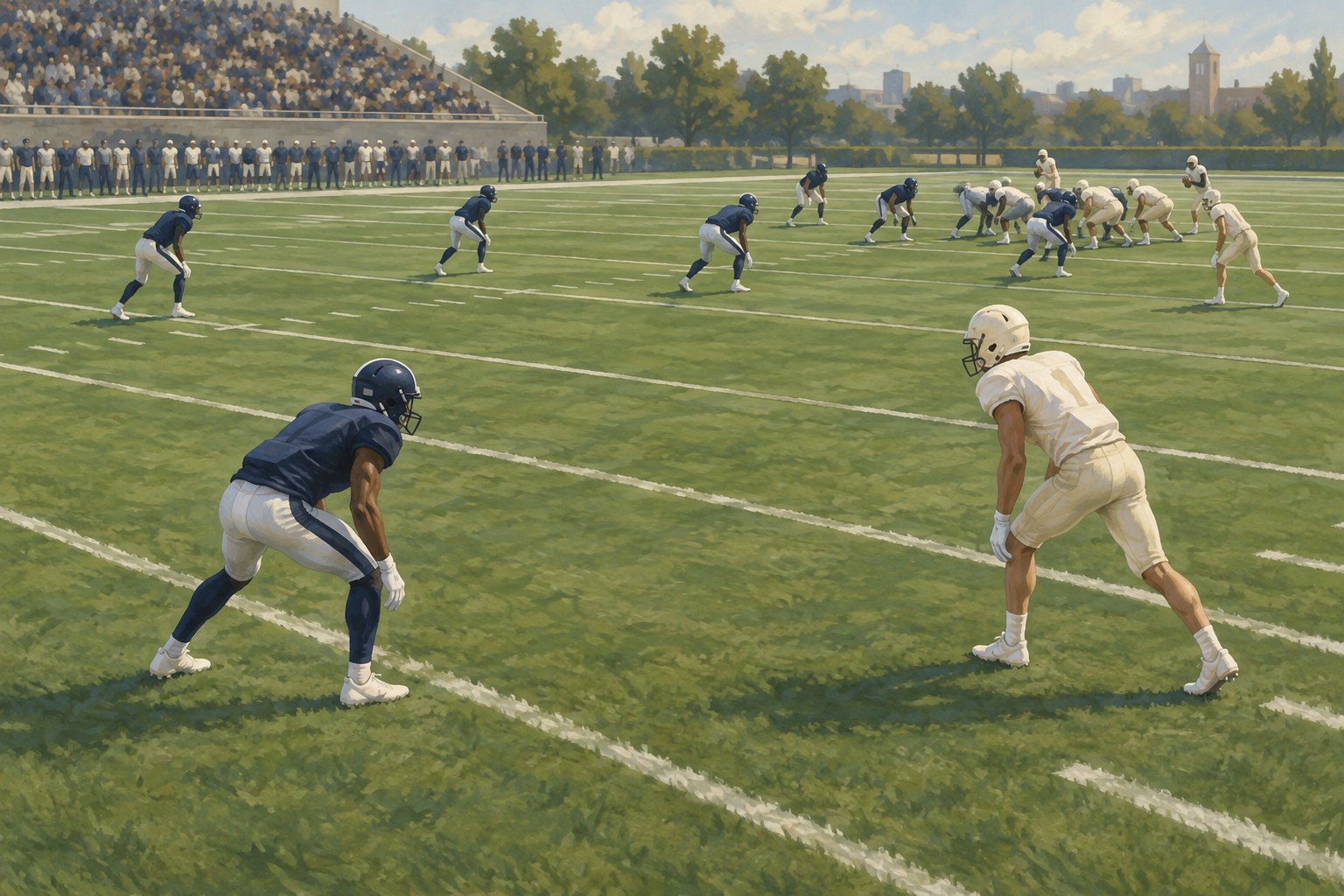
On passing plays, look for how space changes. A defender’s position may discourage a throw before the quarterback begins his motion. Pressure can shorten the time available for a route to develop. Coverage can make a passer hold the ball long enough for pressure to arrive. Establishing which relationship explains a particular snap requires seeing the sequence, preferably from more than one angle.
On running plays, attention often settles on the player who finishes the tackle. Rewatching can reveal the teammate who restricted the runner’s path or forced a change of direction. The final action deserves credit, but it may be the last link in a collective effort.
This attention to the ensemble has a counterpart in our discussion of individual identity within A Hard Day’s Night: a prominent figure becomes more intelligible when the surrounding relationships remain visible. In football, however, those relationships involve assignments that viewers may not know. Apparent coordination is observable; the exact call may remain uncertain.
What Makes a Quick-Hit Film Note Useful?
Short observations can sharpen a review when they preserve enough context to be checked. Their weakness is compression. A sentence about a late throw, an effective rush, or a coverage error may omit the circumstances that would support or complicate it.
When reading quick-hit notes from the Steelers game, look for four elements:
- An identifiable situation: Enough context to locate the play and understand what the offense needed.
- A visible action: A description of movement, positioning, timing, or contact.
- A supported interpretation: An explanation connecting that action to the outcome.
- A clear limit: Recognition when the camera angle or unknown assignment prevents certainty.
For your own notes, keep observation and interpretation separate. Write down the action first, then its possible significance. If a later angle changes your reading, revise it. Good film analysis becomes more valuable when it can survive correction.
A Win Should Inform the Review Without Settling It
New England’s victory supplies the outcome of this particular story. It cannot, by itself, establish how consistently Maye played or how much credit each defensive contributor deserves. A team result and an individual evaluation answer different questions.
Our character-focused review of Cars and its treatment of winning explores how an ending can change the meaning of a competition. Watching an actual football game requires an additional discipline: resist allowing the ending to rewrite every earlier decision. The players acted with incomplete information, before the result was known.
That is the deeper value of returning to Maye and the Patriots defense after the Steelers win. Replay can redistribute attention from the most visible participant to the relationships around him. It can also preserve two judgments at once: a successful team outcome and unresolved questions about the performance behind it. The strongest review earns its conclusions one sequence at a time.
Original content by this site's editorial team. Published: September 23, 2026 at 10:20:47 PDT (Los Angeles time)