
Drake Maye’s performance and New England’s pass coverage are the central questions after the Patriots’ Week 9 loss to the Packers. The team’s After Further Review coverage identifies both as subjects for examination, alongside shorter observations from the game. The useful next step is to separate those questions: what belonged to the quarterback, what depended on the offense around him, and what went wrong when New England had to defend the pass?
Here, film means game footage. This is football commentary, and its judgments require a different kind of restraint from a movie review. There is no scripted dialogue to interpret or character arc that guarantees a resolution. There are decisions made under pressure, coordinated assignments, and images that reveal some details while leaving others uncertain.
The discussion below provides an analytical framework for the issues identified in the Patriots’ review, rather than claiming a snap-by-snap diagnosis. Specific coverage calls, individual responsibilities, and repeated tendencies require evidence beyond the fact that they became subjects of postgame scrutiny.
Start With Maye’s Decision, Then Judge the Throw
A quarterback review becomes less useful when every completion counts as a good decision and every incompletion counts as a bad one. Those outcomes matter, but they do not explain the process. For Maye, the first question should be what information was available when he committed to a throw.
That means following a sequence: the defensive alignment before the snap, the movement immediately afterward, the available passing window, and the release. A receiver who looks open when the replay freezes may not have been open when the quarterback could reasonably deliver the ball. Conversely, a successful pass can still involve a risk that becomes costly when repeated.
Three distinctions help keep the evaluation precise:
- Recognition: Did the quarterback respond to what the defense actually did after the snap?
- Timing: Did the ball leave while the intended opportunity remained available?
- Placement: Did the throw give the receiver a workable chance while accounting for nearby defenders?
These are questions to apply to Maye’s Packers footage, not findings established merely by the loss. They also prevent a familiar shortcut: treating an athletic escape as proof that the entire play was handled well, or a failed throw as proof that the quarterback never understood the defense.
Pressure Requires a Timeline, Not an Automatic Culprit
When a passing play breaks down, attention naturally goes to the quarterback or the blocker nearest the disruption. Neither is a reliable starting verdict. The important issue is when the original plan became difficult to execute.
If pressure arrives before a route can develop, the analysis should examine protection and the availability of an immediate answer. If the quarterback has a viable opportunity and delays, his timing deserves scrutiny. If he moves away from one threat into another, the movement itself becomes part of the evaluation. These possibilities can produce similar-looking endings while suggesting very different corrections.
For Maye, the useful standard is therefore contextual accountability. Supporting circumstances can explain a difficult play without excusing every choice. Equally, responsibility for the offense does not make the quarterback personally responsible for every failure within it.
Our guide to reading a football film breakdown through the David Bailey–Chiefs matchup offers a related entry point. The transferable habit is to follow how an advantage develops instead of assigning credit or blame from the final image.
Coverage Issues Are About Relationships Across the Field
New England’s coverage problems deserve their own analysis. They should not become an indistinct supporting detail in a story about Maye. An offense’s performance and a defense’s performance contribute to the same result, but they operate through different assignments and require different remedies.
On a completed pass, the defender nearest the receiver is often the easiest person to criticize. Proximity, however, does not establish responsibility. That player may have lost an individual matchup, expected help, responded to another route, or tried to recover from a problem elsewhere.
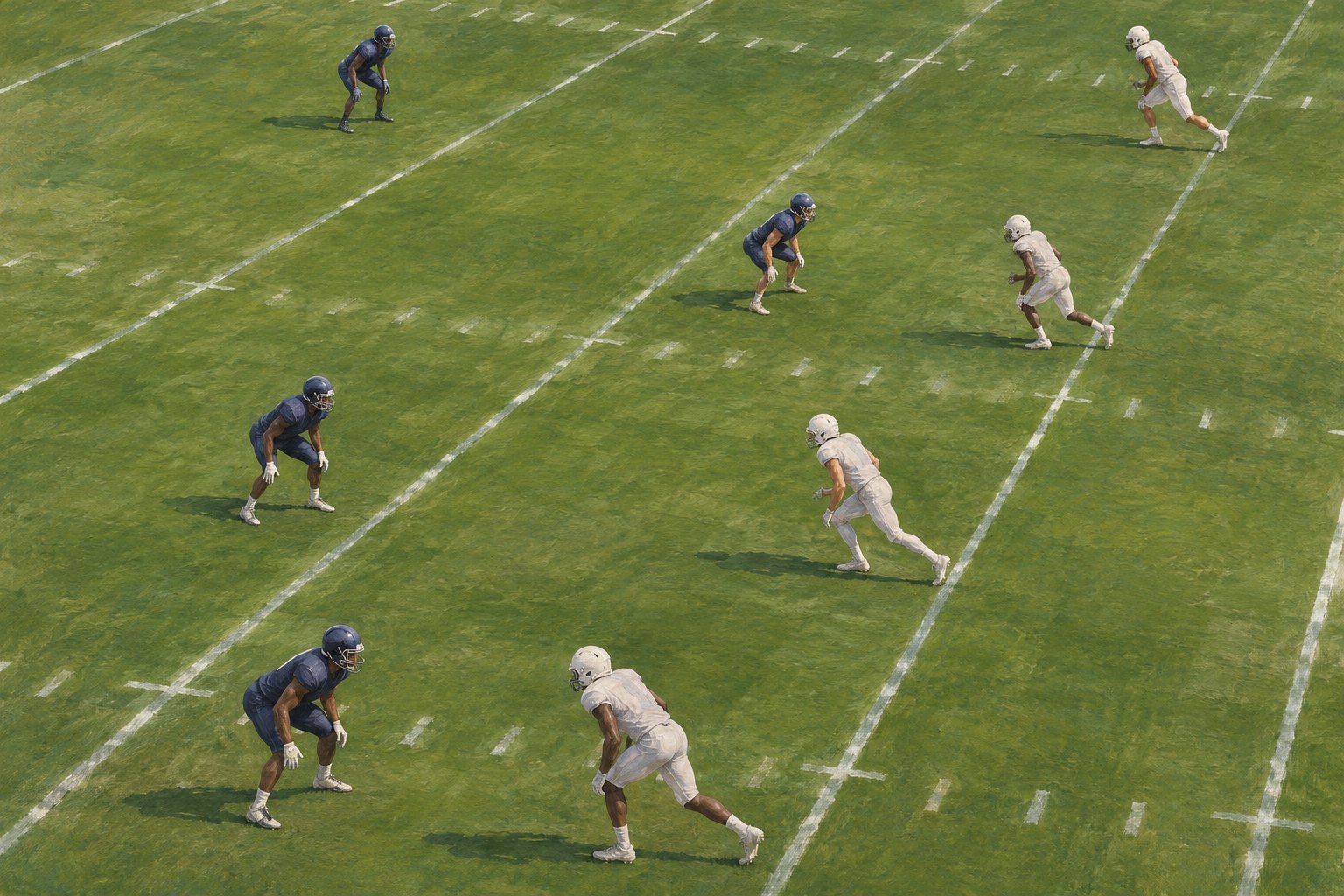
The illustration above is conceptual, not a reconstruction of a Patriots–Packers play. Its value is in emphasizing spacing: defenders have relationships to receivers, teammates, and areas of the field. Evaluating one player without those relationships can turn a complicated exchange into an unjustifiably simple accusation.
Separate Execution From Uncertain Assignments
Some details are directly observable. A defender can lose his footing, arrive late to the catch point, or fail to complete a tackle. Other claims require interpretation: whether a receiver should have been passed to a teammate, whether help was expected inside, or whether a player followed the intended coverage rule.
A careful review describes the visible action first. It then identifies the likely explanation and marks the limits of that inference. Saying that two defenders followed one receiver is an observation. Saying which defender misunderstood the call is a stronger claim.
For the Patriots, the practical question is whether separate completions reveal a shared vulnerability. If similar problems recur under similar conditions, a broader explanation becomes more persuasive. One confusing exchange alone cannot establish that the entire coverage system is defective.
Quick-Hit Notes Need Weight and Context
Short film notes can draw attention to work that a broadcast barely registers: a supporting block, a defender maintaining position, or a route that influences coverage without receiving a target. Their brevity makes them useful, but it also makes them easy to overread.
A note about one snap is evidence about that snap. A claim about a recurring weakness needs multiple examples and relevant context. Readers should ask whether a quick observation describes an isolated event, a repeated pattern within the Packers game, or something believed to extend beyond it.
Those categories should not be treated as interchangeable. A player can make an excellent individual play during an uneven performance. A successful team sequence can also contain a mistake that the opponent fails to exploit. Film review becomes valuable when it preserves those complications.
The Camera Reveals Evidence—and Sets Limits
Football footage shares one important concern with cinema: the frame directs attention. A close view can make a quarterback’s reaction legible while hiding the routes that shaped his decision. A wider angle can reveal spacing while making hand placement or a subtle physical contest harder to see.
That concern connects with our examination of how cinematography guides attention in Schindler’s List. The subjects are entirely different, but the viewing discipline carries across: consider what the image includes before deciding how much it explains.
For Maye and the Patriots, the strongest interpretation of the Packers loss will connect decisions to circumstances and mistakes to plausible corrections. It will distinguish a quarterback’s recognition from his execution, a defender’s visible position from his assumed assignment, and a memorable moment from a demonstrated tendency.
My editorial judgment is that a useful review should leave readers with more precise questions, not merely a stronger emotional verdict. The loss establishes the outcome. Understanding how New England can improve requires the harder work of identifying which choices, techniques, and coordinated responsibilities produced it.
Original content by this site's editorial team. Published: November 9, 2026 at 15:47:00 PST (Los Angeles time)