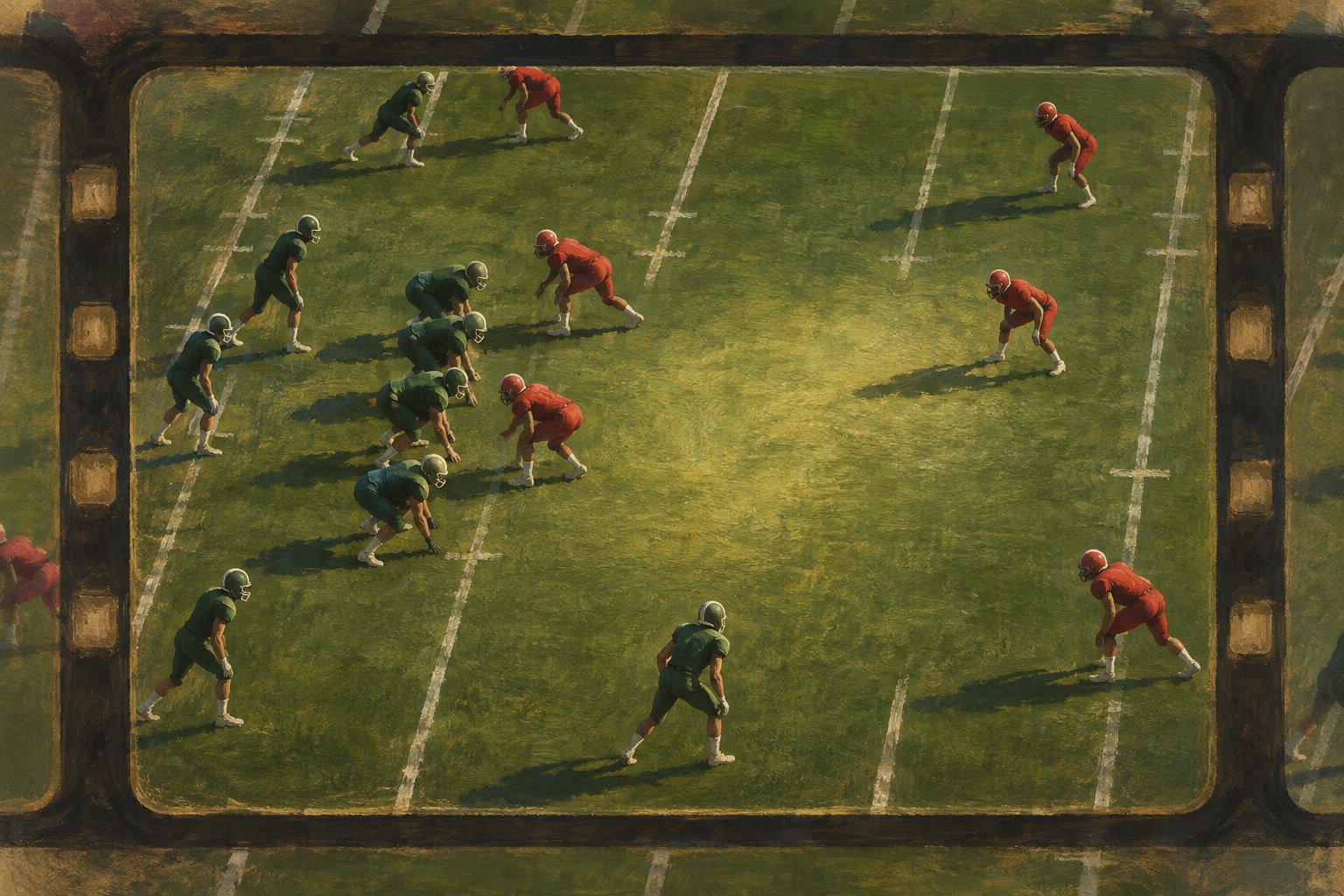
David Bailey’s matchup with the Chiefs is the subject of the New York Jets’ David Bailey Film Breakdown vs. the Chiefs. Here, “film” means football footage examined for what it reveals about play on the field. Readers looking for a movie review should understand that distinction immediately: this is a sports-analysis subject, with a real athlete at its center rather than a fictional character.
The title identifies Bailey, the opponent, and the breakdown format. It does not, by itself, establish which plays appear, what the commentary says, or how convincingly the video explains his performance. This article is therefore a viewing guide, not a scene-by-scene review of the segment. Its central question is specific: what should viewers look for before accepting an interpretation of Bailey’s work against Kansas City?
Start With Bailey, Then Widen the Frame
A player-focused breakdown invites us to follow one person through a crowded image. That is a useful starting point, but it can also narrow our understanding. In football footage, the most visible action is not necessarily the only action that determines the result. To assess Bailey, watch both his movement and the space around him.
Begin before the snap. Locate him, identify the nearby opponents, and notice the distances separating them. Then follow the first exchange of movement. Who changes direction? Who makes contact? Where does space open or disappear? These observations provide firmer ground than an immediate judgment that a player looked dominant, hesitant, or overwhelmed.
A film critic might approach a crowded dramatic scene similarly: first identify the central figure, then examine how the surrounding people constrain that figure’s choices. The comparison is useful as a viewing technique. It does not turn an athlete into a scripted protagonist or establish what he was thinking.
Separate Visible Action From Inferred Intention
The strongest question to bring to Bailey’s footage is not simply whether a play ended well. It is whether the explanation accounts for what the camera actually shows. Movement is observable; intention usually requires additional evidence.
For example, a player taking a particular route across the field may be following an assignment, responding to an opponent, or adjusting after an initial approach fails. Those are different explanations for a similar visible movement. Without the relevant context, confident language about what Bailey “knew” or “wanted” would go beyond the image.
This matters especially when commentary gives a sequence an emotionally satisfying shape. Anticipation, struggle, and payoff make a compelling account, but they can also make an uncertain interpretation feel settled. A useful breakdown should help viewers recognize the evidence supporting its explanation, including where that evidence stops.
Our discussion of what interviews can reveal about character motivation raises a related issue: explanatory material can enrich an interpretation, but it still needs to be tested against the action on screen.
Use Replay to Check Timing, Not Just Technique
Slow motion changes how an action feels. It makes a brief adjustment available for inspection and gives viewers time to notice contact, balance, or direction. It can also make a rapid reaction appear more deliberate than it seemed at full speed.
When examining Bailey against the Chiefs, alternate between detail and duration wherever the footage permits. First watch a sequence continuously. Then study the moment highlighted by the analysis. Finally, return to normal speed and ask whether the explanation still describes the timing accurately.
A paused frame can establish where people were at one instant. It cannot, on its own, establish how long an opening remained available or how quickly someone could respond. That distinction is essential when assessing a decision made during moving play.
Ask What Each Camera Angle Leaves Out
A close view can make an individual exchange legible while hiding activity elsewhere. A wider view can reveal relationships between players while making a small technical detail harder to distinguish. Neither perspective automatically supplies the whole explanation.
For Bailey’s breakdown, the practical question is whether the available angle supports the particular claim being made. If an explanation concerns his immediate interaction with an opponent, a closer view may help. If it concerns the effect of his movement on the wider play, the surrounding action becomes necessary evidence.
Notice the beginning and end of each excerpt, too. A sequence that starts after movement is underway may conceal the initial conditions. One that ends immediately after a striking moment may leave its consequences unclear. These are questions to ask of the presentation, not claims about how this particular segment has been edited.
Recognize the Jets’ Editorial Perspective
The New York Jets are the publisher named for the Bailey breakdown. That gives the piece an identifiable institutional perspective. A team’s presentation can offer a useful route into its players and their work; readers should still distinguish explanation from evaluation.
The important issue is selection. Does a sequence illustrate one successful action, support a recurring pattern, or invite a broader conclusion about the matchup? Those are different levels of argument. One clearly explained example may establish a narrow point without establishing a complete account of Bailey’s performance.
That is a familiar distinction in screen criticism. A memorable scene can show what a performer does well without representing every dimension of the performance. The same habit of proportional judgment helps here: give an example the weight it earns, and resist making it carry an entire game.
A Practical Checklist for Watching the Breakdown
Keep the viewing process simple enough to use without interrupting every second of footage:
- Locate Bailey before the action begins. Note what is visible around him before following his movement.
- Describe the action in plain language. Record changes in direction, contact, and spacing before assigning praise or blame.
- Identify the commentator’s specific claim. Ask which visible detail supports it.
- Rewatch at normal speed. Check whether the explanation accounts for the time available.
- Limit the conclusion. Separate what this example demonstrates from what would require more plays or additional context.
This approach also leaves room for enjoyment. Close attention can make an athletic sequence more absorbing by revealing relationships that a first viewing misses. Our essay on how viewing habits shape unexpected discoveries explores the broader pleasure of allowing attention, rather than first impressions, to guide a response.
The Deeper Question: What Makes an Explanation Earn Trust?
The most interesting critical issue surrounding David Bailey Film Breakdown vs. the Chiefs is the relationship between a person and the story told through selected images of that person. Naming Bailey directs attention toward him. The footage and commentary must then establish why particular moments matter.
My standard for a worthwhile breakdown is straightforward: it should leave the viewer better equipped to see. Praise becomes useful when its reasons are visible. Criticism becomes useful when it identifies an action and acknowledges its context. Uncertainty becomes useful when it prevents a plausible interpretation from hardening into an unsupported fact.
Approach Bailey’s matchup with that standard, and the viewing task becomes more rewarding than collecting a verdict. Watch the action, test the explanation, and keep the conclusion proportional to the evidence. That is where close analysis earns its value.
Original content by this site's editorial team. Published: November 9, 2026 at 08:32:02 PST (Los Angeles time)